

isoprenoids derive from the C5 units isopentenyl diphosphate
(IPP) and its double-bond isomer dimethylallyl diphosphate
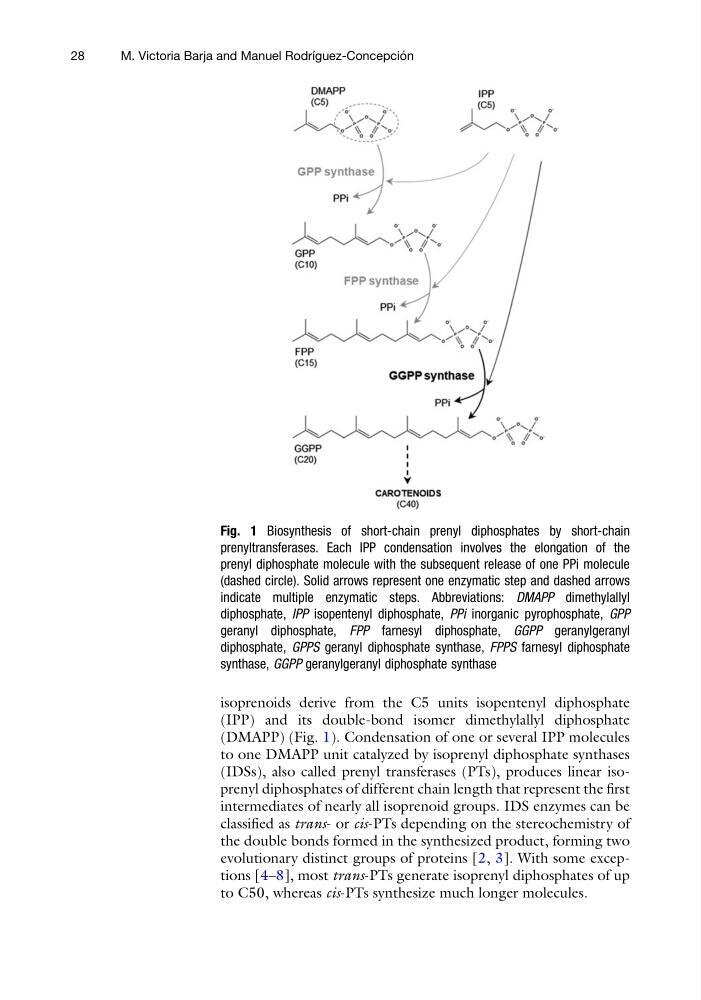
(DMAPP) (Fig. 1). Condensation of one or several IPP molecules
to one DMAPP unit catalyzed by isoprenyl diphosphate synthases
(IDSs), also called prenyl transferases (PTs), produces linear isoprenyl diphosphates of different chain length that represent the first
intermediates of nearly all isoprenoid groups. IDS enzymes can be
classified as trans- or cis-PTs depending on the stereochemistry of
the double bonds formed in the synthesized product, forming two
evolutionary distinct groups of proteins [2, 3]. With some exceptions [4–8], most trans-PTs generate isoprenyl diphosphates of up
to C50, whereas cis-PTs synthesize much longer molecules.
Fig. 1 Biosynthesis of short-chain prenyl diphosphates by short-chain
prenyltransferases. Each IPP condensation involves the elongation of the
prenyl diphosphate molecule with the subsequent release of one PPi molecule
(dashed circle). Solid arrows represent one enzymatic step and dashed arrows
indicate multiple enzymatic steps. Abbreviations: DMAPP dimethylallyl
diphosphate, IPP isopentenyl diphosphate, PPi inorganic pyrophosphate, GPP
geranyl diphosphate, FPP farnesyl diphosphate, GGPP geranylgeranyl
diphosphate, GPPS geranyl diphosphate synthase, FPPS farnesyl diphosphate
synthase, GGPP geranylgeranyl diphosphate synthase
28
M. Victoria Barja and Manuel Rodrı ´guez-Concepcio ´ n
(IPP) and its double-bond isomer dimethylallyl diphosphate
(DMAPP) (Fig. 1). Condensation of one or several IPP molecules
to one DMAPP unit catalyzed by isoprenyl diphosphate synthases
(IDSs), also called prenyl transferases (PTs), produces linear isoprenyl diphosphates of different chain length that represent the first
intermediates of nearly all isoprenoid groups. IDS enzymes can be
classified as trans- or cis-PTs depending on the stereochemistry of
the double bonds formed in the synthesized product, forming two
evolutionary distinct groups of proteins [2, 3]. With some exceptions [4–8], most trans-PTs generate isoprenyl diphosphates of up
to C50, whereas cis-PTs synthesize much longer molecules.
Fig. 1 Biosynthesis of short-chain prenyl diphosphates by short-chain
prenyltransferases. Each IPP condensation involves the elongation of the
prenyl diphosphate molecule with the subsequent release of one PPi molecule
(dashed circle). Solid arrows represent one enzymatic step and dashed arrows
indicate multiple enzymatic steps. Abbreviations: DMAPP dimethylallyl
diphosphate, IPP isopentenyl diphosphate, PPi inorganic pyrophosphate, GPP
geranyl diphosphate, FPP farnesyl diphosphate, GGPP geranylgeranyl
diphosphate, GPPS geranyl diphosphate synthase, FPPS farnesyl diphosphate
synthase, GGPP geranylgeranyl diphosphate synthase
28
M. Victoria Barja and Manuel Rodrı ´guez-Concepcio ´ n