

following description is the practice routinely used in our
laboratory [17].
1. A binary solvent system consisting of methyl-tert-butyl ether–
methanol–water 85:15:4 (solvent A) and methyl-tert-butyl
methyl–methanol–water 7:90:3 (solvent B) is used at a flow
rate of 1 mL min
À1 .
2. Carotenoid separation is performed on a C30 analytical column (3 μm particle size, 25 Â 0.46 cm i.d.). Injection volume
is 20 μL per sample.
3. LC separation is performed using the following gradient
setting: hold at 100% A for 10 min, then gradient from
100 to 50% A in 30 min, 50 to 100% B in 10 min, 100% A in
5 min, and finally isocratic 100% A for 5 min for reequilibrating
column.
4. A split postcolumn of 0.4 mL min
À1 is directly introduced on
the APCI source, which is operated in positive mode. The m/z
scan in the UHR-TOF is in the 50–1200 D range. MS data are
acquired in broad band Collision Induced Dissociation mode
to obtain MS and MS/MS spectra simultaneously.
5. Data evaluation is carried out to identify the carotenoids by
using an in-house mass database created ex professo that contains
the monoisotopic masses, elemental composition and, optionally, the retention time and characteristic product ions for
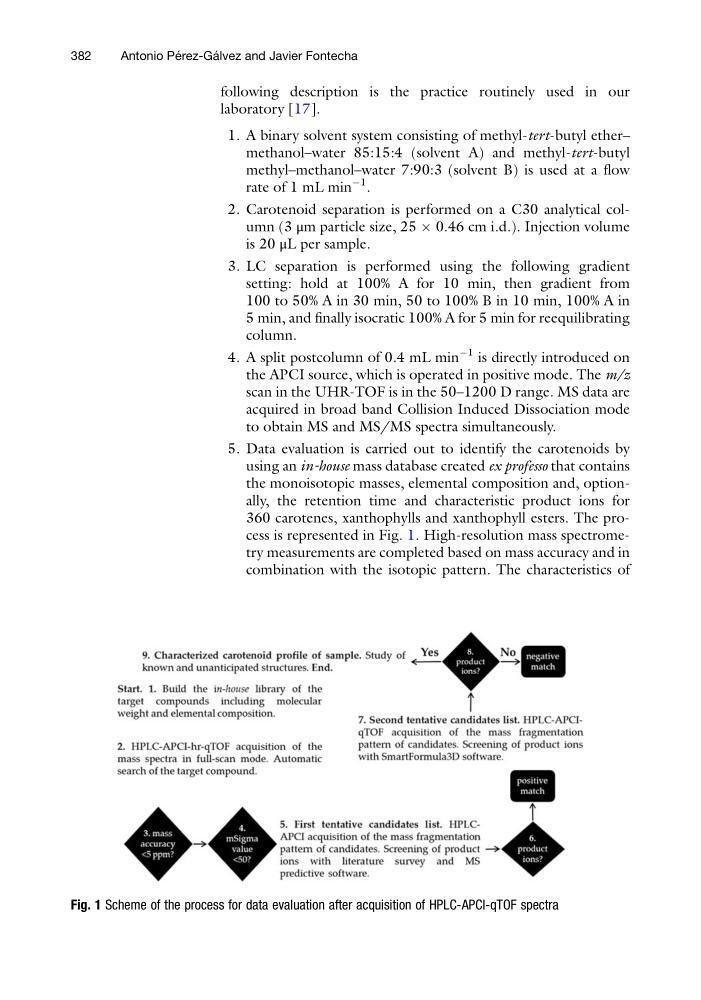
360 carotenes, xanthophylls and xanthophyll esters. The process is represented in Fig. 1. High-resolution mass spectrometry measurements are completed based on mass accuracy and in
combination with the isotopic pattern. The characteristics of
Fig. 1 Scheme of the process for data evaluation after acquisition of HPLC-APCI-qTOF spectra
382
Antonio Pe ´ rez-Ga ´ lvez and Javier Fontecha
laboratory [17].
1. A binary solvent system consisting of methyl-tert-butyl ether–
methanol–water 85:15:4 (solvent A) and methyl-tert-butyl
methyl–methanol–water 7:90:3 (solvent B) is used at a flow
rate of 1 mL min
À1 .
2. Carotenoid separation is performed on a C30 analytical column (3 μm particle size, 25 Â 0.46 cm i.d.). Injection volume
is 20 μL per sample.
3. LC separation is performed using the following gradient
setting: hold at 100% A for 10 min, then gradient from
100 to 50% A in 30 min, 50 to 100% B in 10 min, 100% A in
5 min, and finally isocratic 100% A for 5 min for reequilibrating
column.
4. A split postcolumn of 0.4 mL min
À1 is directly introduced on
the APCI source, which is operated in positive mode. The m/z
scan in the UHR-TOF is in the 50–1200 D range. MS data are
acquired in broad band Collision Induced Dissociation mode
to obtain MS and MS/MS spectra simultaneously.
5. Data evaluation is carried out to identify the carotenoids by
using an in-house mass database created ex professo that contains
the monoisotopic masses, elemental composition and, optionally, the retention time and characteristic product ions for
360 carotenes, xanthophylls and xanthophyll esters. The process is represented in Fig. 1. High-resolution mass spectrometry measurements are completed based on mass accuracy and in
combination with the isotopic pattern. The characteristics of
Fig. 1 Scheme of the process for data evaluation after acquisition of HPLC-APCI-qTOF spectra
382
Antonio Pe ´ rez-Ga ´ lvez and Javier Fontecha