

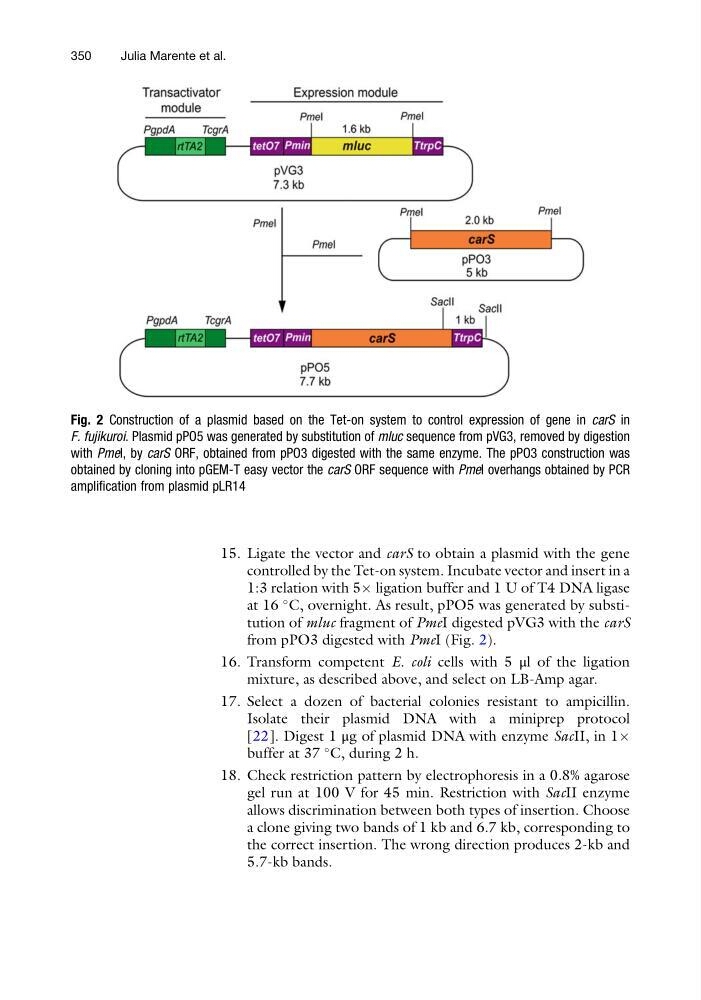
15. Ligate the vector and carS to obtain a plasmid with the gene
controlled by the Tet-on system. Incubate vector and insert in a
1:3 relation with 5Â ligation buffer and 1 U of T4 DNA ligase
at 16
C, overnight. As result, pPO5 was generated by substitution of mluc fragment of PmeI digested pVG3 with the carS
from pPO3 digested with PmeI (Fig. 2).
16. Transform competent E. coli cells with 5 μl of the ligation
mixture, as described above, and select on LB-Amp agar.
17. Select a dozen of bacterial colonies resistant to ampicillin.
Isolate their plasmid DNA with a miniprep protocol
[22]. Digest 1 μg of plasmid DNA with enzyme SacII, in 1Â
buffer at 37
C, during 2 h.
18. Check restriction pattern by electrophoresis in a 0.8% agarose
gel run at 100 V for 45 min. Restriction with SacII enzyme
allows discrimination between both types of insertion. Choose
a clone giving two bands of 1 kb and 6.7 kb, corresponding to
the correct insertion. The wrong direction produces 2-kb and
5.7-kb bands.
Fig. 2 Construction of a plasmid based on the Tet-on system to control expression of gene in carS in
F. fujikuroi. Plasmid pPO5 was generated by substitution of mluc sequence from pVG3, removed by digestion
with PmeI, by carS ORF, obtained from pPO3 digested with the same enzyme. The pPO3 construction was
obtained by cloning into pGEM-T easy vector the carS ORF sequence with PmeI overhangs obtained by PCR
amplification from plasmid pLR14
350
Julia Marente et al.
controlled by the Tet-on system. Incubate vector and insert in a
1:3 relation with 5Â ligation buffer and 1 U of T4 DNA ligase
at 16
C, overnight. As result, pPO5 was generated by substitution of mluc fragment of PmeI digested pVG3 with the carS
from pPO3 digested with PmeI (Fig. 2).
16. Transform competent E. coli cells with 5 μl of the ligation
mixture, as described above, and select on LB-Amp agar.
17. Select a dozen of bacterial colonies resistant to ampicillin.
Isolate their plasmid DNA with a miniprep protocol
[22]. Digest 1 μg of plasmid DNA with enzyme SacII, in 1Â
buffer at 37
C, during 2 h.
18. Check restriction pattern by electrophoresis in a 0.8% agarose
gel run at 100 V for 45 min. Restriction with SacII enzyme
allows discrimination between both types of insertion. Choose
a clone giving two bands of 1 kb and 6.7 kb, corresponding to
the correct insertion. The wrong direction produces 2-kb and
5.7-kb bands.
Fig. 2 Construction of a plasmid based on the Tet-on system to control expression of gene in carS in
F. fujikuroi. Plasmid pPO5 was generated by substitution of mluc sequence from pVG3, removed by digestion
with PmeI, by carS ORF, obtained from pPO3 digested with the same enzyme. The pPO3 construction was
obtained by cloning into pGEM-T easy vector the carS ORF sequence with PmeI overhangs obtained by PCR
amplification from plasmid pLR14
350
Julia Marente et al.