

9. LB medium.
10. Gel extraction kit.
11. Plasmid miniprep kit.
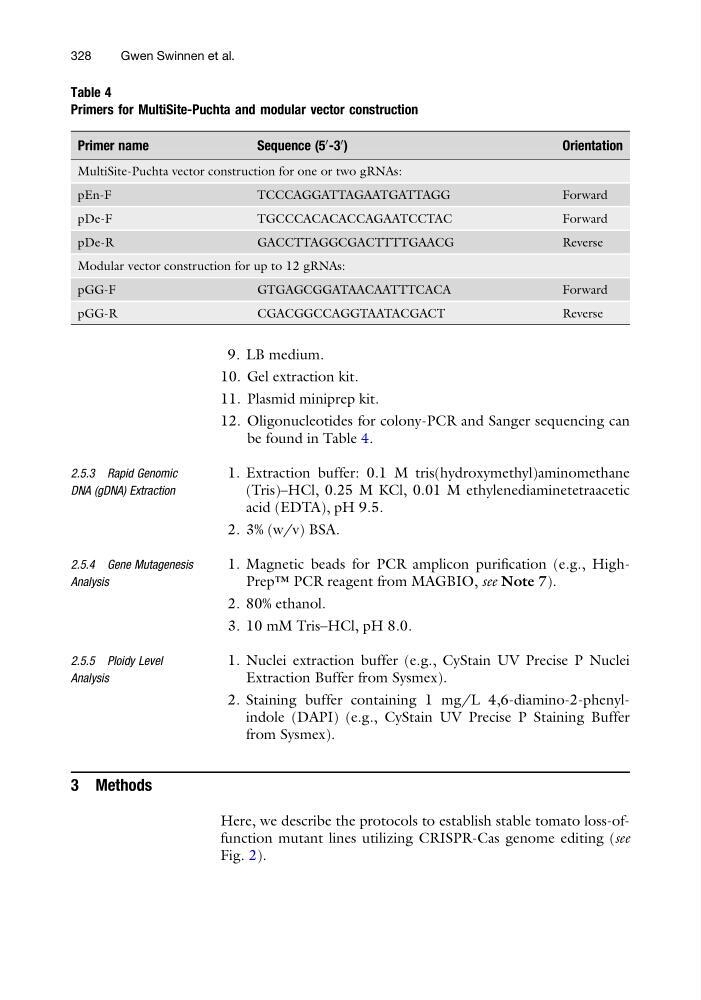
12. Oligonucleotides for colony-PCR and Sanger sequencing can
be found in Table 4.
2.5.3 Rapid Genomic
DNA (gDNA) Extraction
1. Extraction buffer: 0.1 M tris(hydroxymethyl)aminomethane
(Tris)–HCl, 0.25 M KCl, 0.01 M ethylenediaminetetraacetic
acid (EDTA), pH 9.5.
2. 3% (w/v) BSA.
2.5.4 Gene Mutagenesis
Analysis
1. Magnetic beads for PCR amplicon purification (e.g., HighPrep™ PCR reagent from MAGBIO, see Note 7).
2. 80% ethanol.
3. 10 mM Tris–HCl, pH 8.0.
2.5.5 Ploidy Level
Analysis
1. Nuclei extraction buffer (e.g., CyStain UV Precise P Nuclei
Extraction Buffer from Sysmex).
2. Staining buffer containing 1 mg/L 4,6-diamino-2-phenylindole (DAPI) (e.g., CyStain UV Precise P Staining Buffer
from Sysmex).
3 Methods
Here, we describe the protocols to establish stable tomato loss-offunction mutant lines utilizing CRISPR-Cas genome editing (see
Fig. 2).
Table 4
Primers for MultiSite-Puchta and modular vector construction
Primer name
Sequence (5
0 -3
0 )
Orientation
MultiSite-Puchta vector construction for one or two gRNAs:
pEn-F
TCCCAGGATTAGAATGATTAGG
Forward
pDe-F
TGCCCACACACCAGAATCCTAC
Forward
pDe-R
GACCTTAGGCGACTTTTGAACG
Reverse
Modular vector construction for up to 12 gRNAs:
pGG-F
GTGAGCGGATAACAATTTCACA
Forward
pGG-R
CGACGGCCAGGTAATACGACT
Reverse
328
Gwen Swinnen et al.
10. Gel extraction kit.
11. Plasmid miniprep kit.
12. Oligonucleotides for colony-PCR and Sanger sequencing can
be found in Table 4.
2.5.3 Rapid Genomic
DNA (gDNA) Extraction
1. Extraction buffer: 0.1 M tris(hydroxymethyl)aminomethane
(Tris)–HCl, 0.25 M KCl, 0.01 M ethylenediaminetetraacetic
acid (EDTA), pH 9.5.
2. 3% (w/v) BSA.
2.5.4 Gene Mutagenesis
Analysis
1. Magnetic beads for PCR amplicon purification (e.g., HighPrep™ PCR reagent from MAGBIO, see Note 7).
2. 80% ethanol.
3. 10 mM Tris–HCl, pH 8.0.
2.5.5 Ploidy Level
Analysis
1. Nuclei extraction buffer (e.g., CyStain UV Precise P Nuclei
Extraction Buffer from Sysmex).
2. Staining buffer containing 1 mg/L 4,6-diamino-2-phenylindole (DAPI) (e.g., CyStain UV Precise P Staining Buffer
from Sysmex).
3 Methods
Here, we describe the protocols to establish stable tomato loss-offunction mutant lines utilizing CRISPR-Cas genome editing (see
Fig. 2).
Table 4
Primers for MultiSite-Puchta and modular vector construction
Primer name
Sequence (5
0 -3
0 )
Orientation
MultiSite-Puchta vector construction for one or two gRNAs:
pEn-F
TCCCAGGATTAGAATGATTAGG
Forward
pDe-F
TGCCCACACACCAGAATCCTAC
Forward
pDe-R
GACCTTAGGCGACTTTTGAACG
Reverse
Modular vector construction for up to 12 gRNAs:
pGG-F
GTGAGCGGATAACAATTTCACA
Forward
pGG-R
CGACGGCCAGGTAATACGACT
Reverse
328
Gwen Swinnen et al.