

3.3 Explant
Transformation
1. Deposit the Agrobacterium tumefaciens suspension media in a
sterilized glass Petri dish.
2. Deposit the carrot explants inside the cell suspension and proceed to cut the explants into 1 cm pieces (see Note 6) with the
help of a sterile scalpel. Procure to generate little cuts in the
tissue to facilitate the Agrobacterium cells to penetrate the
tissue.
3. Incubate the explants inside the cell suspension for 15 min (see
Note 7).
4. Deposit the sterile absorbent paper squares in a sterilized glass
petri dish, with the help of tweezers.
5. When the incubation time of the explants is over, deposit them
on the paper for removing the excess cell suspension (see Note
8).
6. After removing the excess cell suspension, deposit the explants
in a coculture plate.
7. Incubate the explants for 3 days at 24
C in darkness.
3.4 Somatic
Embryogenesis
Induction
1. After the third day, change the explants from the coculture
plates to the MI plates. Incubate the explants for 14 days in
darkness. During this process, the tissue will swallow and little
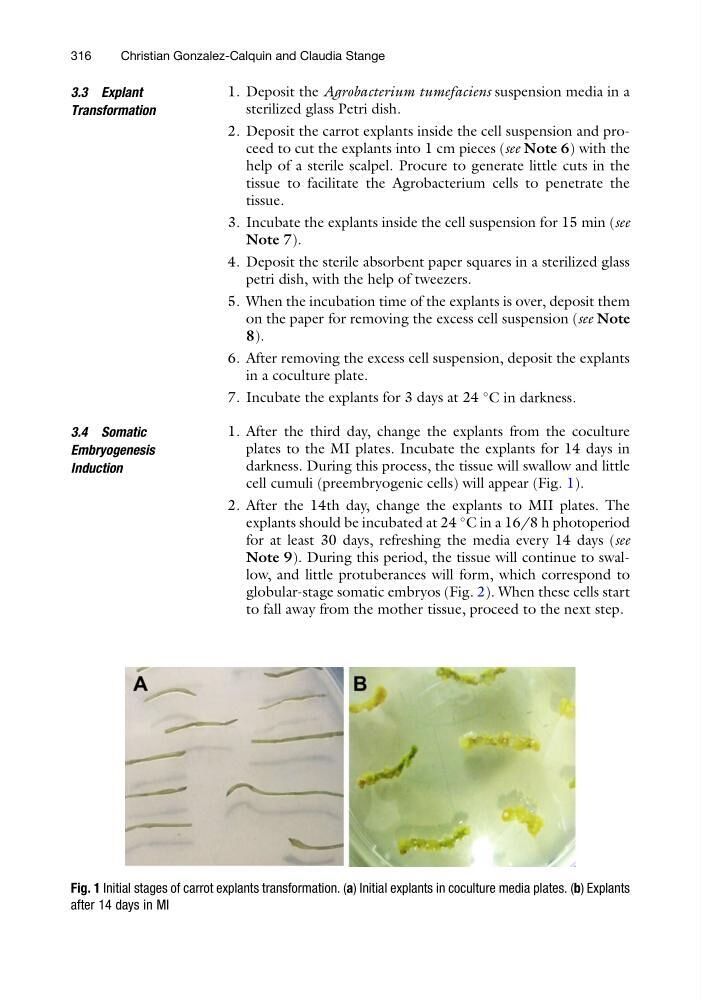
cell cumuli (preembryogenic cells) will appear (Fig. 1).
2. After the 14th day, change the explants to MII plates. The
explants should be incubated at 24
C in a 16/8 h photoperiod
for at least 30 days, refreshing the media every 14 days (see
Note 9). During this period, the tissue will continue to swallow, and little protuberances will form, which correspond to
globular-stage somatic embryos (Fig. 2). When these cells start
to fall away from the mother tissue, proceed to the next step.
Fig. 1 Initial stages of carrot explants transformation. (a) Initial explants in coculture media plates. (b) Explants
after 14 days in MI
316
Christian Gonzalez-Calquin and Claudia Stange
Transformation
1. Deposit the Agrobacterium tumefaciens suspension media in a
sterilized glass Petri dish.
2. Deposit the carrot explants inside the cell suspension and proceed to cut the explants into 1 cm pieces (see Note 6) with the
help of a sterile scalpel. Procure to generate little cuts in the
tissue to facilitate the Agrobacterium cells to penetrate the
tissue.
3. Incubate the explants inside the cell suspension for 15 min (see
Note 7).
4. Deposit the sterile absorbent paper squares in a sterilized glass
petri dish, with the help of tweezers.
5. When the incubation time of the explants is over, deposit them
on the paper for removing the excess cell suspension (see Note
8).
6. After removing the excess cell suspension, deposit the explants
in a coculture plate.
7. Incubate the explants for 3 days at 24
C in darkness.
3.4 Somatic
Embryogenesis
Induction
1. After the third day, change the explants from the coculture
plates to the MI plates. Incubate the explants for 14 days in
darkness. During this process, the tissue will swallow and little
cell cumuli (preembryogenic cells) will appear (Fig. 1).
2. After the 14th day, change the explants to MII plates. The
explants should be incubated at 24
C in a 16/8 h photoperiod
for at least 30 days, refreshing the media every 14 days (see
Note 9). During this period, the tissue will continue to swallow, and little protuberances will form, which correspond to
globular-stage somatic embryos (Fig. 2). When these cells start
to fall away from the mother tissue, proceed to the next step.
Fig. 1 Initial stages of carrot explants transformation. (a) Initial explants in coculture media plates. (b) Explants
after 14 days in MI
316
Christian Gonzalez-Calquin and Claudia Stange