

2 Materials
2.1 Plasmids
1. Plasmids pTV1 (Addgene plasmid # 122528) and pTV3
(Addgene plasmid # 122529) contain fragments of TEV (GenBank accession number DQ986288, including silent mutations G273A and A1119G) cDNA from position 1 to 3198,
and from position 6517 to 9539, respectively.
2. Plasmid pGTEVΔNIb (Addgene plasmid # 122530) contains
the cDNA of TEVΔNIb (DQ986288, G273A, A1119G, NIb
deletion 6982-8517) under the control of the Cauliflower
mosaic virus (CaMV) 35S promoter and terminator in a binary
plasmid derived from pCLEAN-G181 [15]. pTV1 and pTV3
also contain the CaMV 35S promoter and terminator,
respectively.
2.2 Culture Media
1. Liquid Luria–Bertani (LB) medium: weigh 10 g of tryptone,
5 g of yeast extract, and 10 g of NaCl, dissolve in 1 L of water
and sterilize by autoclaving. Add the appropriate antibiotics.
2. Solid LB agar medium: add 15 g of agar to 1 L of liquid LB
medium before sterilizing and autoclave. Adjust the solution to
approximately 55
C, add the appropriate antibiotics and plate.
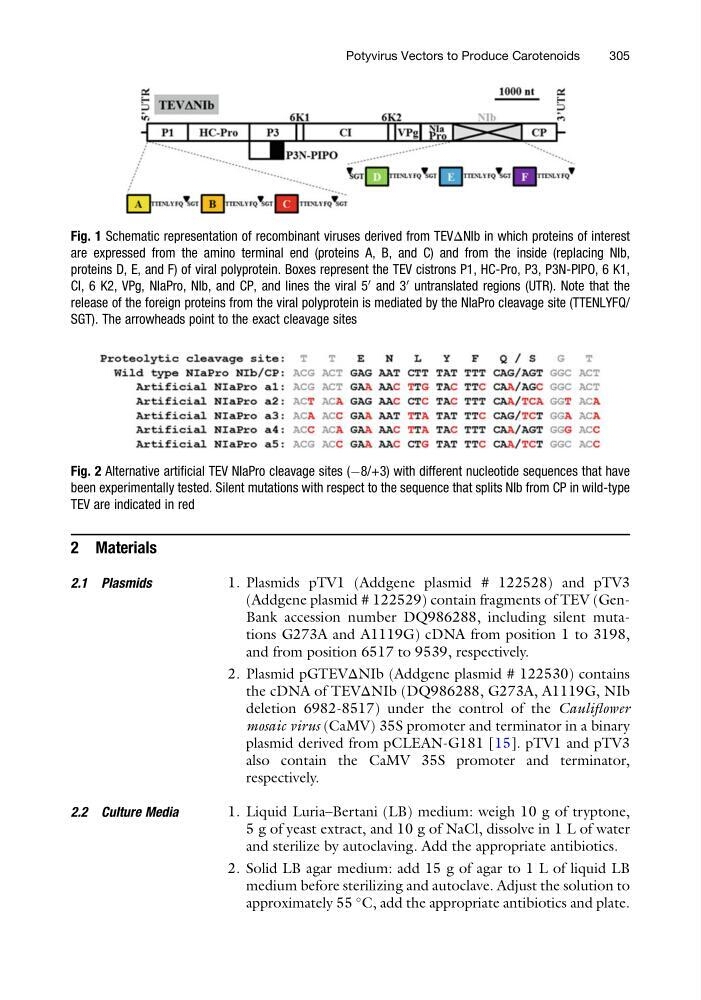
Fig. 1 Schematic representation of recombinant viruses derived from TEVΔNIb in which proteins of interest
are expressed from the amino terminal end (proteins A, B, and C) and from the inside (replacing NIb,
proteins D, E, and F) of viral polyprotein. Boxes represent the TEV cistrons P1, HC-Pro, P3, P3N-PIPO, 6 K1,
CI, 6 K2, VPg, NIaPro, NIb, and CP, and lines the viral 5
0 and 3
0 untranslated regions (UTR). Note that the
release of the foreign proteins from the viral polyprotein is mediated by the NIaPro cleavage site (TTENLYFQ/
SGT). The arrowheads point to the exact cleavage sites
Fig. 2 Alternative artificial TEV NIaPro cleavage sites (À8/+3) with different nucleotide sequences that have
been experimentally tested. Silent mutations with respect to the sequence that splits NIb from CP in wild-type
TEV are indicated in red
Potyvirus Vectors to Produce Carotenoids
305
2.1 Plasmids
1. Plasmids pTV1 (Addgene plasmid # 122528) and pTV3
(Addgene plasmid # 122529) contain fragments of TEV (GenBank accession number DQ986288, including silent mutations G273A and A1119G) cDNA from position 1 to 3198,
and from position 6517 to 9539, respectively.
2. Plasmid pGTEVΔNIb (Addgene plasmid # 122530) contains
the cDNA of TEVΔNIb (DQ986288, G273A, A1119G, NIb
deletion 6982-8517) under the control of the Cauliflower
mosaic virus (CaMV) 35S promoter and terminator in a binary
plasmid derived from pCLEAN-G181 [15]. pTV1 and pTV3
also contain the CaMV 35S promoter and terminator,
respectively.
2.2 Culture Media
1. Liquid Luria–Bertani (LB) medium: weigh 10 g of tryptone,
5 g of yeast extract, and 10 g of NaCl, dissolve in 1 L of water
and sterilize by autoclaving. Add the appropriate antibiotics.
2. Solid LB agar medium: add 15 g of agar to 1 L of liquid LB
medium before sterilizing and autoclave. Adjust the solution to
approximately 55
C, add the appropriate antibiotics and plate.
Fig. 1 Schematic representation of recombinant viruses derived from TEVΔNIb in which proteins of interest
are expressed from the amino terminal end (proteins A, B, and C) and from the inside (replacing NIb,
proteins D, E, and F) of viral polyprotein. Boxes represent the TEV cistrons P1, HC-Pro, P3, P3N-PIPO, 6 K1,
CI, 6 K2, VPg, NIaPro, NIb, and CP, and lines the viral 5
0 and 3
0 untranslated regions (UTR). Note that the
release of the foreign proteins from the viral polyprotein is mediated by the NIaPro cleavage site (TTENLYFQ/
SGT). The arrowheads point to the exact cleavage sites
Fig. 2 Alternative artificial TEV NIaPro cleavage sites (À8/+3) with different nucleotide sequences that have
been experimentally tested. Silent mutations with respect to the sequence that splits NIb from CP in wild-type
TEV are indicated in red
Potyvirus Vectors to Produce Carotenoids
305