

enzymes in plants, and five NCEDs (NCED2, 3, 5, 6, and 9) are
identified in Arabidopsis [66]. The first NCED gene was cloned
from the ABA-deficient maize mutant viviparous 14 [67, 68]. It
also represents the first CCD identified. The cleavage of carotenoids for ABA production starts with the formation of cis-isomers
of violaxanthin and neoxanthin by an unknown isomerase. NCEDs
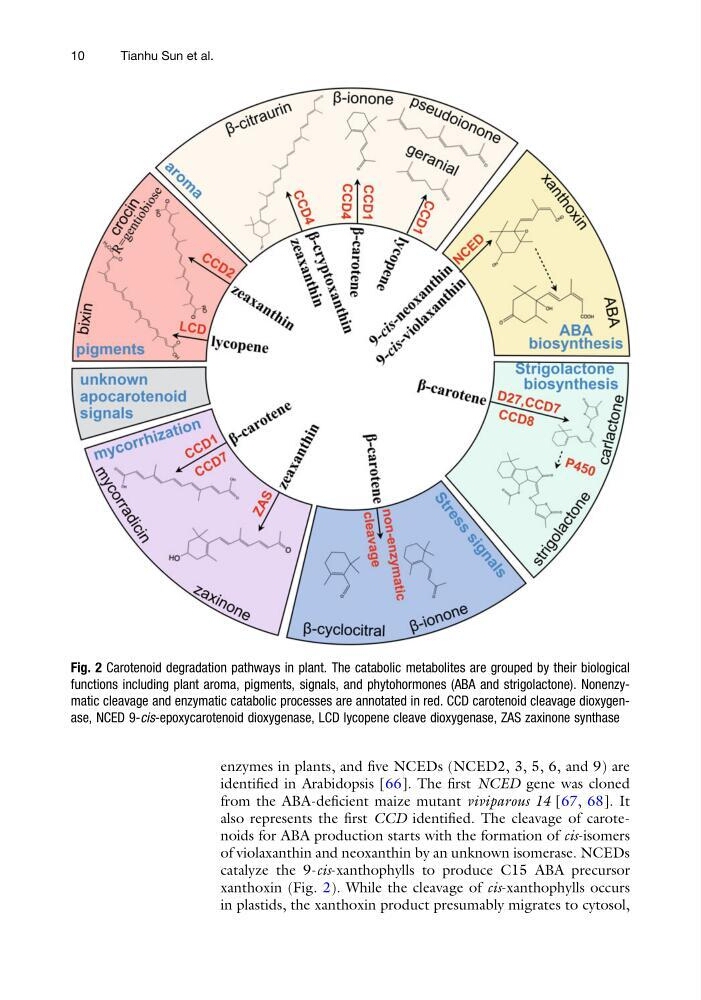
catalyze the 9-cis-xanthophylls to produce C15 ABA precursor
xanthoxin (Fig. 2). While the cleavage of cis-xanthophylls occurs
in plastids, the xanthoxin product presumably migrates to cytosol,
Fig. 2 Carotenoid degradation pathways in plant. The catabolic metabolites are grouped by their biological
functions including plant aroma, pigments, signals, and phytohormones (ABA and strigolactone). Nonenzymatic cleavage and enzymatic catabolic processes are annotated in red. CCD carotenoid cleavage dioxygenase, NCED 9-cis-epoxycarotenoid dioxygenase, LCD lycopene cleave dioxygenase, ZAS zaxinone synthase
10
Tianhu Sun et al.
identified in Arabidopsis [66]. The first NCED gene was cloned
from the ABA-deficient maize mutant viviparous 14 [67, 68]. It
also represents the first CCD identified. The cleavage of carotenoids for ABA production starts with the formation of cis-isomers
of violaxanthin and neoxanthin by an unknown isomerase. NCEDs
catalyze the 9-cis-xanthophylls to produce C15 ABA precursor
xanthoxin (Fig. 2). While the cleavage of cis-xanthophylls occurs
in plastids, the xanthoxin product presumably migrates to cytosol,
Fig. 2 Carotenoid degradation pathways in plant. The catabolic metabolites are grouped by their biological
functions including plant aroma, pigments, signals, and phytohormones (ABA and strigolactone). Nonenzymatic cleavage and enzymatic catabolic processes are annotated in red. CCD carotenoid cleavage dioxygenase, NCED 9-cis-epoxycarotenoid dioxygenase, LCD lycopene cleave dioxygenase, ZAS zaxinone synthase
10
Tianhu Sun et al.