

occur, its energy (E) must coincide with the energy difference
between the two states. The energy of the radiation is inversely
related to its wavelength according to the formula:
E ¼ hν ¼ hc=λ
ð3Þ
where E is the energy of the quantum, h is Planck’s constant, ν the
frequency of the radiation, c the velocity of light, and λ the
wavelength.
The typical absorption spectra of atoms are characterized by the
presence of single absorption lines. The reason is that in the case of
atoms, the electron in its ground state (that is, the lowest energy
level) absorbs radiation of a definite wavelength and is eventually
promoted to an excited state of higher energy. In the case of
molecules, the situation is more complex as an electron can exist
in different vibrational energy levels and each of these in a number
of rotational energy levels. Thus, in this case, the electronic transition can be due to a range of energy quanta matching the energy
differences between electronic basal or excited states in the various
vibrational and rotational energy levels. As a result, the absorption
spectra of molecules are characterized by the presence of absorption
bands [4, 5].
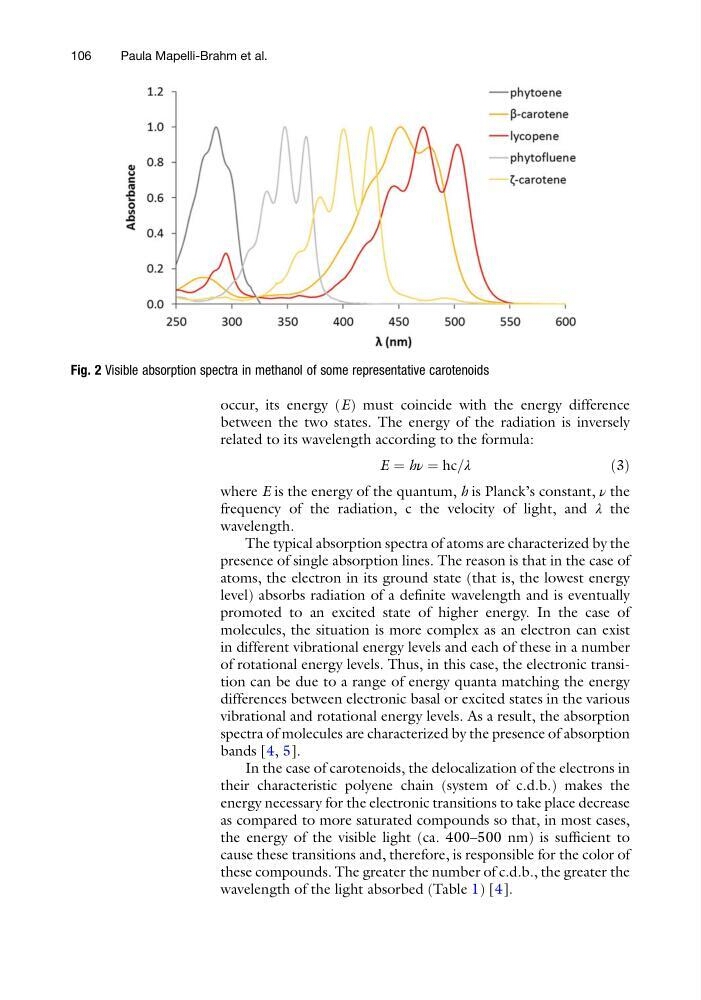
In the case of carotenoids, the delocalization of the electrons in
their characteristic polyene chain (system of c.d.b.) makes the
energy necessary for the electronic transitions to take place decrease
as compared to more saturated compounds so that, in most cases,
the energy of the visible light (ca. 400–500 nm) is sufficient to
cause these transitions and, therefore, is responsible for the color of
these compounds. The greater the number of c.d.b., the greater the
wavelength of the light absorbed (Table 1) [4].
Fig. 2 Visible absorption spectra in methanol of some representative carotenoids
106
Paula Mapelli-Brahm et al.
between the two states. The energy of the radiation is inversely
related to its wavelength according to the formula:
E ¼ hν ¼ hc=λ
ð3Þ
where E is the energy of the quantum, h is Planck’s constant, ν the
frequency of the radiation, c the velocity of light, and λ the
wavelength.
The typical absorption spectra of atoms are characterized by the
presence of single absorption lines. The reason is that in the case of
atoms, the electron in its ground state (that is, the lowest energy
level) absorbs radiation of a definite wavelength and is eventually
promoted to an excited state of higher energy. In the case of
molecules, the situation is more complex as an electron can exist
in different vibrational energy levels and each of these in a number
of rotational energy levels. Thus, in this case, the electronic transition can be due to a range of energy quanta matching the energy
differences between electronic basal or excited states in the various
vibrational and rotational energy levels. As a result, the absorption
spectra of molecules are characterized by the presence of absorption
bands [4, 5].
In the case of carotenoids, the delocalization of the electrons in
their characteristic polyene chain (system of c.d.b.) makes the
energy necessary for the electronic transitions to take place decrease
as compared to more saturated compounds so that, in most cases,
the energy of the visible light (ca. 400–500 nm) is sufficient to
cause these transitions and, therefore, is responsible for the color of
these compounds. The greater the number of c.d.b., the greater the
wavelength of the light absorbed (Table 1) [4].
Fig. 2 Visible absorption spectra in methanol of some representative carotenoids
106
Paula Mapelli-Brahm et al.