

absorption maxima of these cones are: red (λ ~ 650 nm), green
(λ ~ 530 nm), and blue (λ ~ 430 nm). When visible light (coming
either directly from a light source or from an object that was
illuminated by a light source) contact these photoreceptor cells of
the retina, they simultaneously send information via the optic nerve
to the brain, which eventually interprets it in terms of color. This
trichromatic or three-dimensional color perception is the foundation of the Trichromatic Theory of color, which allows each color
stimulus to be numerically defined and represented in a color space.
Nowadays, the most used color spaces for the color specification include CIEXYZ, CIELUV and CIELAB, being the latter the
one recommended by the International Commission of Illumination (CIE) as the most appropriate for the color specification in the
food industry, due to its uniformity, precision and accuracy. The
CIELAB color space is a Cartesian system defined by three rectangular colorimetric coordinates L∗, a∗, b∗ dimensionless magnitudes. The parameters of this space are the following [2]:
– L∗ is defined as lightness and can take values between
0 (corresponding to black) and 100 (corresponding to white).
– a∗ takes positive values for reddish colors and negative values
for the greenish ones.
– b∗ takes positive values for yellowish colors and negative values
for the bluish ones.
From the colorimetric parameters a∗ and b∗, the psychometric parameters chroma (C∗ ab ) and hue-angle (h ab ) are defined [2]:
– C∗ ab allows to determine for each hue its degree of difference in
comparison to a gray color with the same lightness and is related
to the quantitative attribute of colorfulness.
– Hue-angle (h ab ) is the qualitative attribute according to which
colors have been traditionally defined as reddish, greenish, and
so on. Its values, therefore, vary between 0
and 360
.
– Mathematically, these psychometric parameters are defined as
follows [2]:
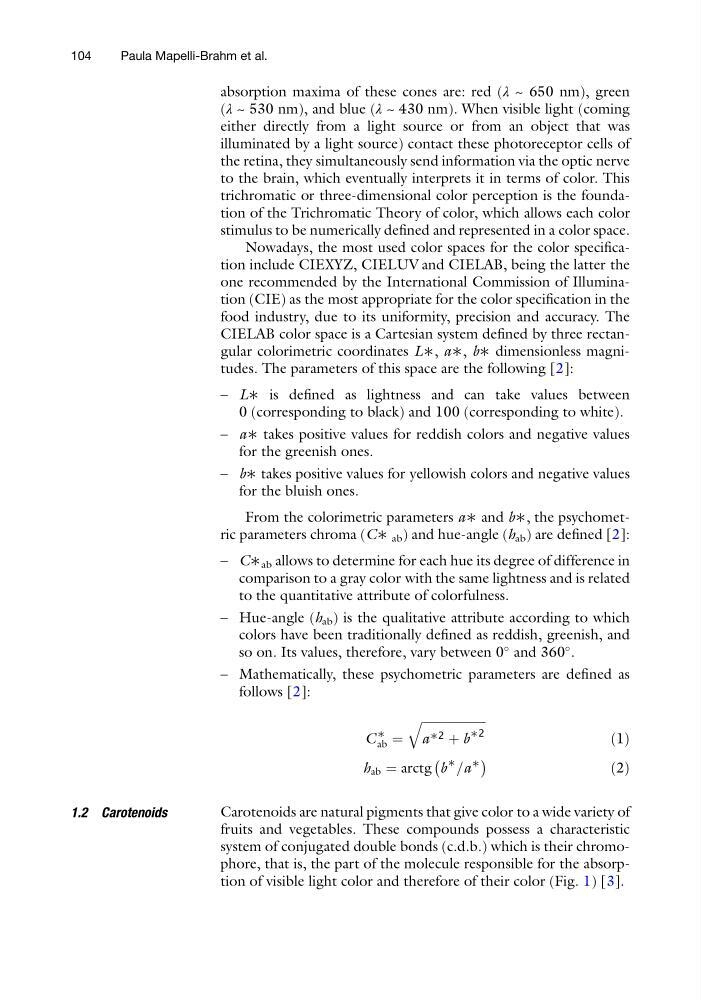
C
∗
ab ¼
ffiffiffiffiffiffiffiffiffiffiffiffiffiffiffiffiffiffiffiffiffi ffi
a ∗2 þ b
∗2
q
ð1Þ
h ab ¼ arctg b
∗
=a
∗
À
Á
ð2Þ
1.2 Carotenoids
Carotenoids are natural pigments that give color to a wide variety of
fruits and vegetables. These compounds possess a characteristic
system of conjugated double bonds (c.d.b.) which is their chromophore, that is, the part of the molecule responsible for the absorption of visible light color and therefore of their color (Fig. 1) [3].
104
Paula Mapelli-Brahm et al.
(λ ~ 530 nm), and blue (λ ~ 430 nm). When visible light (coming
either directly from a light source or from an object that was
illuminated by a light source) contact these photoreceptor cells of
the retina, they simultaneously send information via the optic nerve
to the brain, which eventually interprets it in terms of color. This
trichromatic or three-dimensional color perception is the foundation of the Trichromatic Theory of color, which allows each color
stimulus to be numerically defined and represented in a color space.
Nowadays, the most used color spaces for the color specification include CIEXYZ, CIELUV and CIELAB, being the latter the
one recommended by the International Commission of Illumination (CIE) as the most appropriate for the color specification in the
food industry, due to its uniformity, precision and accuracy. The
CIELAB color space is a Cartesian system defined by three rectangular colorimetric coordinates L∗, a∗, b∗ dimensionless magnitudes. The parameters of this space are the following [2]:
– L∗ is defined as lightness and can take values between
0 (corresponding to black) and 100 (corresponding to white).
– a∗ takes positive values for reddish colors and negative values
for the greenish ones.
– b∗ takes positive values for yellowish colors and negative values
for the bluish ones.
From the colorimetric parameters a∗ and b∗, the psychometric parameters chroma (C∗ ab ) and hue-angle (h ab ) are defined [2]:
– C∗ ab allows to determine for each hue its degree of difference in
comparison to a gray color with the same lightness and is related
to the quantitative attribute of colorfulness.
– Hue-angle (h ab ) is the qualitative attribute according to which
colors have been traditionally defined as reddish, greenish, and
so on. Its values, therefore, vary between 0
and 360
.
– Mathematically, these psychometric parameters are defined as
follows [2]:
C
∗
ab ¼
ffiffiffiffiffiffiffiffiffiffiffiffiffiffiffiffiffiffiffiffiffi ffi
a ∗2 þ b
∗2
q
ð1Þ
h ab ¼ arctg b
∗
=a
∗
À
Á
ð2Þ
1.2 Carotenoids
Carotenoids are natural pigments that give color to a wide variety of
fruits and vegetables. These compounds possess a characteristic
system of conjugated double bonds (c.d.b.) which is their chromophore, that is, the part of the molecule responsible for the absorption of visible light color and therefore of their color (Fig. 1) [3].
104
Paula Mapelli-Brahm et al.