

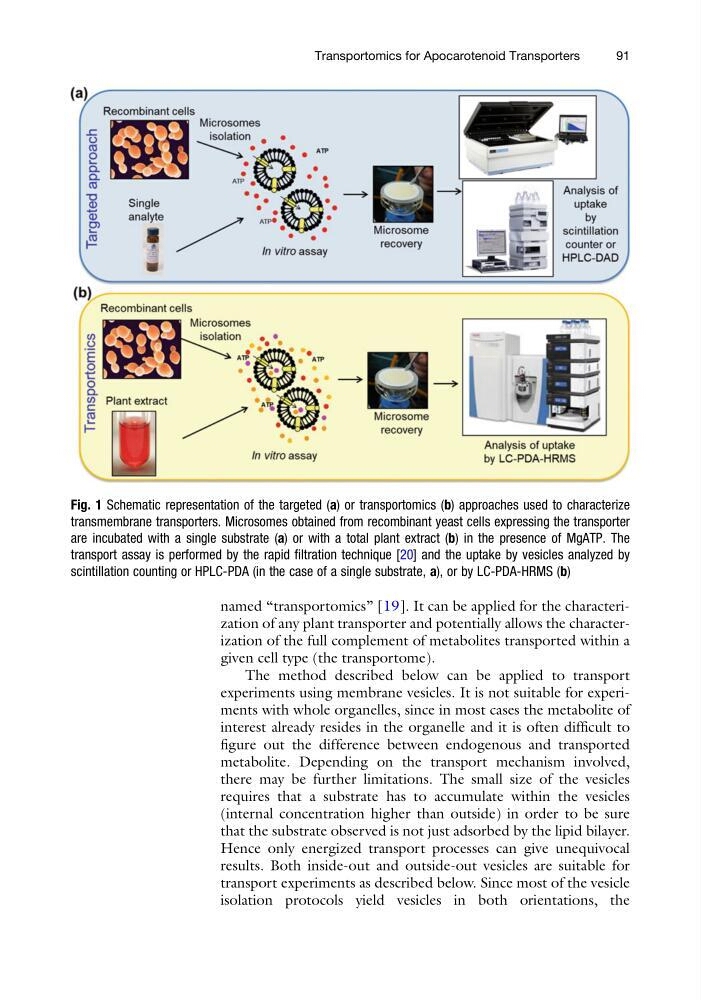
named “transportomics” [19]. It can be applied for the characterization of any plant transporter and potentially allows the characterization of the full complement of metabolites transported within a
given cell type (the transportome).
The method described below can be applied to transport
experiments using membrane vesicles. It is not suitable for experiments with whole organelles, since in most cases the metabolite of
interest already resides in the organelle and it is often difficult to
figure out the difference between endogenous and transported
metabolite. Depending on the transport mechanism involved,
there may be further limitations. The small size of the vesicles
requires that a substrate has to accumulate within the vesicles
(internal concentration higher than outside) in order to be sure
that the substrate observed is not just adsorbed by the lipid bilayer.
Hence only energized transport processes can give unequivocal
results. Both inside-out and outside-out vesicles are suitable for
transport experiments as described below. Since most of the vesicle
isolation protocols yield vesicles in both orientations, the
Fig. 1 Schematic representation of the targeted (a) or transportomics (b) approaches used to characterize
transmembrane transporters. Microsomes obtained from recombinant yeast cells expressing the transporter
are incubated with a single substrate (a) or with a total plant extract (b) in the presence of MgATP. The
transport assay is performed by the rapid filtration technique [20] and the uptake by vesicles analyzed by
scintillation counting or HPLC-PDA (in the case of a single substrate, a), or by LC-PDA-HRMS (b)
Transportomics for Apocarotenoid Transporters
91
given cell type (the transportome).
The method described below can be applied to transport
experiments using membrane vesicles. It is not suitable for experiments with whole organelles, since in most cases the metabolite of
interest already resides in the organelle and it is often difficult to
figure out the difference between endogenous and transported
metabolite. Depending on the transport mechanism involved,
there may be further limitations. The small size of the vesicles
requires that a substrate has to accumulate within the vesicles
(internal concentration higher than outside) in order to be sure
that the substrate observed is not just adsorbed by the lipid bilayer.
Hence only energized transport processes can give unequivocal
results. Both inside-out and outside-out vesicles are suitable for
transport experiments as described below. Since most of the vesicle
isolation protocols yield vesicles in both orientations, the
Fig. 1 Schematic representation of the targeted (a) or transportomics (b) approaches used to characterize
transmembrane transporters. Microsomes obtained from recombinant yeast cells expressing the transporter
are incubated with a single substrate (a) or with a total plant extract (b) in the presence of MgATP. The
transport assay is performed by the rapid filtration technique [20] and the uptake by vesicles analyzed by
scintillation counting or HPLC-PDA (in the case of a single substrate, a), or by LC-PDA-HRMS (b)
Transportomics for Apocarotenoid Transporters
91