

88
G. Grasso et al.
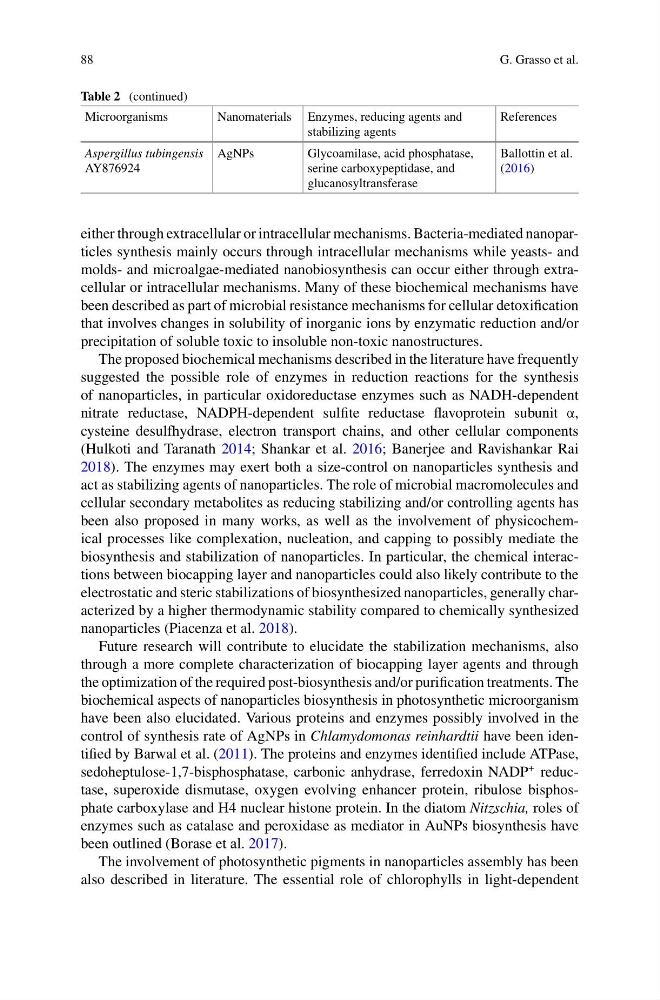
Table 2 (continued)
Microorganisms
Nanomaterials Enzymes, reducing agents and
stabilizing agents
References
Aspergillus tubingensis
AY876924
AgNPs
Glycoamilase, acid phosphatase,
serine carboxypeptidase, and
glucanosyltransferase
Ballottin et al.
(2016)
either through extracellular or intracellular mechanisms. Bacteria-mediated nanoparticles synthesis mainly occurs through intracellular mechanisms while yeasts- and
molds- and microalgae-mediated nanobiosynthesis can occur either through extracellular or intracellular mechanisms. Many of these biochemical mechanisms have
been described as part of microbial resistance mechanisms for cellular detoxification
that involves changes in solubility of inorganic ions by enzymatic reduction and/or
precipitation of soluble toxic to insoluble non-toxic nanostructures.
The proposed biochemical mechanisms described in the literature have frequently
suggested the possible role of enzymes in reduction reactions for the synthesis
of nanoparticles, in particular oxidoreductase enzymes such as NADH-dependent
nitrate reductase, NADPH-dependent sulfite reductase flavoprotein subunit α,
cysteine desulfhydrase, electron transport chains, and other cellular components
(Hulkoti and Taranath 2014; Shankar et al. 2016; Banerjee and Ravishankar Rai
2018). The enzymes may exert both a size-control on nanoparticles synthesis and
act as stabilizing agents of nanoparticles. The role of microbial macromolecules and
cellular secondary metabolites as reducing stabilizing and/or controlling agents has
been also proposed in many works, as well as the involvement of physicochemical processes like complexation, nucleation, and capping to possibly mediate the
biosynthesis and stabilization of nanoparticles. In particular, the chemical interactions between biocapping layer and nanoparticles could also likely contribute to the
electrostatic and steric stabilizations of biosynthesized nanoparticles, generally characterized by a higher thermodynamic stability compared to chemically synthesized
nanoparticles (Piacenza et al. 2018).
Future research will contribute to elucidate the stabilization mechanisms, also
through a more complete characterization of biocapping layer agents and through
the optimization of the required post-biosynthesis and/or purification treatments. The
biochemical aspects of nanoparticles biosynthesis in photosynthetic microorganism
have been also elucidated. Various proteins and enzymes possibly involved in the
control of synthesis rate of AgNPs in Chlamydomonas reinhardtii have been identified by Barwal et al. (2011). The proteins and enzymes identified include ATPase,
sedoheptulose-1,7-bisphosphatase, carbonic anhydrase, ferredoxin NADP
+ reductase, superoxide dismutase, oxygen evolving enhancer protein, ribulose bisphosphate carboxylase and H4 nuclear histone protein. In the diatom Nitzschia, roles of
enzymes such as catalase and peroxidase as mediator in AuNPs biosynthesis have
been outlined (Borase et al. 2017).
The involvement of photosynthetic pigments in nanoparticles assembly has been
also described in literature. The essential role of chlorophylls in light-dependent
G. Grasso et al.
Table 2 (continued)
Microorganisms
Nanomaterials Enzymes, reducing agents and
stabilizing agents
References
Aspergillus tubingensis
AY876924
AgNPs
Glycoamilase, acid phosphatase,
serine carboxypeptidase, and
glucanosyltransferase
Ballottin et al.
(2016)
either through extracellular or intracellular mechanisms. Bacteria-mediated nanoparticles synthesis mainly occurs through intracellular mechanisms while yeasts- and
molds- and microalgae-mediated nanobiosynthesis can occur either through extracellular or intracellular mechanisms. Many of these biochemical mechanisms have
been described as part of microbial resistance mechanisms for cellular detoxification
that involves changes in solubility of inorganic ions by enzymatic reduction and/or
precipitation of soluble toxic to insoluble non-toxic nanostructures.
The proposed biochemical mechanisms described in the literature have frequently
suggested the possible role of enzymes in reduction reactions for the synthesis
of nanoparticles, in particular oxidoreductase enzymes such as NADH-dependent
nitrate reductase, NADPH-dependent sulfite reductase flavoprotein subunit α,
cysteine desulfhydrase, electron transport chains, and other cellular components
(Hulkoti and Taranath 2014; Shankar et al. 2016; Banerjee and Ravishankar Rai
2018). The enzymes may exert both a size-control on nanoparticles synthesis and
act as stabilizing agents of nanoparticles. The role of microbial macromolecules and
cellular secondary metabolites as reducing stabilizing and/or controlling agents has
been also proposed in many works, as well as the involvement of physicochemical processes like complexation, nucleation, and capping to possibly mediate the
biosynthesis and stabilization of nanoparticles. In particular, the chemical interactions between biocapping layer and nanoparticles could also likely contribute to the
electrostatic and steric stabilizations of biosynthesized nanoparticles, generally characterized by a higher thermodynamic stability compared to chemically synthesized
nanoparticles (Piacenza et al. 2018).
Future research will contribute to elucidate the stabilization mechanisms, also
through a more complete characterization of biocapping layer agents and through
the optimization of the required post-biosynthesis and/or purification treatments. The
biochemical aspects of nanoparticles biosynthesis in photosynthetic microorganism
have been also elucidated. Various proteins and enzymes possibly involved in the
control of synthesis rate of AgNPs in Chlamydomonas reinhardtii have been identified by Barwal et al. (2011). The proteins and enzymes identified include ATPase,
sedoheptulose-1,7-bisphosphatase, carbonic anhydrase, ferredoxin NADP
+ reductase, superoxide dismutase, oxygen evolving enhancer protein, ribulose bisphosphate carboxylase and H4 nuclear histone protein. In the diatom Nitzschia, roles of
enzymes such as catalase and peroxidase as mediator in AuNPs biosynthesis have
been outlined (Borase et al. 2017).
The involvement of photosynthetic pigments in nanoparticles assembly has been
also described in literature. The essential role of chlorophylls in light-dependent