

Characterization Techniques in Nanotechnology …
31
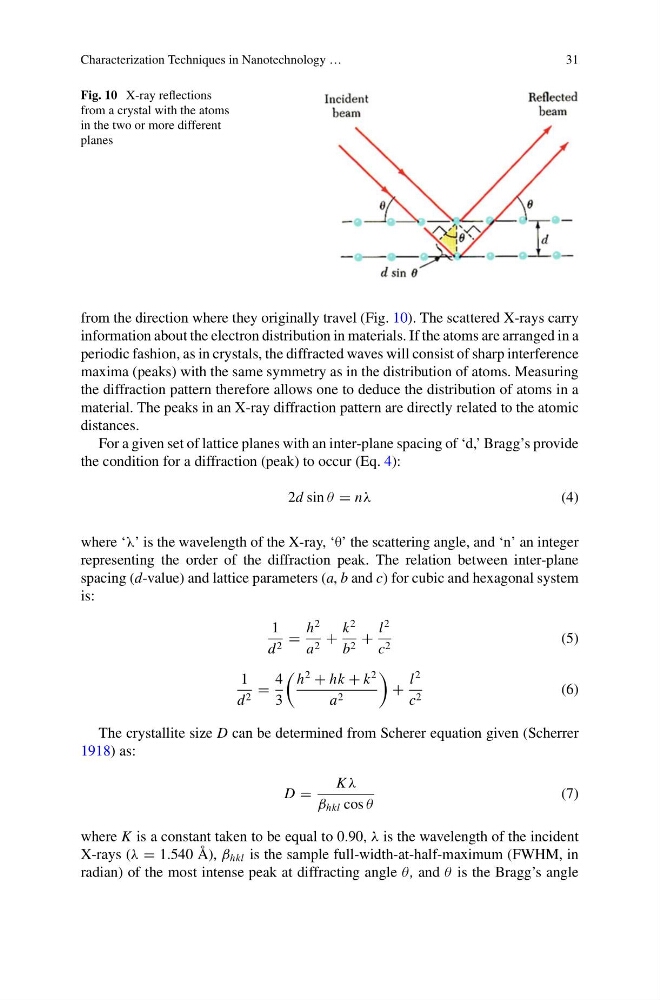
Fig. 10 X-ray reflections
from a crystal with the atoms
in the two or more different
planes
from the direction where they originally travel (Fig. 10). The scattered X-rays carry
information about the electron distribution in materials. If the atoms are arranged in a
periodic fashion, as in crystals, the diffracted waves will consist of sharp interference
maxima (peaks) with the same symmetry as in the distribution of atoms. Measuring
the diffraction pattern therefore allows one to deduce the distribution of atoms in a
material. The peaks in an X-ray diffraction pattern are directly related to the atomic
distances.
For a given set of lattice planes with an inter-plane spacing of ‘d,’ Bragg’s provide
the condition for a diffraction (peak) to occur (Eq. 4):
2d sin θ = nλ
(4)
where ‘λ’ is the wavelength of the X-ray, ‘θ’ the scattering angle, and ‘n’ an integer
representing the order of the diffraction peak. The relation between inter-plane
spacing (d-value) and lattice parameters (a, b and c) for cubic and hexagonal system
is:
1
d 2 =
h
2
a 2 +
k
2
b 2 +
l
2
c 2
(5)
1
d 2 =
4
3
h
2
+ hk + k
2
a 2
+
l
2
c 2
(6)
The crystallite size D can be determined from Scherer equation given (Scherrer
1918) as:
D =
K λ
β hkl cos θ
(7)
where K is a constant taken to be equal to 0.90, λ is the wavelength of the incident
X-rays (λ = 1.540 Å), β hkl is the sample full-width-at-half-maximum (FWHM, in
radian) of the most intense peak at diffracting angle θ , and θ is the Bragg’s angle
31
Fig. 10 X-ray reflections
from a crystal with the atoms
in the two or more different
planes
from the direction where they originally travel (Fig. 10). The scattered X-rays carry
information about the electron distribution in materials. If the atoms are arranged in a
periodic fashion, as in crystals, the diffracted waves will consist of sharp interference
maxima (peaks) with the same symmetry as in the distribution of atoms. Measuring
the diffraction pattern therefore allows one to deduce the distribution of atoms in a
material. The peaks in an X-ray diffraction pattern are directly related to the atomic
distances.
For a given set of lattice planes with an inter-plane spacing of ‘d,’ Bragg’s provide
the condition for a diffraction (peak) to occur (Eq. 4):
2d sin θ = nλ
(4)
where ‘λ’ is the wavelength of the X-ray, ‘θ’ the scattering angle, and ‘n’ an integer
representing the order of the diffraction peak. The relation between inter-plane
spacing (d-value) and lattice parameters (a, b and c) for cubic and hexagonal system
is:
1
d 2 =
h
2
a 2 +
k
2
b 2 +
l
2
c 2
(5)
1
d 2 =
4
3
h
2
+ hk + k
2
a 2
+
l
2
c 2
(6)
The crystallite size D can be determined from Scherer equation given (Scherrer
1918) as:
D =
K λ
β hkl cos θ
(7)
where K is a constant taken to be equal to 0.90, λ is the wavelength of the incident
X-rays (λ = 1.540 Å), β hkl is the sample full-width-at-half-maximum (FWHM, in
radian) of the most intense peak at diffracting angle θ , and θ is the Bragg’s angle