

Beneficial Microbes as Novel Microbial Cell …
319
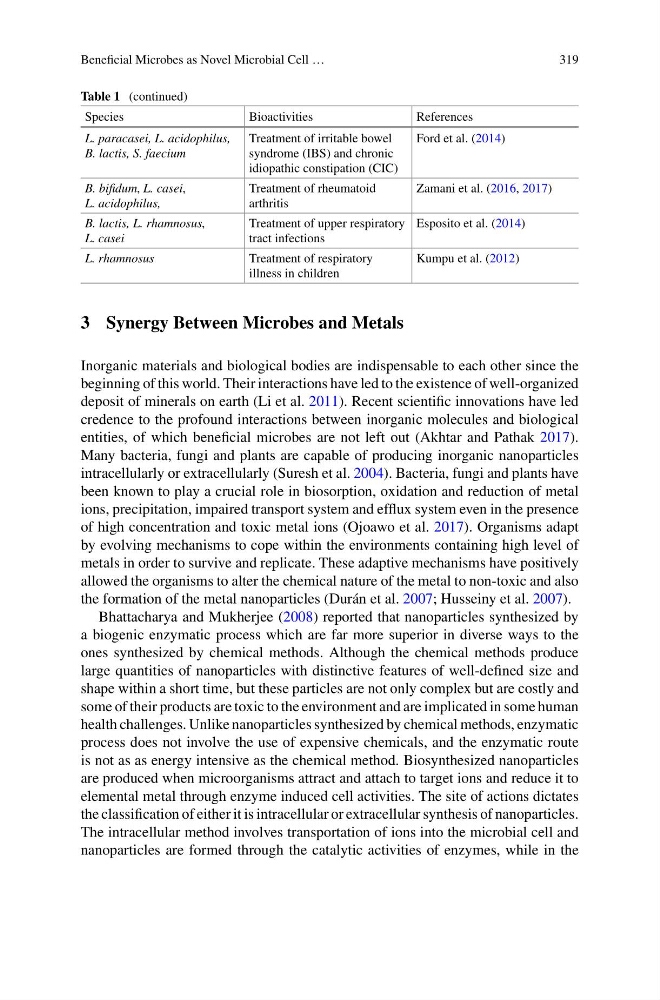
Table 1 (continued)
Species
Bioactivities
References
L. paracasei, L. acidophilus,
B. lactis, S. faecium
Treatment of irritable bowel
syndrome (IBS) and chronic
idiopathic constipation (CIC)
Ford et al. (2014)
B. bifidum, L. casei,
L. acidophilus,
Treatment of rheumatoid
arthritis
Zamani et al. (2016, 2017)
B. lactis, L. rhamnosus,
L. casei
Treatment of upper respiratory
tract infections
Esposito et al. (2014)
L. rhamnosus
Treatment of respiratory
illness in children
Kumpu et al. (2012)
3 Synergy Between Microbes and Metals
Inorganic materials and biological bodies are indispensable to each other since the
beginning of this world. Their interactions have led to the existence of well-organized
deposit of minerals on earth (Li et al. 2011). Recent scientific innovations have led
credence to the profound interactions between inorganic molecules and biological
entities, of which beneficial microbes are not left out (Akhtar and Pathak 2017).
Many bacteria, fungi and plants are capable of producing inorganic nanoparticles
intracellularly or extracellularly (Suresh et al. 2004). Bacteria, fungi and plants have
been known to play a crucial role in biosorption, oxidation and reduction of metal
ions, precipitation, impaired transport system and efflux system even in the presence
of high concentration and toxic metal ions (Ojoawo et al. 2017). Organisms adapt
by evolving mechanisms to cope within the environments containing high level of
metals in order to survive and replicate. These adaptive mechanisms have positively
allowed the organisms to alter the chemical nature of the metal to non-toxic and also
the formation of the metal nanoparticles (Durán et al. 2007; Husseiny et al. 2007).
Bhattacharya and Mukherjee (2008) reported that nanoparticles synthesized by
a biogenic enzymatic process which are far more superior in diverse ways to the
ones synthesized by chemical methods. Although the chemical methods produce
large quantities of nanoparticles with distinctive features of well-defined size and
shape within a short time, but these particles are not only complex but are costly and
some of their products are toxic to the environment and are implicated in some human
health challenges. Unlike nanoparticles synthesized by chemical methods, enzymatic
process does not involve the use of expensive chemicals, and the enzymatic route
is not as as energy intensive as the chemical method. Biosynthesized nanoparticles
are produced when microorganisms attract and attach to target ions and reduce it to
elemental metal through enzyme induced cell activities. The site of actions dictates
the classification of either it is intracellular or extracellular synthesis of nanoparticles.
The intracellular method involves transportation of ions into the microbial cell and
nanoparticles are formed through the catalytic activities of enzymes, while in the
319
Table 1 (continued)
Species
Bioactivities
References
L. paracasei, L. acidophilus,
B. lactis, S. faecium
Treatment of irritable bowel
syndrome (IBS) and chronic
idiopathic constipation (CIC)
Ford et al. (2014)
B. bifidum, L. casei,
L. acidophilus,
Treatment of rheumatoid
arthritis
Zamani et al. (2016, 2017)
B. lactis, L. rhamnosus,
L. casei
Treatment of upper respiratory
tract infections
Esposito et al. (2014)
L. rhamnosus
Treatment of respiratory
illness in children
Kumpu et al. (2012)
3 Synergy Between Microbes and Metals
Inorganic materials and biological bodies are indispensable to each other since the
beginning of this world. Their interactions have led to the existence of well-organized
deposit of minerals on earth (Li et al. 2011). Recent scientific innovations have led
credence to the profound interactions between inorganic molecules and biological
entities, of which beneficial microbes are not left out (Akhtar and Pathak 2017).
Many bacteria, fungi and plants are capable of producing inorganic nanoparticles
intracellularly or extracellularly (Suresh et al. 2004). Bacteria, fungi and plants have
been known to play a crucial role in biosorption, oxidation and reduction of metal
ions, precipitation, impaired transport system and efflux system even in the presence
of high concentration and toxic metal ions (Ojoawo et al. 2017). Organisms adapt
by evolving mechanisms to cope within the environments containing high level of
metals in order to survive and replicate. These adaptive mechanisms have positively
allowed the organisms to alter the chemical nature of the metal to non-toxic and also
the formation of the metal nanoparticles (Durán et al. 2007; Husseiny et al. 2007).
Bhattacharya and Mukherjee (2008) reported that nanoparticles synthesized by
a biogenic enzymatic process which are far more superior in diverse ways to the
ones synthesized by chemical methods. Although the chemical methods produce
large quantities of nanoparticles with distinctive features of well-defined size and
shape within a short time, but these particles are not only complex but are costly and
some of their products are toxic to the environment and are implicated in some human
health challenges. Unlike nanoparticles synthesized by chemical methods, enzymatic
process does not involve the use of expensive chemicals, and the enzymatic route
is not as as energy intensive as the chemical method. Biosynthesized nanoparticles
are produced when microorganisms attract and attach to target ions and reduce it to
elemental metal through enzyme induced cell activities. The site of actions dictates
the classification of either it is intracellular or extracellular synthesis of nanoparticles.
The intracellular method involves transportation of ions into the microbial cell and
nanoparticles are formed through the catalytic activities of enzymes, while in the