

Microbial-Mediated Nanoparticles for Sustainable Environment …
301
spectrophotometry used for analysis of vibrational and rotational aspects. Usually,
this technique makes use of the potassium bromide palletization method for analysis.
Many researches in the present era are focused on analysis of the geometrical shapes
and crystal features of the nanoparticles. This is usually done via X-ray powder
diffraction. This is an important technique since it gives the average crystallite size
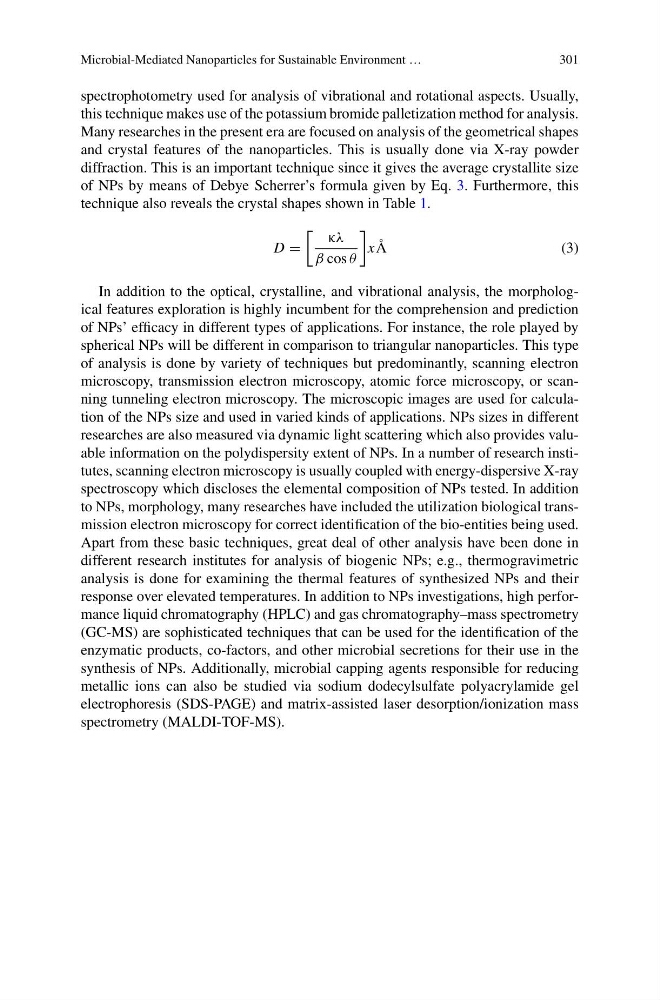
of NPs by means of Debye Scherrer’s formula given by Eq. 3. Furthermore, this
technique also reveals the crystal shapes shown in Table 1.
D =
κλ
β cos θ
xÅ
( 3 )
In addition to the optical, crystalline, and vibrational analysis, the morphological features exploration is highly incumbent for the comprehension and prediction
of NPs’ efficacy in different types of applications. For instance, the role played by
spherical NPs will be different in comparison to triangular nanoparticles. This type
of analysis is done by variety of techniques but predominantly, scanning electron
microscopy, transmission electron microscopy, atomic force microscopy, or scanning tunneling electron microscopy. The microscopic images are used for calculation of the NPs size and used in varied kinds of applications. NPs sizes in different
researches are also measured via dynamic light scattering which also provides valuable information on the polydispersity extent of NPs. In a number of research institutes, scanning electron microscopy is usually coupled with energy-dispersive X-ray
spectroscopy which discloses the elemental composition of NPs tested. In addition
to NPs, morphology, many researches have included the utilization biological transmission electron microscopy for correct identification of the bio-entities being used.
Apart from these basic techniques, great deal of other analysis have been done in
different research institutes for analysis of biogenic NPs; e.g., thermogravimetric
analysis is done for examining the thermal features of synthesized NPs and their
response over elevated temperatures. In addition to NPs investigations, high performance liquid chromatography (HPLC) and gas chromatography–mass spectrometry
(GC-MS) are sophisticated techniques that can be used for the identification of the
enzymatic products, co-factors, and other microbial secretions for their use in the
synthesis of NPs. Additionally, microbial capping agents responsible for reducing
metallic ions can also be studied via sodium dodecylsulfate polyacrylamide gel
electrophoresis (SDS-PAGE) and matrix-assisted laser desorption/ionization mass
spectrometry (MALDI-TOF-MS).
301
spectrophotometry used for analysis of vibrational and rotational aspects. Usually,
this technique makes use of the potassium bromide palletization method for analysis.
Many researches in the present era are focused on analysis of the geometrical shapes
and crystal features of the nanoparticles. This is usually done via X-ray powder
diffraction. This is an important technique since it gives the average crystallite size
of NPs by means of Debye Scherrer’s formula given by Eq. 3. Furthermore, this
technique also reveals the crystal shapes shown in Table 1.
D =
κλ
β cos θ
xÅ
( 3 )
In addition to the optical, crystalline, and vibrational analysis, the morphological features exploration is highly incumbent for the comprehension and prediction
of NPs’ efficacy in different types of applications. For instance, the role played by
spherical NPs will be different in comparison to triangular nanoparticles. This type
of analysis is done by variety of techniques but predominantly, scanning electron
microscopy, transmission electron microscopy, atomic force microscopy, or scanning tunneling electron microscopy. The microscopic images are used for calculation of the NPs size and used in varied kinds of applications. NPs sizes in different
researches are also measured via dynamic light scattering which also provides valuable information on the polydispersity extent of NPs. In a number of research institutes, scanning electron microscopy is usually coupled with energy-dispersive X-ray
spectroscopy which discloses the elemental composition of NPs tested. In addition
to NPs, morphology, many researches have included the utilization biological transmission electron microscopy for correct identification of the bio-entities being used.
Apart from these basic techniques, great deal of other analysis have been done in
different research institutes for analysis of biogenic NPs; e.g., thermogravimetric
analysis is done for examining the thermal features of synthesized NPs and their
response over elevated temperatures. In addition to NPs investigations, high performance liquid chromatography (HPLC) and gas chromatography–mass spectrometry
(GC-MS) are sophisticated techniques that can be used for the identification of the
enzymatic products, co-factors, and other microbial secretions for their use in the
synthesis of NPs. Additionally, microbial capping agents responsible for reducing
metallic ions can also be studied via sodium dodecylsulfate polyacrylamide gel
electrophoresis (SDS-PAGE) and matrix-assisted laser desorption/ionization mass
spectrometry (MALDI-TOF-MS).