

170
I. A. Sanusi et al.
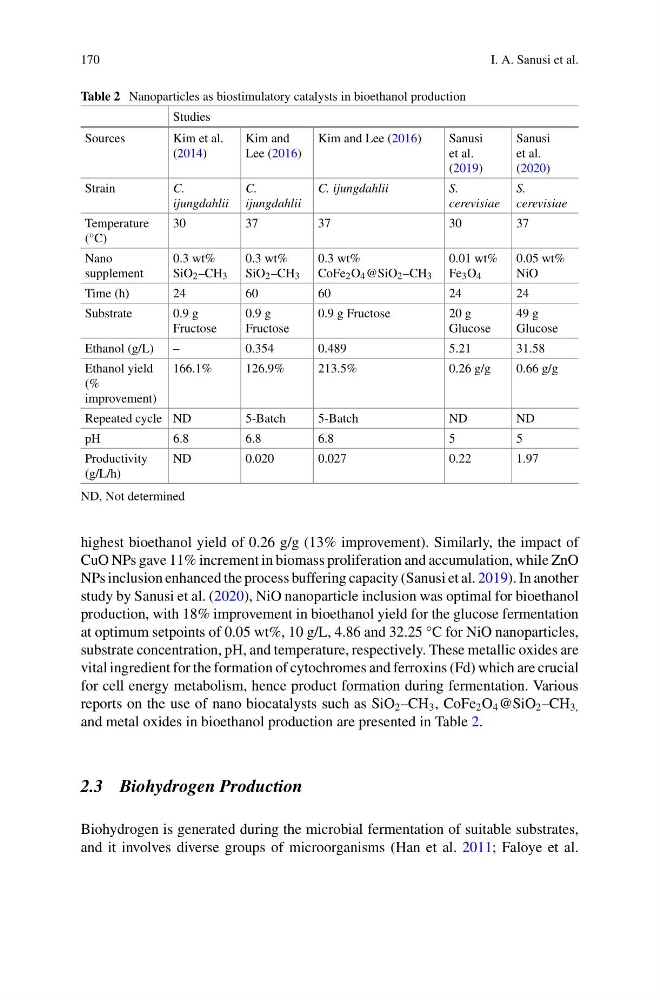
Table 2 Nanoparticles as biostimulatory catalysts in bioethanol production
Studies
Sources
Kim et al.
(2014)
Kim and
Lee (2016)
Kim and Lee (2016)
Sanusi
et al.
(2019)
Sanusi
et al.
(2020)
Strain
C.
ijungdahlii
C.
ijungdahlii
C. ijungdahlii
S.
cerevisiae
S.
cerevisiae
Temperature
(°C)
30
37
37
30
37
Nano
supplement
0.3 wt%
SiO 2 –CH 3
0.3 wt%
SiO 2 –CH 3
0.3 wt%
CoFe 2 O 4 @SiO 2 –CH 3
0.01 wt%
Fe 3 O 4
0.05 wt%
NiO
Time (h)
24
60
60
24
24
Substrate
0.9 g
Fructose
0.9 g
Fructose
0.9 g Fructose
20 g
Glucose
49 g
Glucose
Ethanol (g/L)
–
0.354
0.489
5.21
31.58
Ethanol yield
(%
improvement)
166.1%
126.9%
213.5%
0.26 g/g
0.66 g/g
Repeated cycle ND
5-Batch
5-Batch
ND
ND
pH
6.8
6.8
6.8
5
5
Productivity
(g/L/h)
ND
0.020
0.027
0.22
1.97
ND, Not determined
highest bioethanol yield of 0.26 g/g (13% improvement). Similarly, the impact of
CuO NPs gave 11% increment in biomass proliferation and accumulation, while ZnO
NPs inclusion enhanced the process buffering capacity (Sanusi et al. 2019). In another
study by Sanusi et al. (2020), NiO nanoparticle inclusion was optimal for bioethanol
production, with 18% improvement in bioethanol yield for the glucose fermentation
at optimum setpoints of 0.05 wt%, 10 g/L, 4.86 and 32.25 °C for NiO nanoparticles,
substrate concentration, pH, and temperature, respectively. These metallic oxides are
vital ingredient for the formation of cytochromes and ferroxins (Fd) which are crucial
for cell energy metabolism, hence product formation during fermentation. Various
reports on the use of nano biocatalysts such as SiO 2 –CH 3 , CoFe 2 O 4 @SiO 2 –CH 3,
and metal oxides in bioethanol production are presented in Table 2.
2.3 Biohydrogen Production
Biohydrogen is generated during the microbial fermentation of suitable substrates,
and it involves diverse groups of microorganisms (Han et al. 2011; Faloye et al.
I. A. Sanusi et al.
Table 2 Nanoparticles as biostimulatory catalysts in bioethanol production
Studies
Sources
Kim et al.
(2014)
Kim and
Lee (2016)
Kim and Lee (2016)
Sanusi
et al.
(2019)
Sanusi
et al.
(2020)
Strain
C.
ijungdahlii
C.
ijungdahlii
C. ijungdahlii
S.
cerevisiae
S.
cerevisiae
Temperature
(°C)
30
37
37
30
37
Nano
supplement
0.3 wt%
SiO 2 –CH 3
0.3 wt%
SiO 2 –CH 3
0.3 wt%
CoFe 2 O 4 @SiO 2 –CH 3
0.01 wt%
Fe 3 O 4
0.05 wt%
NiO
Time (h)
24
60
60
24
24
Substrate
0.9 g
Fructose
0.9 g
Fructose
0.9 g Fructose
20 g
Glucose
49 g
Glucose
Ethanol (g/L)
–
0.354
0.489
5.21
31.58
Ethanol yield
(%
improvement)
166.1%
126.9%
213.5%
0.26 g/g
0.66 g/g
Repeated cycle ND
5-Batch
5-Batch
ND
ND
pH
6.8
6.8
6.8
5
5
Productivity
(g/L/h)
ND
0.020
0.027
0.22
1.97
ND, Not determined
highest bioethanol yield of 0.26 g/g (13% improvement). Similarly, the impact of
CuO NPs gave 11% increment in biomass proliferation and accumulation, while ZnO
NPs inclusion enhanced the process buffering capacity (Sanusi et al. 2019). In another
study by Sanusi et al. (2020), NiO nanoparticle inclusion was optimal for bioethanol
production, with 18% improvement in bioethanol yield for the glucose fermentation
at optimum setpoints of 0.05 wt%, 10 g/L, 4.86 and 32.25 °C for NiO nanoparticles,
substrate concentration, pH, and temperature, respectively. These metallic oxides are
vital ingredient for the formation of cytochromes and ferroxins (Fd) which are crucial
for cell energy metabolism, hence product formation during fermentation. Various
reports on the use of nano biocatalysts such as SiO 2 –CH 3 , CoFe 2 O 4 @SiO 2 –CH 3,
and metal oxides in bioethanol production are presented in Table 2.
2.3 Biohydrogen Production
Biohydrogen is generated during the microbial fermentation of suitable substrates,
and it involves diverse groups of microorganisms (Han et al. 2011; Faloye et al.