

168
I. A. Sanusi et al.
signalling pathways and result in stronger attachment and reactivity. Other significant properties of nanoparticles that could improve bioprocess performance include
large surface-to-volume ratio, high surface reaction activity, high catalytic efficiency,
strong adsorption ability and redox potential that is normally high due to small atomic
size (Willner et al. 2006; Ansari and Husain 2012; Abdelsalam et al. 2016). Nanotechnology has been applied in the production of different biofuels such as biodiesel,
bioethanol, biohydrogen and biogas, and these are subsequently discussed.
2.1 Biodiesel Production
Biodiesels are alkyl esters of both short- and long-chain fatty acids from either animal
fats or vegetable oils. Production of biodiesel from microalgal lipids, vegetable oils
and animal oils has attracted interest due to the many benefits of biodiesel; (i) feed
stocks are highly abundant since they are regarded as waste, (ii) food security-wise,
(iii) reduced production cost, (iv) decreased CO 2 emissions and (v) its degradability
(Sekoai et al. 2019). Biodiesel is one clean energy source that is considered a
suitable substitute for the conventional petroleum diesel. This is due to its higher
energy density, enhanced lubricating property, environmental friendliness, and they
can be produced using non-edible oils (Sekoai et al. 2019). Nanotechnology has
been employed in biodiesel production to achieve high product yields (Lee et al.
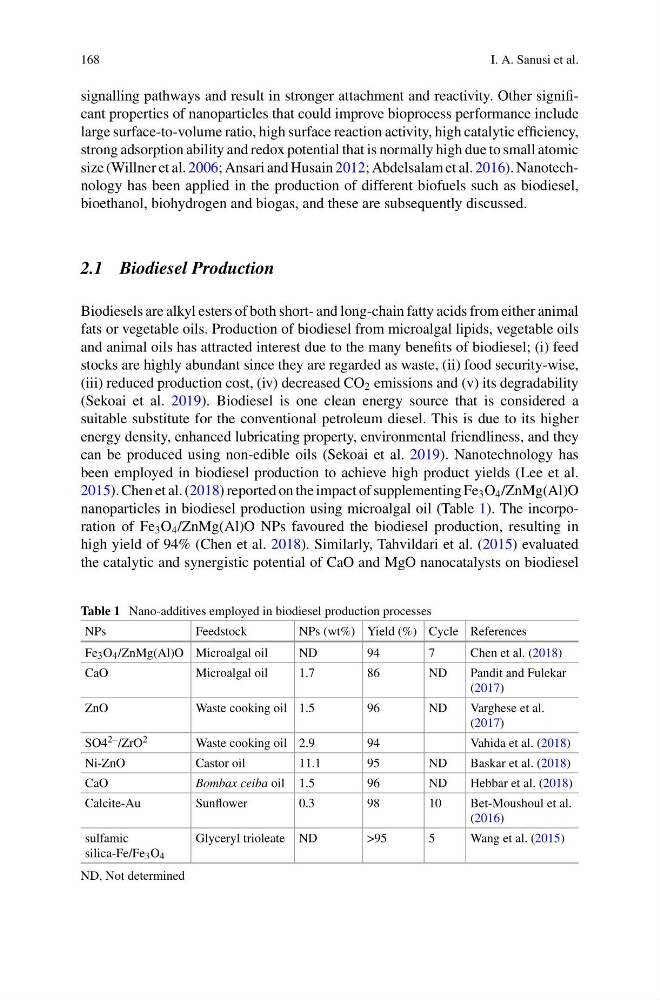
2015). Chen et al. (2018) reported on the impact of supplementing Fe 3 O 4 /ZnMg(Al)O
nanoparticles in biodiesel production using microalgal oil (Table 1). The incorporation of Fe 3 O 4 /ZnMg(Al)O NPs favoured the biodiesel production, resulting in
high yield of 94% (Chen et al. 2018). Similarly, Tahvildari et al. (2015) evaluated
the catalytic and synergistic potential of CaO and MgO nanocatalysts on biodiesel
Table 1 Nano-additives employed in biodiesel production processes
NPs
Feedstock
NPs (wt%) Yield (%) Cycle References
Fe 3 O 4 /ZnMg(Al)O Microalgal oil
ND
94
7
Chen et al. (2018)
CaO
Microalgal oil
1.7
86
ND
Pandit and Fulekar
(2017)
ZnO
Waste cooking oil 1.5
96
ND
Varghese et al.
(2017)
SO4 2– /ZrO 2
Waste cooking oil 2.9
94
Vahida et al. (2018)
Ni-ZnO
Castor oil
11.1
95
ND
Baskar et al. (2018)
CaO
Bombax ceiba oil 1.5
96
ND
Hebbar et al. (2018)
Calcite-Au
Sunflower
0.3
98
10
Bet-Moushoul et al.
(2016)
sulfamic
silica-Fe/Fe 3 O 4
Glyceryl trioleate ND
>95
5
Wang et al. (2015)
ND, Not determined
I. A. Sanusi et al.
signalling pathways and result in stronger attachment and reactivity. Other significant properties of nanoparticles that could improve bioprocess performance include
large surface-to-volume ratio, high surface reaction activity, high catalytic efficiency,
strong adsorption ability and redox potential that is normally high due to small atomic
size (Willner et al. 2006; Ansari and Husain 2012; Abdelsalam et al. 2016). Nanotechnology has been applied in the production of different biofuels such as biodiesel,
bioethanol, biohydrogen and biogas, and these are subsequently discussed.
2.1 Biodiesel Production
Biodiesels are alkyl esters of both short- and long-chain fatty acids from either animal
fats or vegetable oils. Production of biodiesel from microalgal lipids, vegetable oils
and animal oils has attracted interest due to the many benefits of biodiesel; (i) feed
stocks are highly abundant since they are regarded as waste, (ii) food security-wise,
(iii) reduced production cost, (iv) decreased CO 2 emissions and (v) its degradability
(Sekoai et al. 2019). Biodiesel is one clean energy source that is considered a
suitable substitute for the conventional petroleum diesel. This is due to its higher
energy density, enhanced lubricating property, environmental friendliness, and they
can be produced using non-edible oils (Sekoai et al. 2019). Nanotechnology has
been employed in biodiesel production to achieve high product yields (Lee et al.
2015). Chen et al. (2018) reported on the impact of supplementing Fe 3 O 4 /ZnMg(Al)O
nanoparticles in biodiesel production using microalgal oil (Table 1). The incorporation of Fe 3 O 4 /ZnMg(Al)O NPs favoured the biodiesel production, resulting in
high yield of 94% (Chen et al. 2018). Similarly, Tahvildari et al. (2015) evaluated
the catalytic and synergistic potential of CaO and MgO nanocatalysts on biodiesel
Table 1 Nano-additives employed in biodiesel production processes
NPs
Feedstock
NPs (wt%) Yield (%) Cycle References
Fe 3 O 4 /ZnMg(Al)O Microalgal oil
ND
94
7
Chen et al. (2018)
CaO
Microalgal oil
1.7
86
ND
Pandit and Fulekar
(2017)
ZnO
Waste cooking oil 1.5
96
ND
Varghese et al.
(2017)
SO4 2– /ZrO 2
Waste cooking oil 2.9
94
Vahida et al. (2018)
Ni-ZnO
Castor oil
11.1
95
ND
Baskar et al. (2018)
CaO
Bombax ceiba oil 1.5
96
ND
Hebbar et al. (2018)
Calcite-Au
Sunflower
0.3
98
10
Bet-Moushoul et al.
(2016)
sulfamic
silica-Fe/Fe 3 O 4
Glyceryl trioleate ND
>95
5
Wang et al. (2015)
ND, Not determined