

Current Advances in Fungal …
123
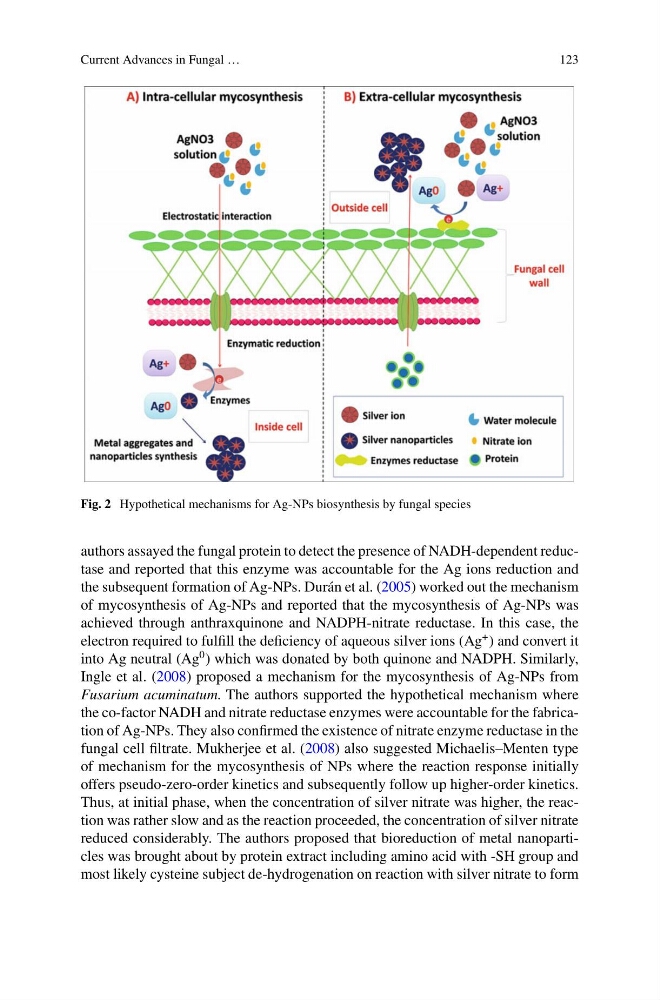
Fig. 2 Hypothetical mechanisms for Ag-NPs biosynthesis by fungal species
authors assayed the fungal protein to detect the presence of NADH-dependent reductase and reported that this enzyme was accountable for the Ag ions reduction and
the subsequent formation of Ag-NPs. Durán et al. (2005) worked out the mechanism
of mycosynthesis of Ag-NPs and reported that the mycosynthesis of Ag-NPs was
achieved through anthraxquinone and NADPH-nitrate reductase. In this case, the
electron required to fulfill the deficiency of aqueous silver ions (Ag
+ ) and convert it
into Ag neutral (Ag
0 ) which was donated by both quinone and NADPH. Similarly,
Ingle et al. (2008) proposed a mechanism for the mycosynthesis of Ag-NPs from
Fusarium acuminatum. The authors supported the hypothetical mechanism where
the co-factor NADH and nitrate reductase enzymes were accountable for the fabrication of Ag-NPs. They also confirmed the existence of nitrate enzyme reductase in the
fungal cell filtrate. Mukherjee et al. (2008) also suggested Michaelis–Menten type
of mechanism for the mycosynthesis of NPs where the reaction response initially
offers pseudo-zero-order kinetics and subsequently follow up higher-order kinetics.
Thus, at initial phase, when the concentration of silver nitrate was higher, the reaction was rather slow and as the reaction proceeded, the concentration of silver nitrate
reduced considerably. The authors proposed that bioreduction of metal nanoparticles was brought about by protein extract including amino acid with -SH group and
most likely cysteine subject de-hydrogenation on reaction with silver nitrate to form
123
Fig. 2 Hypothetical mechanisms for Ag-NPs biosynthesis by fungal species
authors assayed the fungal protein to detect the presence of NADH-dependent reductase and reported that this enzyme was accountable for the Ag ions reduction and
the subsequent formation of Ag-NPs. Durán et al. (2005) worked out the mechanism
of mycosynthesis of Ag-NPs and reported that the mycosynthesis of Ag-NPs was
achieved through anthraxquinone and NADPH-nitrate reductase. In this case, the
electron required to fulfill the deficiency of aqueous silver ions (Ag
+ ) and convert it
into Ag neutral (Ag
0 ) which was donated by both quinone and NADPH. Similarly,
Ingle et al. (2008) proposed a mechanism for the mycosynthesis of Ag-NPs from
Fusarium acuminatum. The authors supported the hypothetical mechanism where
the co-factor NADH and nitrate reductase enzymes were accountable for the fabrication of Ag-NPs. They also confirmed the existence of nitrate enzyme reductase in the
fungal cell filtrate. Mukherjee et al. (2008) also suggested Michaelis–Menten type
of mechanism for the mycosynthesis of NPs where the reaction response initially
offers pseudo-zero-order kinetics and subsequently follow up higher-order kinetics.
Thus, at initial phase, when the concentration of silver nitrate was higher, the reaction was rather slow and as the reaction proceeded, the concentration of silver nitrate
reduced considerably. The authors proposed that bioreduction of metal nanoparticles was brought about by protein extract including amino acid with -SH group and
most likely cysteine subject de-hydrogenation on reaction with silver nitrate to form