

Current Advances in Fungal …
121
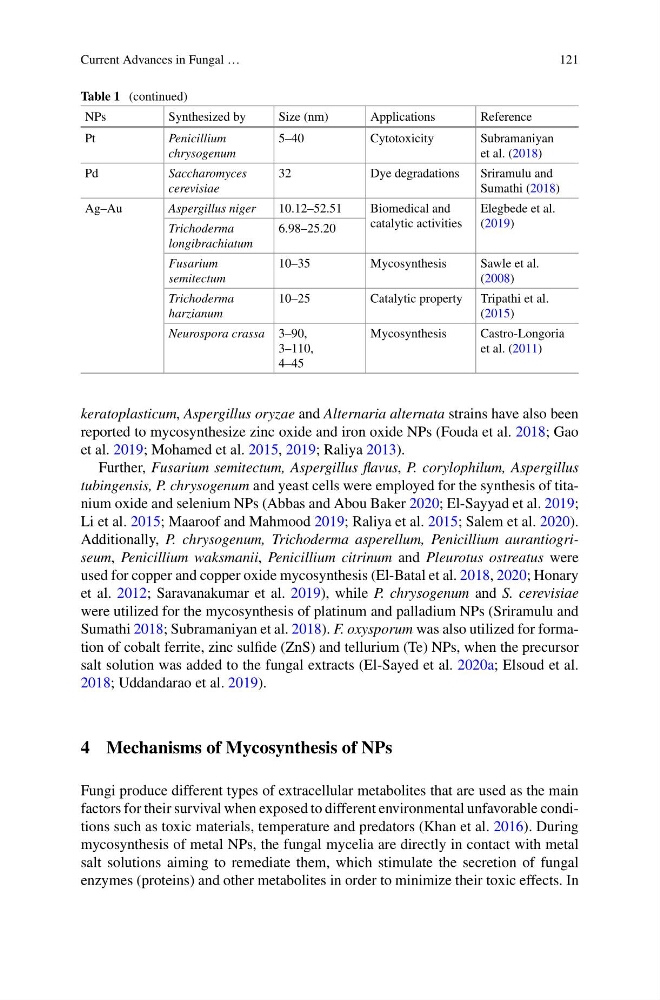
Table 1 (continued)
NPs
Synthesized by
Size (nm)
Applications
Reference
Pt
Penicillium
chrysogenum
5–40
Cytotoxicity
Subramaniyan
et al. (2018)
Pd
Saccharomyces
cerevisiae
32
Dye degradations
Sriramulu and
Sumathi (2018)
Ag–Au
Aspergillus niger
10.12–52.51
Biomedical and
catalytic activities
Elegbede et al.
(2019)
Trichoderma
longibrachiatum
6.98–25.20
Fusarium
semitectum
10–35
Mycosynthesis
Sawle et al.
(2008)
Trichoderma
harzianum
10–25
Catalytic property Tripathi et al.
(2015)
Neurospora crassa 3–90,
3–110,
4–45
Mycosynthesis
Castro-Longoria
et al. (2011)
keratoplasticum, Aspergillus oryzae and Alternaria alternata strains have also been
reported to mycosynthesize zinc oxide and iron oxide NPs (Fouda et al. 2018; Gao
et al. 2019; Mohamed et al. 2015, 2019; Raliya 2013).
Further, Fusarium semitectum, Aspergillus flavus, P. corylophilum, Aspergillus
tubingensis, P. chrysogenum and yeast cells were employed for the synthesis of titanium oxide and selenium NPs (Abbas and Abou Baker 2020; El-Sayyad et al. 2019;
Li et al. 2015; Maaroof and Mahmood 2019; Raliya et al. 2015; Salem et al. 2020).
Additionally, P. chrysogenum, Trichoderma asperellum, Penicillium aurantiogriseum, Penicillium waksmanii, Penicillium citrinum and Pleurotus ostreatus were
used for copper and copper oxide mycosynthesis (El-Batal et al. 2018, 2020; Honary
et al. 2012; Saravanakumar et al. 2019), while P. chrysogenum and S. cerevisiae
were utilized for the mycosynthesis of platinum and palladium NPs (Sriramulu and
Sumathi 2018; Subramaniyan et al. 2018). F. oxysporum was also utilized for formation of cobalt ferrite, zinc sulfide (ZnS) and tellurium (Te) NPs, when the precursor
salt solution was added to the fungal extracts (El-Sayed et al. 2020a; Elsoud et al.
2018; Uddandarao et al. 2019).
4 Mechanisms of Mycosynthesis of NPs
Fungi produce different types of extracellular metabolites that are used as the main
factors for their survival when exposed to different environmental unfavorable conditions such as toxic materials, temperature and predators (Khan et al. 2016). During
mycosynthesis of metal NPs, the fungal mycelia are directly in contact with metal
salt solutions aiming to remediate them, which stimulate the secretion of fungal
enzymes (proteins) and other metabolites in order to minimize their toxic effects. In
121
Table 1 (continued)
NPs
Synthesized by
Size (nm)
Applications
Reference
Pt
Penicillium
chrysogenum
5–40
Cytotoxicity
Subramaniyan
et al. (2018)
Pd
Saccharomyces
cerevisiae
32
Dye degradations
Sriramulu and
Sumathi (2018)
Ag–Au
Aspergillus niger
10.12–52.51
Biomedical and
catalytic activities
Elegbede et al.
(2019)
Trichoderma
longibrachiatum
6.98–25.20
Fusarium
semitectum
10–35
Mycosynthesis
Sawle et al.
(2008)
Trichoderma
harzianum
10–25
Catalytic property Tripathi et al.
(2015)
Neurospora crassa 3–90,
3–110,
4–45
Mycosynthesis
Castro-Longoria
et al. (2011)
keratoplasticum, Aspergillus oryzae and Alternaria alternata strains have also been
reported to mycosynthesize zinc oxide and iron oxide NPs (Fouda et al. 2018; Gao
et al. 2019; Mohamed et al. 2015, 2019; Raliya 2013).
Further, Fusarium semitectum, Aspergillus flavus, P. corylophilum, Aspergillus
tubingensis, P. chrysogenum and yeast cells were employed for the synthesis of titanium oxide and selenium NPs (Abbas and Abou Baker 2020; El-Sayyad et al. 2019;
Li et al. 2015; Maaroof and Mahmood 2019; Raliya et al. 2015; Salem et al. 2020).
Additionally, P. chrysogenum, Trichoderma asperellum, Penicillium aurantiogriseum, Penicillium waksmanii, Penicillium citrinum and Pleurotus ostreatus were
used for copper and copper oxide mycosynthesis (El-Batal et al. 2018, 2020; Honary
et al. 2012; Saravanakumar et al. 2019), while P. chrysogenum and S. cerevisiae
were utilized for the mycosynthesis of platinum and palladium NPs (Sriramulu and
Sumathi 2018; Subramaniyan et al. 2018). F. oxysporum was also utilized for formation of cobalt ferrite, zinc sulfide (ZnS) and tellurium (Te) NPs, when the precursor
salt solution was added to the fungal extracts (El-Sayed et al. 2020a; Elsoud et al.
2018; Uddandarao et al. 2019).
4 Mechanisms of Mycosynthesis of NPs
Fungi produce different types of extracellular metabolites that are used as the main
factors for their survival when exposed to different environmental unfavorable conditions such as toxic materials, temperature and predators (Khan et al. 2016). During
mycosynthesis of metal NPs, the fungal mycelia are directly in contact with metal
salt solutions aiming to remediate them, which stimulate the secretion of fungal
enzymes (proteins) and other metabolites in order to minimize their toxic effects. In