

76
in an aqueous hybrid flow battery with a water-resistant BASE separator and aqueous vanadium flow catholyte [80]. The vanadium catholyte was cycled per the
reaction
VO 2
+ + 2H
+
+ e
− ↔ VO
2+ + H 2 O
E cell ~ 3.7 V at 25 °C
cycling in the V
4+/5+
regime to maintain a high cyclability of the cell. The choice
of BASE, which has low room temperature conductivity and is known to be unstable in water, required ultra-low current densities of 0.006 mA cm
−2
to operate the
cells, and ultimately led to poor performance and battery degradation. The lowtemperature operation of aqueous systems allows substantial flexibility in separator
choice, from high conductivity NaSICON ceramic to low-cost polymer separators.
The variety of aqueous catholytes available, such as sodium ferrocyanide, aqueous
polysulfide, and aqueous air catholytes, shows great promise for these lowtemperature molten sodium battery systems as well [81–83]. The biggest challenge
to the use of these aqueous systems relates to the strong reactivity of sodium and its
lower-melting alloys with water. Failure of seals or the separator itself could lead to
potentially dangerous side reactions in such a system.
Air (O 2 )
Air cathodes use oxygen (O 2 ) in the air as a cathode material. The oxidation and
reduction of oxygen is typically mediated by catalysts, often supported on a carbon
electrode. This arrangement offers a clear advantage in that the active material does
not have to be stored in the battery, dramatically increasing the energy density of the
system. The voltage of the air cathode is highly dependent on which reactions occur
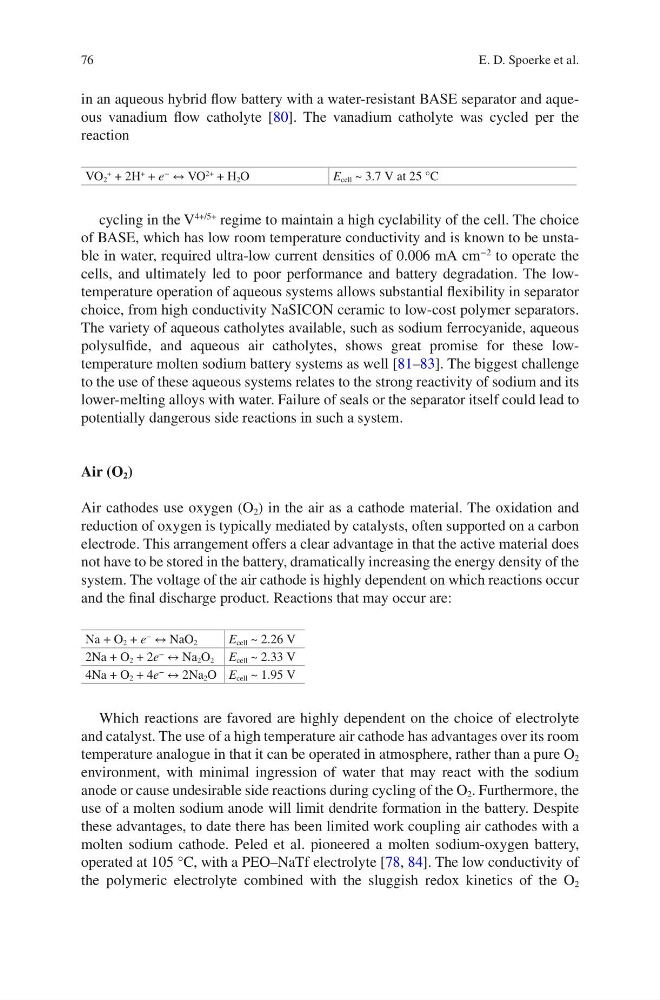
and the final discharge product. Reactions that may occur are:
Na + O 2 + e
−
↔ NaO 2
E cell ~ 2.26 V
2Na + O 2 + 2e
−
↔ Na 2 O 2 E cell ~ 2.33 V
4Na + O 2 + 4e
−
↔ 2Na 2 O E cell ~ 1.95 V
Which reactions are favored are highly dependent on the choice of electrolyte
and catalyst. The use of a high temperature air cathode has advantages over its room
temperature analogue in that it can be operated in atmosphere, rather than a pure O 2
environment, with minimal ingression of water that may react with the sodium
anode or cause undesirable side reactions during cycling of the O 2 . Furthermore, the
use of a molten sodium anode will limit dendrite formation in the battery. Despite
these advantages, to date there has been limited work coupling air cathodes with a
molten sodium cathode. Peled et al. pioneered a molten sodium-oxygen battery,
operated at 105 °C, with a PEO–NaTf electrolyte [78, 84]. The low conductivity of
the polymeric electrolyte combined with the sluggish redox kinetics of the O 2
E. D. Spoerke et al.
in an aqueous hybrid flow battery with a water-resistant BASE separator and aqueous vanadium flow catholyte [80]. The vanadium catholyte was cycled per the
reaction
VO 2
+ + 2H
+
+ e
− ↔ VO
2+ + H 2 O
E cell ~ 3.7 V at 25 °C
cycling in the V
4+/5+
regime to maintain a high cyclability of the cell. The choice
of BASE, which has low room temperature conductivity and is known to be unstable in water, required ultra-low current densities of 0.006 mA cm
−2
to operate the
cells, and ultimately led to poor performance and battery degradation. The lowtemperature operation of aqueous systems allows substantial flexibility in separator
choice, from high conductivity NaSICON ceramic to low-cost polymer separators.
The variety of aqueous catholytes available, such as sodium ferrocyanide, aqueous
polysulfide, and aqueous air catholytes, shows great promise for these lowtemperature molten sodium battery systems as well [81–83]. The biggest challenge
to the use of these aqueous systems relates to the strong reactivity of sodium and its
lower-melting alloys with water. Failure of seals or the separator itself could lead to
potentially dangerous side reactions in such a system.
Air (O 2 )
Air cathodes use oxygen (O 2 ) in the air as a cathode material. The oxidation and
reduction of oxygen is typically mediated by catalysts, often supported on a carbon
electrode. This arrangement offers a clear advantage in that the active material does
not have to be stored in the battery, dramatically increasing the energy density of the
system. The voltage of the air cathode is highly dependent on which reactions occur
and the final discharge product. Reactions that may occur are:
Na + O 2 + e
−
↔ NaO 2
E cell ~ 2.26 V
2Na + O 2 + 2e
−
↔ Na 2 O 2 E cell ~ 2.33 V
4Na + O 2 + 4e
−
↔ 2Na 2 O E cell ~ 1.95 V
Which reactions are favored are highly dependent on the choice of electrolyte
and catalyst. The use of a high temperature air cathode has advantages over its room
temperature analogue in that it can be operated in atmosphere, rather than a pure O 2
environment, with minimal ingression of water that may react with the sodium
anode or cause undesirable side reactions during cycling of the O 2 . Furthermore, the
use of a molten sodium anode will limit dendrite formation in the battery. Despite
these advantages, to date there has been limited work coupling air cathodes with a
molten sodium cathode. Peled et al. pioneered a molten sodium-oxygen battery,
operated at 105 °C, with a PEO–NaTf electrolyte [78, 84]. The low conductivity of
the polymeric electrolyte combined with the sluggish redox kinetics of the O 2
E. D. Spoerke et al.