

74
Other Metal Halides
A wide variety of other metal halides have been screened for use as battery cathodes
beyond NiCl 2 and FeCl 2 . Transition metal chlorides such as copper, manganese,
chromium, aluminum, silver, and titanium proved to be soluble in the electrolyte
and therefore not promising for use in a metal halide battery. Molybdenum, cobalt
and zinc chlorides, as well as tin(IV) iodide demonstrated insolubility in the molten
electrolyte and are therefore considered to be more promising as cathode materials,
though further research is needed to demonstrate the electrochemical effects of
cycling the materials in a battery [72–75]. To further enhance the capabilities of the
screening process, Zhu et al. developed mathematical formulae to simulate and analyze various molten sodium battery chemistries. In their work they simulated the
performance of copper iodide with an iodide salt as the catholyte and high ionic
conductivity NaSICON as the solid electrolyte in a low-temperature molten sodium
battery [76]. The application of these computer models will help to rapidly identify
such promising materials.
Fully Molten Salts
Inorganic molten salts have recently been explored as a redox-active catholyte for
molten sodium batteries. In these systems, the redox-active species is fully dissolved in the molten salt electrolyte to form a redox-active catholyte: an inorganic
analogue to the redox-active catholytes in flow batteries. The molten salt catholyte
is separated from the sodium anode by a ceramic separator. The use of a catholyte,
similar to the molten polysulfides in Na–S batteries, has the advantage of improving
redox kinetics over a solid cathode to lower the overall resistance of the battery. An
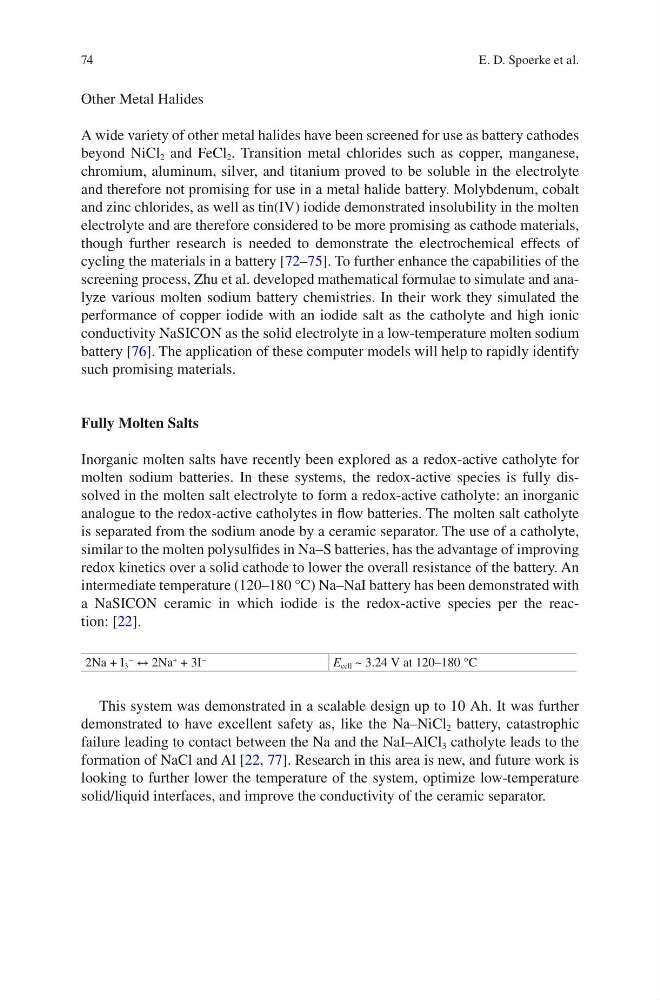
intermediate temperature (120–180 °C) Na–NaI battery has been demonstrated with
a NaSICON ceramic in which iodide is the redox-active species per the reaction: [22].
2Na + I 3
−
↔ 2Na
+ + 3I
−
E cell ~ 3.24 V at 120–180 °C
This system was demonstrated in a scalable design up to 10 Ah. It was further
demonstrated to have excellent safety as, like the Na–NiCl 2 battery, catastrophic
failure leading to contact between the Na and the NaI–AlCl 3 catholyte leads to the
formation of NaCl and Al [22, 77]. Research in this area is new, and future work is
looking to further lower the temperature of the system, optimize low-temperature
solid/liquid interfaces, and improve the conductivity of the ceramic separator.
E. D. Spoerke et al.
Other Metal Halides
A wide variety of other metal halides have been screened for use as battery cathodes
beyond NiCl 2 and FeCl 2 . Transition metal chlorides such as copper, manganese,
chromium, aluminum, silver, and titanium proved to be soluble in the electrolyte
and therefore not promising for use in a metal halide battery. Molybdenum, cobalt
and zinc chlorides, as well as tin(IV) iodide demonstrated insolubility in the molten
electrolyte and are therefore considered to be more promising as cathode materials,
though further research is needed to demonstrate the electrochemical effects of
cycling the materials in a battery [72–75]. To further enhance the capabilities of the
screening process, Zhu et al. developed mathematical formulae to simulate and analyze various molten sodium battery chemistries. In their work they simulated the
performance of copper iodide with an iodide salt as the catholyte and high ionic
conductivity NaSICON as the solid electrolyte in a low-temperature molten sodium
battery [76]. The application of these computer models will help to rapidly identify
such promising materials.
Fully Molten Salts
Inorganic molten salts have recently been explored as a redox-active catholyte for
molten sodium batteries. In these systems, the redox-active species is fully dissolved in the molten salt electrolyte to form a redox-active catholyte: an inorganic
analogue to the redox-active catholytes in flow batteries. The molten salt catholyte
is separated from the sodium anode by a ceramic separator. The use of a catholyte,
similar to the molten polysulfides in Na–S batteries, has the advantage of improving
redox kinetics over a solid cathode to lower the overall resistance of the battery. An
intermediate temperature (120–180 °C) Na–NaI battery has been demonstrated with
a NaSICON ceramic in which iodide is the redox-active species per the reaction: [22].
2Na + I 3
−
↔ 2Na
+ + 3I
−
E cell ~ 3.24 V at 120–180 °C
This system was demonstrated in a scalable design up to 10 Ah. It was further
demonstrated to have excellent safety as, like the Na–NiCl 2 battery, catastrophic
failure leading to contact between the Na and the NaI–AlCl 3 catholyte leads to the
formation of NaCl and Al [22, 77]. Research in this area is new, and future work is
looking to further lower the temperature of the system, optimize low-temperature
solid/liquid interfaces, and improve the conductivity of the ceramic separator.
E. D. Spoerke et al.