

65
BASE
Original molten sodium batteries utilized a β”-alumina solid electrolyte (BASE)
separator, and many sodium batteries still utilize this material today. BASE has been
discussed extensively in the literature if details beyond the scope of this discussion
are of interest to the reader [12, 17–20]. BASE may be thought of as Na 2 O-doped
Al 2 O 3 in a rhombohedral (R3m) crystal structure, composed of alternating layers of
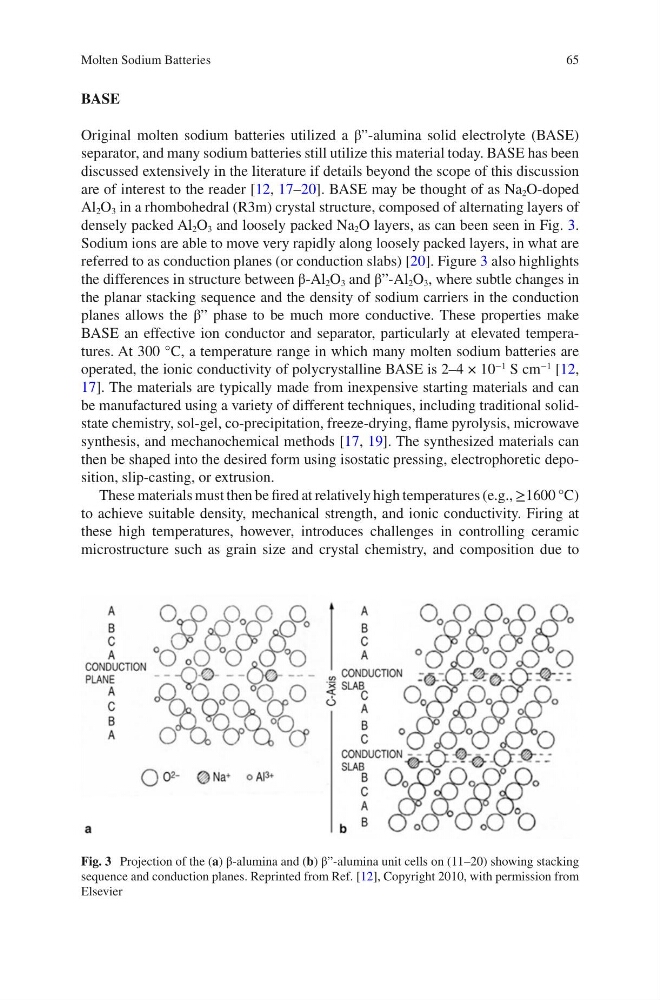
densely packed Al 2 O 3 and loosely packed Na 2 O layers, as can been seen in Fig. 3.
Sodium ions are able to move very rapidly along loosely packed layers, in what are
referred to as conduction planes (or conduction slabs) [20]. Figure 3 also highlights
the differences in structure between β-Al 2 O 3 and β”-Al 2 O 3 , where subtle changes in
the planar stacking sequence and the density of sodium carriers in the conduction
planes allows the β” phase to be much more conductive. These properties make
BASE an effective ion conductor and separator, particularly at elevated temperatures. At 300 °C, a temperature range in which many molten sodium batteries are
operated, the ionic conductivity of polycrystalline BASE is 2–4 × 10
−1
S cm
−1
[12,
17]. The materials are typically made from inexpensive starting materials and can
be manufactured using a variety of different techniques, including traditional solidstate chemistry, sol-gel, co-precipitation, freeze-drying, flame pyrolysis, microwave
synthesis, and mechanochemical methods [17, 19]. The synthesized materials can
then be shaped into the desired form using isostatic pressing, electrophoretic deposition, slip-casting, or extrusion.
These materials must then be fired at relatively high temperatures (e.g., ≥1600 °C)
to achieve suitable density, mechanical strength, and ionic conductivity. Firing at
these high temperatures, however, introduces challenges in controlling ceramic
microstructure such as grain size and crystal chemistry, and composition due to
Fig. 3 Projection of the (a) β-alumina and (b) β”-alumina unit cells on (11–20) showing stacking
sequence and conduction planes. Reprinted from Ref. [12], Copyright 2010, with permission from
Elsevier
Molten Sodium Batteries
BASE
Original molten sodium batteries utilized a β”-alumina solid electrolyte (BASE)
separator, and many sodium batteries still utilize this material today. BASE has been
discussed extensively in the literature if details beyond the scope of this discussion
are of interest to the reader [12, 17–20]. BASE may be thought of as Na 2 O-doped
Al 2 O 3 in a rhombohedral (R3m) crystal structure, composed of alternating layers of
densely packed Al 2 O 3 and loosely packed Na 2 O layers, as can been seen in Fig. 3.
Sodium ions are able to move very rapidly along loosely packed layers, in what are
referred to as conduction planes (or conduction slabs) [20]. Figure 3 also highlights
the differences in structure between β-Al 2 O 3 and β”-Al 2 O 3 , where subtle changes in
the planar stacking sequence and the density of sodium carriers in the conduction
planes allows the β” phase to be much more conductive. These properties make
BASE an effective ion conductor and separator, particularly at elevated temperatures. At 300 °C, a temperature range in which many molten sodium batteries are
operated, the ionic conductivity of polycrystalline BASE is 2–4 × 10
−1
S cm
−1
[12,
17]. The materials are typically made from inexpensive starting materials and can
be manufactured using a variety of different techniques, including traditional solidstate chemistry, sol-gel, co-precipitation, freeze-drying, flame pyrolysis, microwave
synthesis, and mechanochemical methods [17, 19]. The synthesized materials can
then be shaped into the desired form using isostatic pressing, electrophoretic deposition, slip-casting, or extrusion.
These materials must then be fired at relatively high temperatures (e.g., ≥1600 °C)
to achieve suitable density, mechanical strength, and ionic conductivity. Firing at
these high temperatures, however, introduces challenges in controlling ceramic
microstructure such as grain size and crystal chemistry, and composition due to
Fig. 3 Projection of the (a) β-alumina and (b) β”-alumina unit cells on (11–20) showing stacking
sequence and conduction planes. Reprinted from Ref. [12], Copyright 2010, with permission from
Elsevier
Molten Sodium Batteries