

63
or storage community. Still, the combination of long cycle life, low-cost materials,
and significant energy density, means that these molten Na batteries have significant
potential for select grid-scale energy storage applications. Battery manufacturers,
such as NGK and FZSoNick (FIAMM), have deployed some NaS and NaNiCl 2
grid-scale batteries around the world for renewables integration, load shifting, frequency regulation, backup power, and other grid-scale applications [3, 5, 6].
Continued expansion of these technologies will be facilitated by significant reductions in capital costs, reductions likely made possible through innovations in materials and cell designs.
2 Battery Components
2.1 Sodium Anode
With a redox potential of E Na Na
+ /
= −2.71 V versus a standard hydrogen electrode,
a metallic sodium anode can be coupled with a number of cathode chemistries to
achieve useful energy densities, and the global abundance and availability of
sodium, relative to lithium, for example, makes it an economically and geopolitically desirable choice [7]. As a metal, it is inherently electrically conductive, making it relatively easy to inject or extract electrons from the anode during
electrochemical cycling. Finally, in the molten state, the sodium will naturally flow
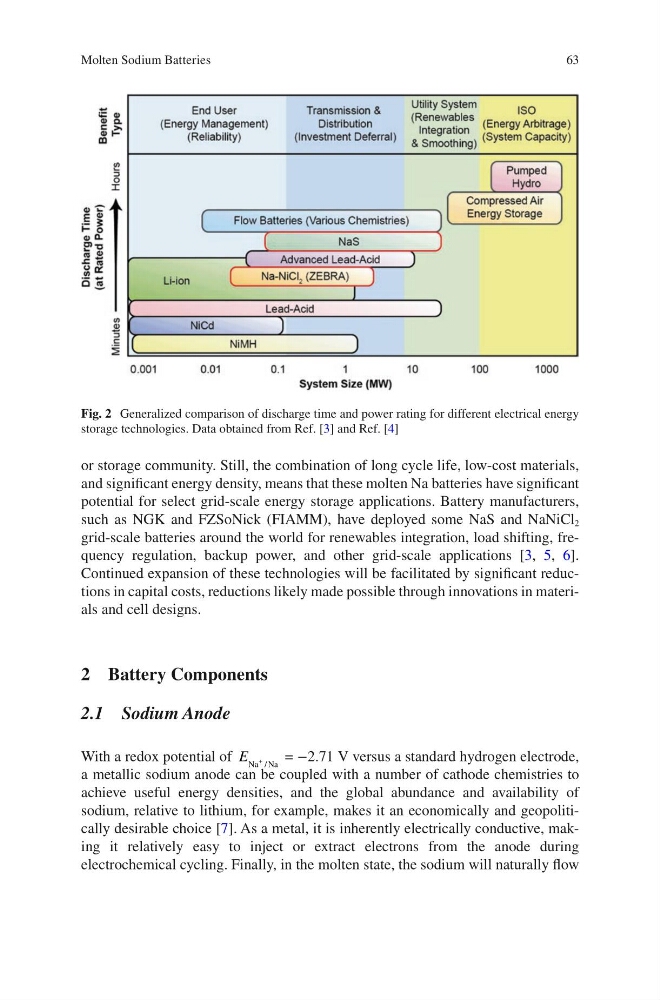
Fig. 2 Generalized comparison of discharge time and power rating for different electrical energy
storage technologies. Data obtained from Ref. [3] and Ref. [4]
Molten Sodium Batteries
or storage community. Still, the combination of long cycle life, low-cost materials,
and significant energy density, means that these molten Na batteries have significant
potential for select grid-scale energy storage applications. Battery manufacturers,
such as NGK and FZSoNick (FIAMM), have deployed some NaS and NaNiCl 2
grid-scale batteries around the world for renewables integration, load shifting, frequency regulation, backup power, and other grid-scale applications [3, 5, 6].
Continued expansion of these technologies will be facilitated by significant reductions in capital costs, reductions likely made possible through innovations in materials and cell designs.
2 Battery Components
2.1 Sodium Anode
With a redox potential of E Na Na
+ /
= −2.71 V versus a standard hydrogen electrode,
a metallic sodium anode can be coupled with a number of cathode chemistries to
achieve useful energy densities, and the global abundance and availability of
sodium, relative to lithium, for example, makes it an economically and geopolitically desirable choice [7]. As a metal, it is inherently electrically conductive, making it relatively easy to inject or extract electrons from the anode during
electrochemical cycling. Finally, in the molten state, the sodium will naturally flow
Fig. 2 Generalized comparison of discharge time and power rating for different electrical energy
storage technologies. Data obtained from Ref. [3] and Ref. [4]
Molten Sodium Batteries