

61
All of the issues above are ultimately tied to both battery performance and the
critically important cost of a battery, weighed against the market demand for the
battery. An extremely high performing sodium battery composed of overly costly
materials or that is too expensive for utility companies or industrial interests to
deploy is likely to have limited impact on the need for energy storage. In contrast,
an inexpensive battery that has a short lifetime, poor performance, or is unsafe, is
ultimately not cost-effective either. In the discussions below, it is clear that researchers are looking not only for materials and chemistries that make energy storage
possible, but there is clear consideration of how the materials chemistry in each
system make these batteries practical. One of the most important factors limiting the
widespread practical application of molten sodium batteries is the reality that these
batteries are typically utilized at elevated temperatures, near 300 °C. The high operating temperature keeps the battery above the melting temperature of the necessary
molten components in the system, but it also facilitates rapid ion transport and reaction kinetics that are important to delivering reasonable power from the storage
device. This high temperature, though, can lead to accelerated aging or degradation
of material components, leads to potentially detrimental (or dangerous) side reactions, requires more advanced (often expensive) thermal management strategies,
limits the application space of the system, and overall drastically increases the cost
of the battery, even when the basic cell components might be inexpensive. One of
the primary challenges to modern battery researchers is to lower the operating temperature of the battery without sacrificing the performance traditionally seen at
elevated temperatures. Ultimately, the goal remains to develop a cost-effective molten sodium battery system suitable for widespread grid-scale application.
1.3 Battery Basics
To understand sodium batteries it is important to first understand how a battery is
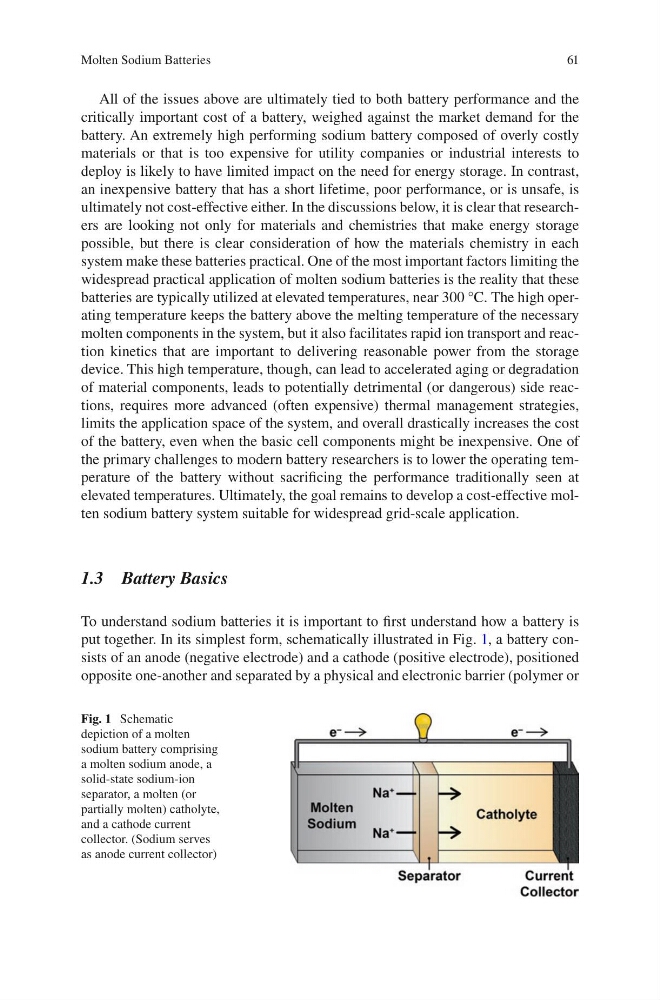
put together. In its simplest form, schematically illustrated in Fig. 1, a battery consists of an anode (negative electrode) and a cathode (positive electrode), positioned
opposite one-another and separated by a physical and electronic barrier (polymer or
Fig. 1 Schematic
depiction of a molten
sodium battery comprising
a molten sodium anode, a
solid-state sodium-ion
separator, a molten (or
partially molten) catholyte,
and a cathode current
collector. (Sodium serves
as anode current collector)
Molten Sodium Batteries
All of the issues above are ultimately tied to both battery performance and the
critically important cost of a battery, weighed against the market demand for the
battery. An extremely high performing sodium battery composed of overly costly
materials or that is too expensive for utility companies or industrial interests to
deploy is likely to have limited impact on the need for energy storage. In contrast,
an inexpensive battery that has a short lifetime, poor performance, or is unsafe, is
ultimately not cost-effective either. In the discussions below, it is clear that researchers are looking not only for materials and chemistries that make energy storage
possible, but there is clear consideration of how the materials chemistry in each
system make these batteries practical. One of the most important factors limiting the
widespread practical application of molten sodium batteries is the reality that these
batteries are typically utilized at elevated temperatures, near 300 °C. The high operating temperature keeps the battery above the melting temperature of the necessary
molten components in the system, but it also facilitates rapid ion transport and reaction kinetics that are important to delivering reasonable power from the storage
device. This high temperature, though, can lead to accelerated aging or degradation
of material components, leads to potentially detrimental (or dangerous) side reactions, requires more advanced (often expensive) thermal management strategies,
limits the application space of the system, and overall drastically increases the cost
of the battery, even when the basic cell components might be inexpensive. One of
the primary challenges to modern battery researchers is to lower the operating temperature of the battery without sacrificing the performance traditionally seen at
elevated temperatures. Ultimately, the goal remains to develop a cost-effective molten sodium battery system suitable for widespread grid-scale application.
1.3 Battery Basics
To understand sodium batteries it is important to first understand how a battery is
put together. In its simplest form, schematically illustrated in Fig. 1, a battery consists of an anode (negative electrode) and a cathode (positive electrode), positioned
opposite one-another and separated by a physical and electronic barrier (polymer or
Fig. 1 Schematic
depiction of a molten
sodium battery comprising
a molten sodium anode, a
solid-state sodium-ion
separator, a molten (or
partially molten) catholyte,
and a cathode current
collector. (Sodium serves
as anode current collector)
Molten Sodium Batteries