

48
confirmed the initial co-insertion/de-insertion of Zn-ion and triflate anions during
discharge/charge reaction. A discharge capacity of 120 mAh g
−1
was achieved by
the former Zn//IL-GPE//MnO 2 battery at 6.25 mA g
−1
. These studies are still at the
infant stages and it is obvious that further research is currently underway to fully
exploit the usefulness this system [105, 106].
5 Summary and Outlook
Rechargeable ZIBs utilizing both aqueous and non-aqueous electrolytes have
advanced quite significantly ever since its renewed interest from 2012. In specific,
the aqueous ZIBs are highly attractive due to the benefits of their high safety, lowcost, and less toxic features. As presented above, the identification of highperformance electrodes, especially cathode materials, have been crucial for battery
performance enhancements to meet practical stationary storage applications. Since
the major find for the aqueous cathodes have been focused on manganese and
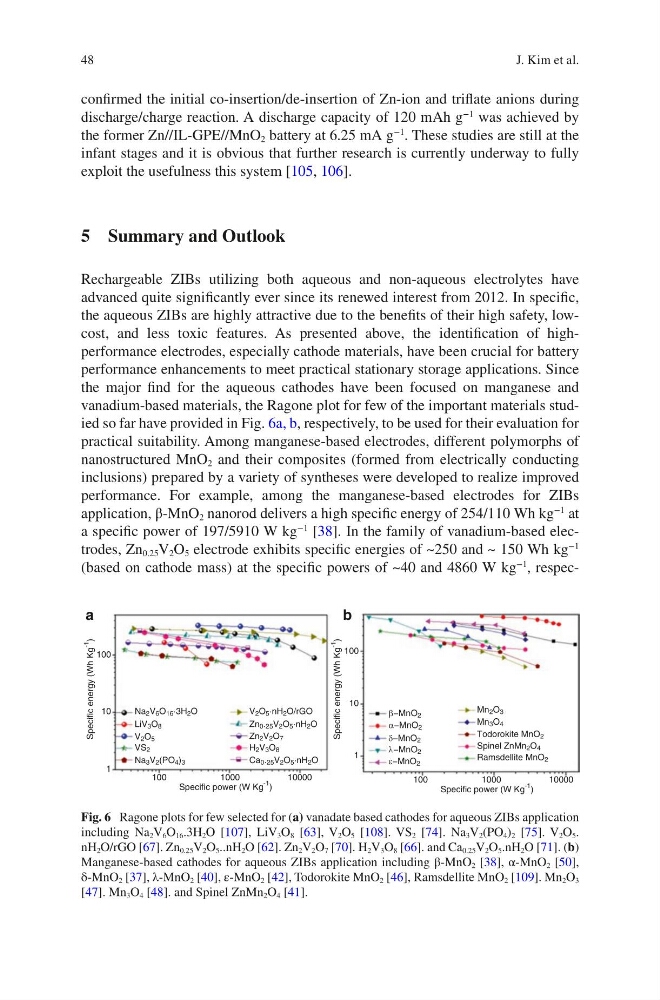
vanadium- based materials, the Ragone plot for few of the important materials studied so far have provided in Fig. 6a, b, respectively, to be used for their evaluation for
practical suitability. Among manganese-based electrodes, different polymorphs of
nanostructured MnO 2 and their composites (formed from electrically conducting
inclusions) prepared by a variety of syntheses were developed to realize improved
performance. For example, among the manganese-based electrodes for ZIBs
application, β-MnO 2 nanorod delivers a high specific energy of 254/110 Wh kg
−1
at
a specific power of 197/5910 W kg
−1
[38]. In the family of vanadium-based electrodes, Zn 0.25 V 2 O 5 electrode exhibits specific energies of ~250 and ~ 150 Wh kg
−1
(based on cathode mass) at the specific powers of ~40 and 4860 W kg
−1
, respec100
a
b
1
10
100
1000
Na2V6O16·3H2O
V 2O5·nH2O/rGO
Zn0.25V2O5·nH2O
Ca0.25V2O5·nH2O
Zn2V2O7
H2V3O8
Na3V2(PO4)3
LiV3O8
β−MnO2
Mn2O3
Mn3O4
Todorokite MnO2
Spinel ZnMn2O4
Ramsdellite MnO2
α−MnO2
δ−MnO2
λ−MnO2
ε−MnO2
V2O5
VS2
Specific power (W Kg
-1
)
Specific energy (Wh Kg
-1
)
1
10
100
Specific energy (Wh Kg
-1
)
10000
100
1 000
Specific power (W Kg
-1
)
10000
Fig. 6 Ragone plots for few selected for (a) vanadate based cathodes for aqueous ZIBs application
including Na 2 V 6 O 16 .3H 2 O [107], LiV 3 O 8 [63], V 2 O 5 [108]. VS 2 [74]. Na 3 V 2 (PO 4 ) 2 [75]. V 2 O 5 .
nH 2 O/rGO [67]. Zn 0.25 V 2 O 5 ..nH 2 O [62]. Zn 2 V 2 O 7 [70]. H 2 V 3 O 8 [66]. and Ca 0.25 V 2 O 5 .nH 2 O [71]. (b)
Manganese-based cathodes for aqueous ZIBs application including β-MnO 2 [38], α-MnO 2 [50],
δ-MnO 2 [37], λ-MnO 2 [40], ε-MnO 2 [42], Todorokite MnO 2 [46], Ramsdellite MnO 2 [109]. Mn 2 O 3
[47]. Mn 3 O 4 [48]. and Spinel ZnMn 2 O 4 [41].
J. Kim et al.
confirmed the initial co-insertion/de-insertion of Zn-ion and triflate anions during
discharge/charge reaction. A discharge capacity of 120 mAh g
−1
was achieved by
the former Zn//IL-GPE//MnO 2 battery at 6.25 mA g
−1
. These studies are still at the
infant stages and it is obvious that further research is currently underway to fully
exploit the usefulness this system [105, 106].
5 Summary and Outlook
Rechargeable ZIBs utilizing both aqueous and non-aqueous electrolytes have
advanced quite significantly ever since its renewed interest from 2012. In specific,
the aqueous ZIBs are highly attractive due to the benefits of their high safety, lowcost, and less toxic features. As presented above, the identification of highperformance electrodes, especially cathode materials, have been crucial for battery
performance enhancements to meet practical stationary storage applications. Since
the major find for the aqueous cathodes have been focused on manganese and
vanadium- based materials, the Ragone plot for few of the important materials studied so far have provided in Fig. 6a, b, respectively, to be used for their evaluation for
practical suitability. Among manganese-based electrodes, different polymorphs of
nanostructured MnO 2 and their composites (formed from electrically conducting
inclusions) prepared by a variety of syntheses were developed to realize improved
performance. For example, among the manganese-based electrodes for ZIBs
application, β-MnO 2 nanorod delivers a high specific energy of 254/110 Wh kg
−1
at
a specific power of 197/5910 W kg
−1
[38]. In the family of vanadium-based electrodes, Zn 0.25 V 2 O 5 electrode exhibits specific energies of ~250 and ~ 150 Wh kg
−1
(based on cathode mass) at the specific powers of ~40 and 4860 W kg
−1
, respec100
a
b
1
10
100
1000
Na2V6O16·3H2O
V 2O5·nH2O/rGO
Zn0.25V2O5·nH2O
Ca0.25V2O5·nH2O
Zn2V2O7
H2V3O8
Na3V2(PO4)3
LiV3O8
β−MnO2
Mn2O3
Mn3O4
Todorokite MnO2
Spinel ZnMn2O4
Ramsdellite MnO2
α−MnO2
δ−MnO2
λ−MnO2
ε−MnO2
V2O5
VS2
Specific power (W Kg
-1
)
Specific energy (Wh Kg
-1
)
1
10
100
Specific energy (Wh Kg
-1
)
10000
100
1 000
Specific power (W Kg
-1
)
10000
Fig. 6 Ragone plots for few selected for (a) vanadate based cathodes for aqueous ZIBs application
including Na 2 V 6 O 16 .3H 2 O [107], LiV 3 O 8 [63], V 2 O 5 [108]. VS 2 [74]. Na 3 V 2 (PO 4 ) 2 [75]. V 2 O 5 .
nH 2 O/rGO [67]. Zn 0.25 V 2 O 5 ..nH 2 O [62]. Zn 2 V 2 O 7 [70]. H 2 V 3 O 8 [66]. and Ca 0.25 V 2 O 5 .nH 2 O [71]. (b)
Manganese-based cathodes for aqueous ZIBs application including β-MnO 2 [38], α-MnO 2 [50],
δ-MnO 2 [37], λ-MnO 2 [40], ε-MnO 2 [42], Todorokite MnO 2 [46], Ramsdellite MnO 2 [109]. Mn 2 O 3
[47]. Mn 3 O 4 [48]. and Spinel ZnMn 2 O 4 [41].
J. Kim et al.