

156
For sensible heat storage, thermal energy can be stored or released in gas, liquid
or solid depending on the requirement of different applications. Common sensible
heat storage media include steam, water, oils, soil, sand beds, rocks, liquid sodium,
molten salts, etc. [5]. The ability to store or release thermal energy for a given mass
of material depends on the difference between the initial and final storage
temperature, mass of the storage medium and the specific heat capacity. In this
sense, the amount of energy stored/released (Q) by a sensible heat storage medium
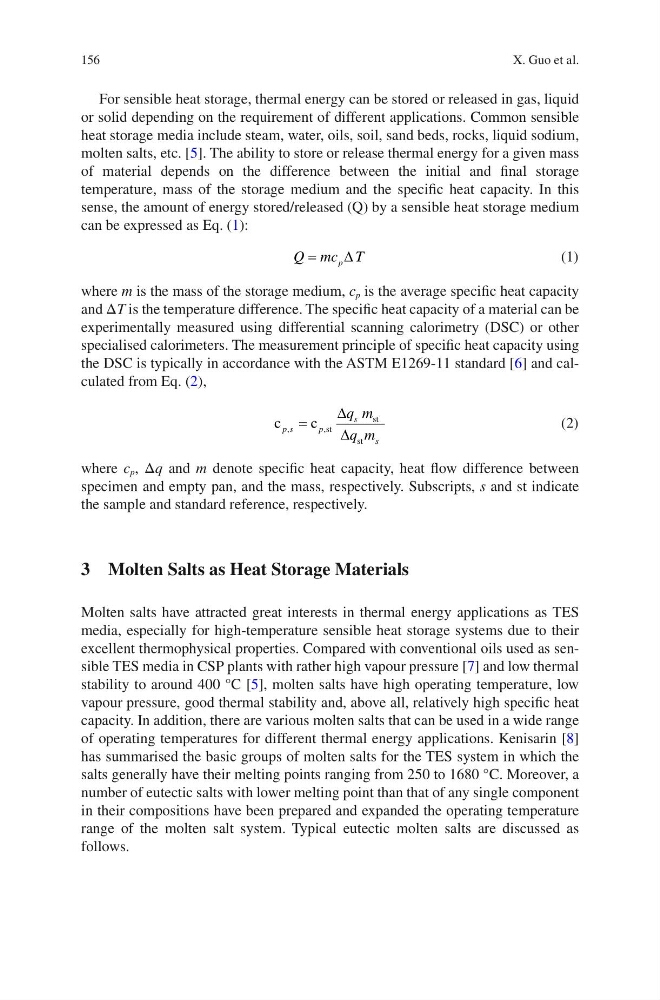
can be expressed as Eq. (1):
Q mc T
p
=
∆
(1)
where m is the mass of the storage medium, c p is the average specific heat capacity
and ΔT is the temperature difference. The specific heat capacity of a material can be
experimentally measured using differential scanning calorimetry (DSC) or other
specialised calorimeters. The measurement principle of specific heat capacity using
the DSC is typically in accordance with the ASTM E1269-11 standard [6] and calculated from Eq. (2),
c
c st
st
st
p s
p
s
s
q m
q m
,
,
=
∆
∆
(2)
where c p , Δq and m denote specific heat capacity, heat flow difference between
specimen and empty pan, and the mass, respectively. Subscripts, s and st indicate
the sample and standard reference, respectively.
3 Molten Salts as Heat Storage Materials
Molten salts have attracted great interests in thermal energy applications as TES
media, especially for high-temperature sensible heat storage systems due to their
excellent thermophysical properties. Compared with conventional oils used as sensible TES media in CSP plants with rather high vapour pressure [7] and low thermal
stability to around 400 °C [5], molten salts have high operating temperature, low
vapour pressure, good thermal stability and, above all, relatively high specific heat
capacity. In addition, there are various molten salts that can be used in a wide range
of operating temperatures for different thermal energy applications. Kenisarin [8]
has summarised the basic groups of molten salts for the TES system in which the
salts generally have their melting points ranging from 250 to 1680 °C. Moreover, a
number of eutectic salts with lower melting point than that of any single component
in their compositions have been prepared and expanded the operating temperature
range of the molten salt system. Typical eutectic molten salts are discussed as
follows.
X. Guo et al.
For sensible heat storage, thermal energy can be stored or released in gas, liquid
or solid depending on the requirement of different applications. Common sensible
heat storage media include steam, water, oils, soil, sand beds, rocks, liquid sodium,
molten salts, etc. [5]. The ability to store or release thermal energy for a given mass
of material depends on the difference between the initial and final storage
temperature, mass of the storage medium and the specific heat capacity. In this
sense, the amount of energy stored/released (Q) by a sensible heat storage medium
can be expressed as Eq. (1):
Q mc T
p
=
∆
(1)
where m is the mass of the storage medium, c p is the average specific heat capacity
and ΔT is the temperature difference. The specific heat capacity of a material can be
experimentally measured using differential scanning calorimetry (DSC) or other
specialised calorimeters. The measurement principle of specific heat capacity using
the DSC is typically in accordance with the ASTM E1269-11 standard [6] and calculated from Eq. (2),
c
c st
st
st
p s
p
s
s
q m
q m
,
,
=
∆
∆
(2)
where c p , Δq and m denote specific heat capacity, heat flow difference between
specimen and empty pan, and the mass, respectively. Subscripts, s and st indicate
the sample and standard reference, respectively.
3 Molten Salts as Heat Storage Materials
Molten salts have attracted great interests in thermal energy applications as TES
media, especially for high-temperature sensible heat storage systems due to their
excellent thermophysical properties. Compared with conventional oils used as sensible TES media in CSP plants with rather high vapour pressure [7] and low thermal
stability to around 400 °C [5], molten salts have high operating temperature, low
vapour pressure, good thermal stability and, above all, relatively high specific heat
capacity. In addition, there are various molten salts that can be used in a wide range
of operating temperatures for different thermal energy applications. Kenisarin [8]
has summarised the basic groups of molten salts for the TES system in which the
salts generally have their melting points ranging from 250 to 1680 °C. Moreover, a
number of eutectic salts with lower melting point than that of any single component
in their compositions have been prepared and expanded the operating temperature
range of the molten salt system. Typical eutectic molten salts are discussed as
follows.
X. Guo et al.