

120
when the electron is transferred, a hole is left behind in the dye. There is a limitation
to the stability and lifetime of these DSSCs, however, as the iodine couple is corrosive to the electrodes and has a low breakdown voltage of 0.9 V. Additionally,
iodine absorbs light in the visible region, preventing this light from reaching the dye
and reducing efficiency. It is essential that the dye is absorbing and can effectively
transport electrons to the wide band-gap semiconductor, typically TiO 2 . It is also
important for recombination of holes and electrons at the anode to be prevented, and
the electrolyte also plays a role here. Much of the work on DSSCs has been focused
on improvements to the dye sensitizer. However, stability and longevity of these
devices hinge on the redox electrolyte’s properties. Such electrolytes are going
through the same evolution process as other devices before: first liquids, then ionic
liquids, and now the search for solid electrolytes.
Recently, a new sub-generation of quasi- solid-state DSSCs utilizing the Co(II)/
Co(III) redox couple have renewed interest in this area as they open up the voltageoperation window and improve the lifetime of the electrodes [124, 127]. This newer
redox couple, when coupled with ionic liquids, has helped in improving the performance of DSSCs, but ionic liquids still remain susceptible to leaks, especially when
exposed to high temperatures under direct sunlight. Solid-state electrolytes, especially polymeric hole transporters, have been employed, but face issues with crystallization. Again, polymer nanocomposites and MOFs show improvement in the
Platinum Layer
Liquid electrolyte or
organic hole transporter
Dye Molecule
Mesoporous TiO 2
FTO glass
Light
e -
e -
FTO glass
3I −
I 3
−
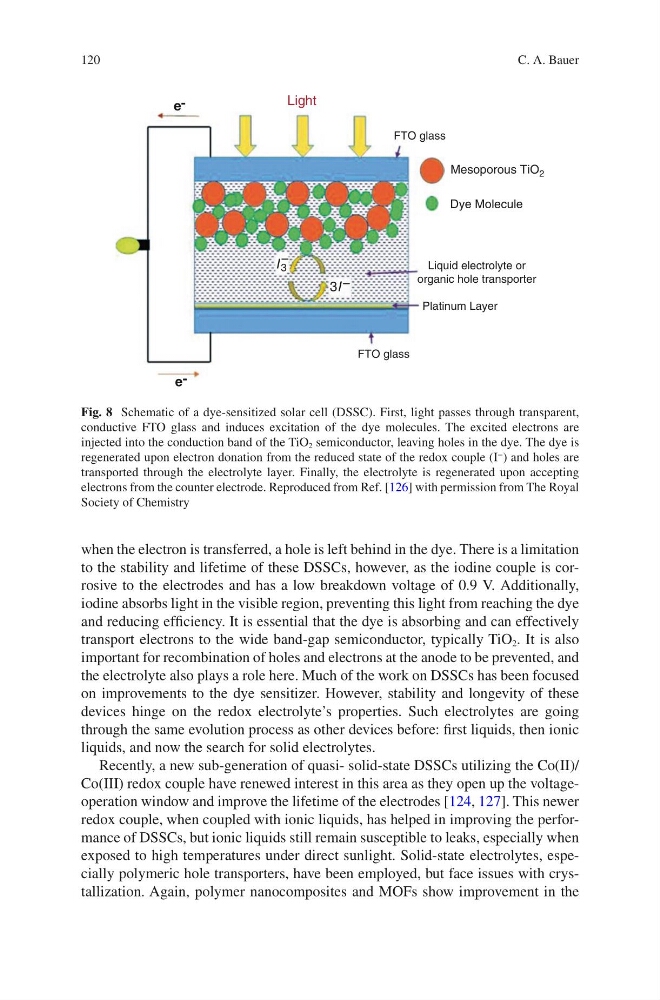
Fig. 8 Schematic of a dye-sensitized solar cell (DSSC). First, light passes through transparent,
conductive FTO glass and induces excitation of the dye molecules. The excited electrons are
injected into the conduction band of the TiO 2 semiconductor, leaving holes in the dye. The dye is
regenerated upon electron donation from the reduced state of the redox couple (I
−
) and holes are
transported through the electrolyte layer. Finally, the electrolyte is regenerated upon accepting
electrons from the counter electrode. Reproduced from Ref. [126] with permission from The Royal
Society of Chemistry
C. A. Bauer
when the electron is transferred, a hole is left behind in the dye. There is a limitation
to the stability and lifetime of these DSSCs, however, as the iodine couple is corrosive to the electrodes and has a low breakdown voltage of 0.9 V. Additionally,
iodine absorbs light in the visible region, preventing this light from reaching the dye
and reducing efficiency. It is essential that the dye is absorbing and can effectively
transport electrons to the wide band-gap semiconductor, typically TiO 2 . It is also
important for recombination of holes and electrons at the anode to be prevented, and
the electrolyte also plays a role here. Much of the work on DSSCs has been focused
on improvements to the dye sensitizer. However, stability and longevity of these
devices hinge on the redox electrolyte’s properties. Such electrolytes are going
through the same evolution process as other devices before: first liquids, then ionic
liquids, and now the search for solid electrolytes.
Recently, a new sub-generation of quasi- solid-state DSSCs utilizing the Co(II)/
Co(III) redox couple have renewed interest in this area as they open up the voltageoperation window and improve the lifetime of the electrodes [124, 127]. This newer
redox couple, when coupled with ionic liquids, has helped in improving the performance of DSSCs, but ionic liquids still remain susceptible to leaks, especially when
exposed to high temperatures under direct sunlight. Solid-state electrolytes, especially polymeric hole transporters, have been employed, but face issues with crystallization. Again, polymer nanocomposites and MOFs show improvement in the
Platinum Layer
Liquid electrolyte or
organic hole transporter
Dye Molecule
Mesoporous TiO 2
FTO glass
Light
e -
e -
FTO glass
3I −
I 3
−
Fig. 8 Schematic of a dye-sensitized solar cell (DSSC). First, light passes through transparent,
conductive FTO glass and induces excitation of the dye molecules. The excited electrons are
injected into the conduction band of the TiO 2 semiconductor, leaving holes in the dye. The dye is
regenerated upon electron donation from the reduced state of the redox couple (I
−
) and holes are
transported through the electrolyte layer. Finally, the electrolyte is regenerated upon accepting
electrons from the counter electrode. Reproduced from Ref. [126] with permission from The Royal
Society of Chemistry
C. A. Bauer