

118
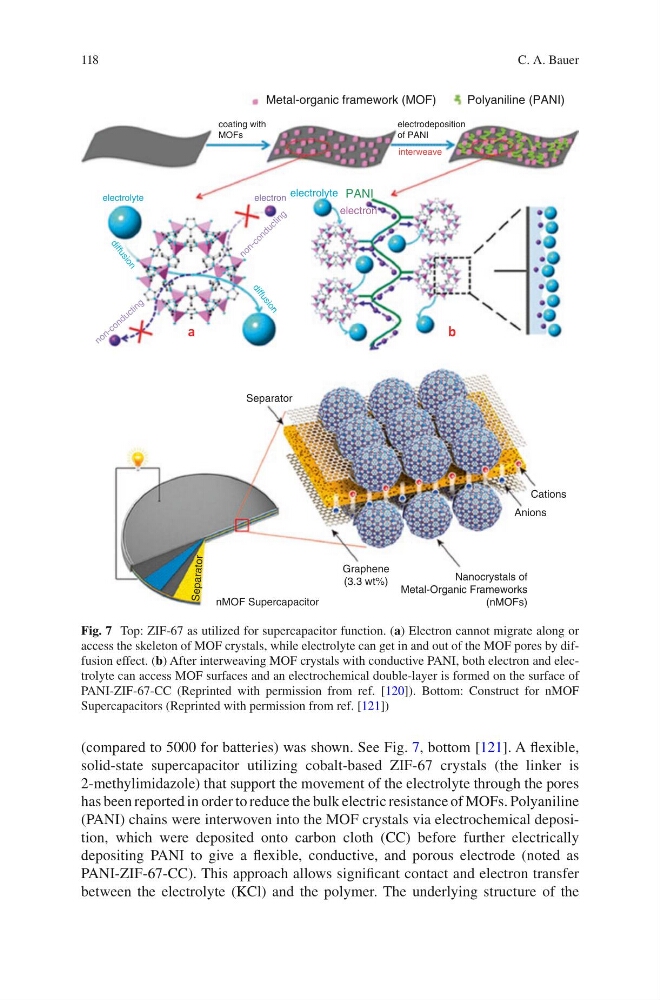
(compared to 5000 for batteries) was shown. See Fig. 7, bottom [121]. A flexible,
solid-state supercapacitor utilizing cobalt-based ZIF-67 crystals (the linker is
2- methylimidazole) that support the movement of the electrolyte through the pores
has been reported in order to reduce the bulk electric resistance of MOFs. Polyaniline
(PANI) chains were interwoven into the MOF crystals via electrochemical deposition, which were deposited onto carbon cloth (CC) before further electrically
depositing PANI to give a flexible, conductive, and porous electrode (noted as
PANI-ZIF-67-CC). This approach allows significant contact and electron transfer
between the electrolyte (KCl) and the polymer. The underlying structure of the
Metal-organic framework (MOF)
coating with
MOFs
electrodeposition
of PANI
Separator
nMOF Supercapacitor
Sepa rator
Graphene
(3.3 wt%)
Nanocrystals of
Metal-Organic Frameworks
(nMOFs)
Anions
Cations
interweave
PANI
electrolyte
electrolyte
a
b
d
if
f
u
s
io
n
d
if
f
u
s
io
n
electron
electron
n o n - c o n d u c t in
g
n o n - c o n d u c t in
g
Polyaniline (PANI)
Fig. 7 Top: ZIF-67 as utilized for supercapacitor function. (a) Electron cannot migrate along or
access the skeleton of MOF crystals, while electrolyte can get in and out of the MOF pores by diffusion effect. (b) After interweaving MOF crystals with conductive PANI, both electron and electrolyte can access MOF surfaces and an electrochemical double-layer is formed on the surface of
PANI-ZIF-67-CC (Reprinted with permission from ref. [120]). Bottom: Construct for nMOF
Supercapacitors (Reprinted with permission from ref. [121])
C. A. Bauer
(compared to 5000 for batteries) was shown. See Fig. 7, bottom [121]. A flexible,
solid-state supercapacitor utilizing cobalt-based ZIF-67 crystals (the linker is
2- methylimidazole) that support the movement of the electrolyte through the pores
has been reported in order to reduce the bulk electric resistance of MOFs. Polyaniline
(PANI) chains were interwoven into the MOF crystals via electrochemical deposition, which were deposited onto carbon cloth (CC) before further electrically
depositing PANI to give a flexible, conductive, and porous electrode (noted as
PANI-ZIF-67-CC). This approach allows significant contact and electron transfer
between the electrolyte (KCl) and the polymer. The underlying structure of the
Metal-organic framework (MOF)
coating with
MOFs
electrodeposition
of PANI
Separator
nMOF Supercapacitor
Sepa rator
Graphene
(3.3 wt%)
Nanocrystals of
Metal-Organic Frameworks
(nMOFs)
Anions
Cations
interweave
PANI
electrolyte
electrolyte
a
b
d
if
f
u
s
io
n
d
if
f
u
s
io
n
electron
electron
n o n - c o n d u c t in
g
n o n - c o n d u c t in
g
Polyaniline (PANI)
Fig. 7 Top: ZIF-67 as utilized for supercapacitor function. (a) Electron cannot migrate along or
access the skeleton of MOF crystals, while electrolyte can get in and out of the MOF pores by diffusion effect. (b) After interweaving MOF crystals with conductive PANI, both electron and electrolyte can access MOF surfaces and an electrochemical double-layer is formed on the surface of
PANI-ZIF-67-CC (Reprinted with permission from ref. [120]). Bottom: Construct for nMOF
Supercapacitors (Reprinted with permission from ref. [121])
C. A. Bauer