

111
5.2 Polymer Nanocomposites
For Li-Ion
Solid and gel polymeric electrolytes have been reported and some have found commercial use already. Significant progress has been made, and the reader is referred
to reference [13] for a thorough review. The earliest examples are the lithium salts
incorporated in PEO (PEO-LiX), which is classified as a dry solid polymer electrolyte (SPE). X is often chosen as a bulky group that results in relatively low lattice
Charge
Charge
MIT-20d
MIT-20-X
Ionic conductivity in MIT-20-X
Discharge
Copper
Anode
Cathode
Aluminum
Separator
Discharge
Li +
Li +
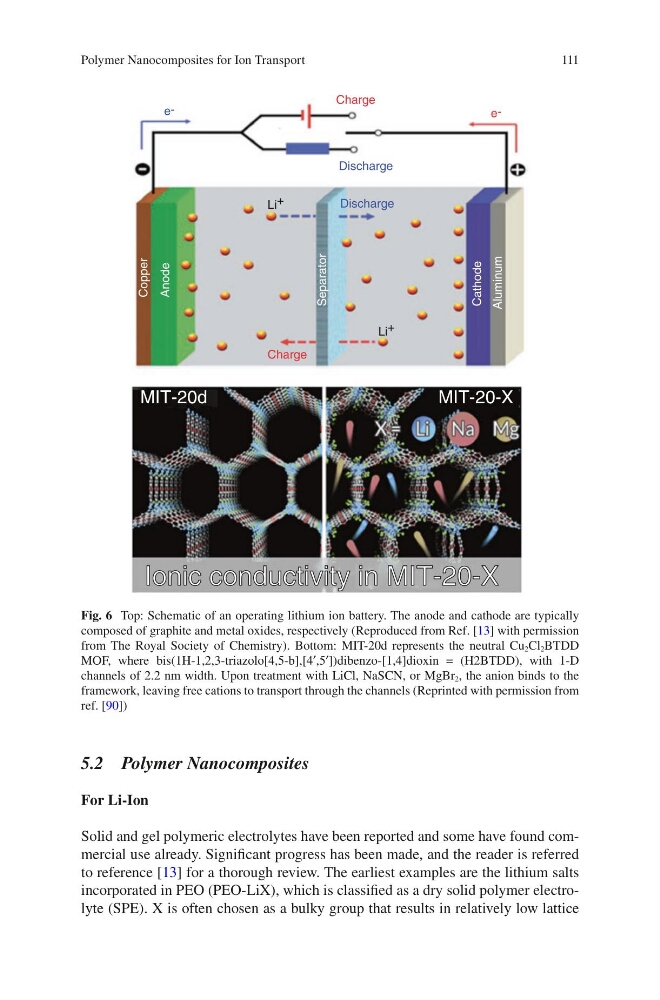
eFig. 6 Top: Schematic of an operating lithium ion battery. The anode and cathode are typically
composed of graphite and metal oxides, respectively (Reproduced from Ref. [13] with permission
from The Royal Society of Chemistry). Bottom: MIT-20d represents the neutral Cu 2 Cl 2 BTDD
MOF, where bis(1H-1,2,3-triazolo[4,5-b],[4′,5′])dibenzo-[1,4]dioxin = (H2BTDD), with 1-D
channels of 2.2 nm width. Upon treatment with LiCl, NaSCN, or MgBr 2 , the anion binds to the
framework, leaving free cations to transport through the channels (Reprinted with permission from
ref. [90])
Polymer Nanocomposites for Ion Transport
5.2 Polymer Nanocomposites
For Li-Ion
Solid and gel polymeric electrolytes have been reported and some have found commercial use already. Significant progress has been made, and the reader is referred
to reference [13] for a thorough review. The earliest examples are the lithium salts
incorporated in PEO (PEO-LiX), which is classified as a dry solid polymer electrolyte (SPE). X is often chosen as a bulky group that results in relatively low lattice
Charge
Charge
MIT-20d
MIT-20-X
Ionic conductivity in MIT-20-X
Discharge
Copper
Anode
Cathode
Aluminum
Separator
Discharge
Li +
Li +
eFig. 6 Top: Schematic of an operating lithium ion battery. The anode and cathode are typically
composed of graphite and metal oxides, respectively (Reproduced from Ref. [13] with permission
from The Royal Society of Chemistry). Bottom: MIT-20d represents the neutral Cu 2 Cl 2 BTDD
MOF, where bis(1H-1,2,3-triazolo[4,5-b],[4′,5′])dibenzo-[1,4]dioxin = (H2BTDD), with 1-D
channels of 2.2 nm width. Upon treatment with LiCl, NaSCN, or MgBr 2 , the anion binds to the
framework, leaving free cations to transport through the channels (Reprinted with permission from
ref. [90])
Polymer Nanocomposites for Ion Transport