

due to wide band gap, complex synthetic procedure, high cost, high toxicity, and
leaching.
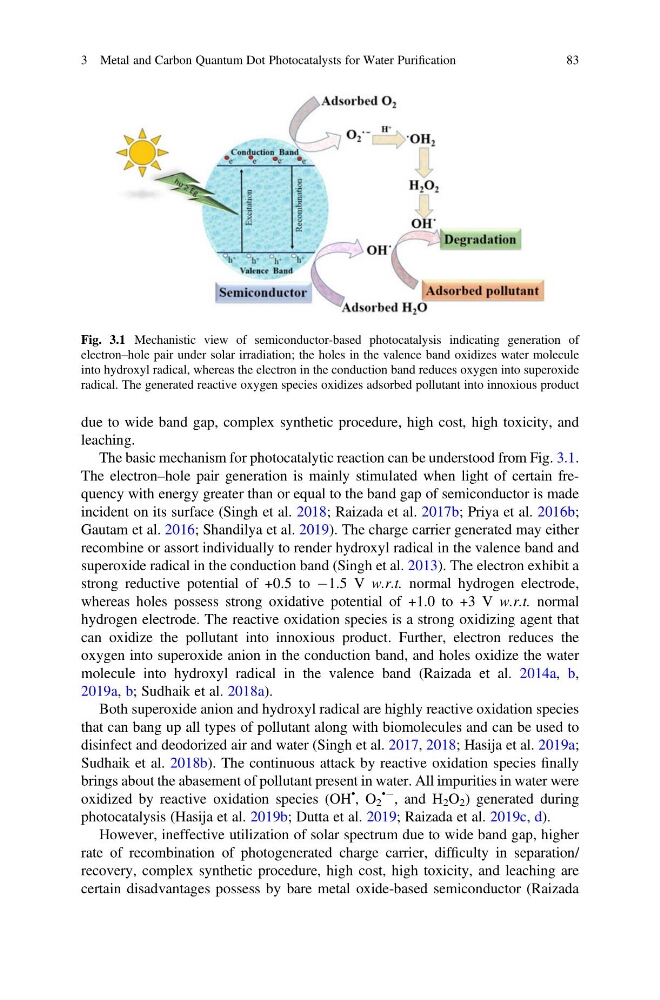
The basic mechanism for photocatalytic reaction can be understood from Fig. 3.1.
The electron–hole pair generation is mainly stimulated when light of certain frequency with energy greater than or equal to the band gap of semiconductor is made
incident on its surface (Singh et al. 2018; Raizada et al. 2017b; Priya et al. 2016b;
Gautam et al. 2016; Shandilya et al. 2019). The charge carrier generated may either
recombine or assort individually to render hydroxyl radical in the valence band and
superoxide radical in the conduction band (Singh et al. 2013). The electron exhibit a
strong reductive potential of +0.5 to À1.5 V w.r.t. normal hydrogen electrode,
whereas holes possess strong oxidative potential of +1.0 to +3 V w.r.t. normal
hydrogen electrode. The reactive oxidation species is a strong oxidizing agent that
can oxidize the pollutant into innoxious product. Further, electron reduces the
oxygen into superoxide anion in the conduction band, and holes oxidize the water
molecule into hydroxyl radical in the valence band (Raizada et al. 2014a, b,
2019a, b; Sudhaik et al. 2018a).
Both superoxide anion and hydroxyl radical are highly reactive oxidation species
that can bang up all types of pollutant along with biomolecules and can be used to
disinfect and deodorized air and water (Singh et al. 2017, 2018; Hasija et al. 2019a;
Sudhaik et al. 2018b). The continuous attack by reactive oxidation species finally
brings about the abasement of pollutant present in water. All impurities in water were
oxidized by reactive oxidation species (OH
•
, O 2
•À , and H 2 O 2 ) generated during
photocatalysis (Hasija et al. 2019b; Dutta et al. 2019; Raizada et al. 2019c, d).
However, ineffective utilization of solar spectrum due to wide band gap, higher
rate of recombination of photogenerated charge carrier, difficulty in separation/
recovery, complex synthetic procedure, high cost, high toxicity, and leaching are
certain disadvantages possess by bare metal oxide-based semiconductor (Raizada
Fig. 3.1 Mechanistic view of semiconductor-based photocatalysis indicating generation of
electron–hole pair under solar irradiation; the holes in the valence band oxidizes water molecule
into hydroxyl radical, whereas the electron in the conduction band reduces oxygen into superoxide
radical. The generated reactive oxygen species oxidizes adsorbed pollutant into innoxious product
3 Metal and Carbon Quantum Dot Photocatalysts for Water Purification
83
leaching.
The basic mechanism for photocatalytic reaction can be understood from Fig. 3.1.
The electron–hole pair generation is mainly stimulated when light of certain frequency with energy greater than or equal to the band gap of semiconductor is made
incident on its surface (Singh et al. 2018; Raizada et al. 2017b; Priya et al. 2016b;
Gautam et al. 2016; Shandilya et al. 2019). The charge carrier generated may either
recombine or assort individually to render hydroxyl radical in the valence band and
superoxide radical in the conduction band (Singh et al. 2013). The electron exhibit a
strong reductive potential of +0.5 to À1.5 V w.r.t. normal hydrogen electrode,
whereas holes possess strong oxidative potential of +1.0 to +3 V w.r.t. normal
hydrogen electrode. The reactive oxidation species is a strong oxidizing agent that
can oxidize the pollutant into innoxious product. Further, electron reduces the
oxygen into superoxide anion in the conduction band, and holes oxidize the water
molecule into hydroxyl radical in the valence band (Raizada et al. 2014a, b,
2019a, b; Sudhaik et al. 2018a).
Both superoxide anion and hydroxyl radical are highly reactive oxidation species
that can bang up all types of pollutant along with biomolecules and can be used to
disinfect and deodorized air and water (Singh et al. 2017, 2018; Hasija et al. 2019a;
Sudhaik et al. 2018b). The continuous attack by reactive oxidation species finally
brings about the abasement of pollutant present in water. All impurities in water were
oxidized by reactive oxidation species (OH
•
, O 2
•À , and H 2 O 2 ) generated during
photocatalysis (Hasija et al. 2019b; Dutta et al. 2019; Raizada et al. 2019c, d).
However, ineffective utilization of solar spectrum due to wide band gap, higher
rate of recombination of photogenerated charge carrier, difficulty in separation/
recovery, complex synthetic procedure, high cost, high toxicity, and leaching are
certain disadvantages possess by bare metal oxide-based semiconductor (Raizada
Fig. 3.1 Mechanistic view of semiconductor-based photocatalysis indicating generation of
electron–hole pair under solar irradiation; the holes in the valence band oxidizes water molecule
into hydroxyl radical, whereas the electron in the conduction band reduces oxygen into superoxide
radical. The generated reactive oxygen species oxidizes adsorbed pollutant into innoxious product
3 Metal and Carbon Quantum Dot Photocatalysts for Water Purification
83