

performed by Liu et al. (2019). Chang and Tseng (2018) synthesized g-C 3 N 4 /Cu 2 O
crystals for CO 2 photoreduction under visible light irradiations. The method
proceeded via pyrolysis of melamine at 550
C, followed by dispersion of copper
chloride (CuCl 2 ) in the presence of hydroxylamine hydrochloride. The mixture is
kept in a temperature-controlled water bath at 30
C, till color change is observed
from light blue to clay orange. Yuan et al. (2018) similarly prepared g-C 3 N 4 /Cu 2 O
via 0.5 g calcined urea that was added in 0.37 g Cu (NO 3 ) 2 and pyrolyzed in a tubular
furnace at 200
C, till light gray powder was obtained.
Wet chemistry routes including hydrothermal, solvothermal, and chemical reduction methods utilize different solvent systems at low temperature for fabrication of
sandwich-like g-C 3 N 4 /Cu 2 O heterostructure. A facile one-step reduction process
was followed for synthesis of CNCu using precursors urea and Cu (NO 3 ) 2 with
hydrazinium hydrate (N 2 H 4 .H 2 O). There was a stepwise process involving dispersion of mixture, ultrasonication, and oven drying at 60
C for 6 h. The reduction
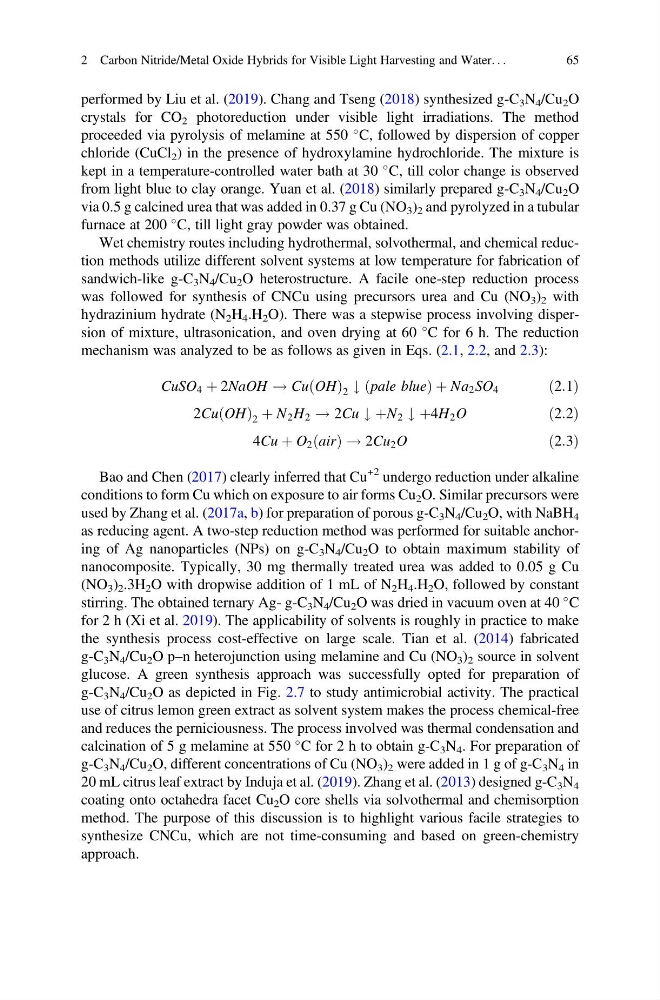
mechanism was analyzed to be as follows as given in Eqs. (2.1, 2.2, and 2.3):
CuSO 4 þ 2NaOH ! Cu OH
ð Þ 2 # pale blue
ð
ÞþNa 2 SO 4
ð2:1Þ
2Cu OH
ð Þ 2 þ N 2 H 2 ! 2Cu # þN 2 # þ4H 2 O
ð2:2Þ
4Cu þ O 2 air
ð Þ ! 2Cu 2 O
ð2:3Þ
Bao and Chen (2017) clearly inferred that Cu
+2 undergo reduction under alkaline
conditions to form Cu which on exposure to air forms Cu 2 O. Similar precursors were
used by Zhang et al. (2017a, b) for preparation of porous g-C 3 N 4 /Cu 2 O, with NaBH 4
as reducing agent. A two-step reduction method was performed for suitable anchoring of Ag nanoparticles (NPs) on g-C 3 N 4 /Cu 2 O to obtain maximum stability of
nanocomposite. Typically, 30 mg thermally treated urea was added to 0.05 g Cu
(NO 3 ) 2 .3H 2 O with dropwise addition of 1 mL of N 2 H 4 .H 2 O, followed by constant
stirring. The obtained ternary Ag- g-C 3 N 4 /Cu 2 O was dried in vacuum oven at 40
C
for 2 h (Xi et al. 2019). The applicability of solvents is roughly in practice to make
the synthesis process cost-effective on large scale. Tian et al. (2014) fabricated
g-C 3 N 4 /Cu 2 O p–n heterojunction using melamine and Cu (NO 3 ) 2 source in solvent
glucose. A green synthesis approach was successfully opted for preparation of
g-C 3 N 4 /Cu 2 O as depicted in Fig. 2.7 to study antimicrobial activity. The practical
use of citrus lemon green extract as solvent system makes the process chemical-free
and reduces the perniciousness. The process involved was thermal condensation and
calcination of 5 g melamine at 550
C for 2 h to obtain g-C 3 N 4 . For preparation of
g-C 3 N 4 /Cu 2 O, different concentrations of Cu (NO 3 ) 2 were added in 1 g of g-C 3 N 4 in
20 mL citrus leaf extract by Induja et al. (2019). Zhang et al. (2013) designed g-C 3 N 4
coating onto octahedra facet Cu 2 O core shells via solvothermal and chemisorption
method. The purpose of this discussion is to highlight various facile strategies to
synthesize CNCu, which are not time-consuming and based on green-chemistry
approach.
2 Carbon Nitride/Metal Oxide Hybrids for Visible Light Harvesting and Water. . .
65
crystals for CO 2 photoreduction under visible light irradiations. The method
proceeded via pyrolysis of melamine at 550
C, followed by dispersion of copper
chloride (CuCl 2 ) in the presence of hydroxylamine hydrochloride. The mixture is
kept in a temperature-controlled water bath at 30
C, till color change is observed
from light blue to clay orange. Yuan et al. (2018) similarly prepared g-C 3 N 4 /Cu 2 O
via 0.5 g calcined urea that was added in 0.37 g Cu (NO 3 ) 2 and pyrolyzed in a tubular
furnace at 200
C, till light gray powder was obtained.
Wet chemistry routes including hydrothermal, solvothermal, and chemical reduction methods utilize different solvent systems at low temperature for fabrication of
sandwich-like g-C 3 N 4 /Cu 2 O heterostructure. A facile one-step reduction process
was followed for synthesis of CNCu using precursors urea and Cu (NO 3 ) 2 with
hydrazinium hydrate (N 2 H 4 .H 2 O). There was a stepwise process involving dispersion of mixture, ultrasonication, and oven drying at 60
C for 6 h. The reduction
mechanism was analyzed to be as follows as given in Eqs. (2.1, 2.2, and 2.3):
CuSO 4 þ 2NaOH ! Cu OH
ð Þ 2 # pale blue
ð
ÞþNa 2 SO 4
ð2:1Þ
2Cu OH
ð Þ 2 þ N 2 H 2 ! 2Cu # þN 2 # þ4H 2 O
ð2:2Þ
4Cu þ O 2 air
ð Þ ! 2Cu 2 O
ð2:3Þ
Bao and Chen (2017) clearly inferred that Cu
+2 undergo reduction under alkaline
conditions to form Cu which on exposure to air forms Cu 2 O. Similar precursors were
used by Zhang et al. (2017a, b) for preparation of porous g-C 3 N 4 /Cu 2 O, with NaBH 4
as reducing agent. A two-step reduction method was performed for suitable anchoring of Ag nanoparticles (NPs) on g-C 3 N 4 /Cu 2 O to obtain maximum stability of
nanocomposite. Typically, 30 mg thermally treated urea was added to 0.05 g Cu
(NO 3 ) 2 .3H 2 O with dropwise addition of 1 mL of N 2 H 4 .H 2 O, followed by constant
stirring. The obtained ternary Ag- g-C 3 N 4 /Cu 2 O was dried in vacuum oven at 40
C
for 2 h (Xi et al. 2019). The applicability of solvents is roughly in practice to make
the synthesis process cost-effective on large scale. Tian et al. (2014) fabricated
g-C 3 N 4 /Cu 2 O p–n heterojunction using melamine and Cu (NO 3 ) 2 source in solvent
glucose. A green synthesis approach was successfully opted for preparation of
g-C 3 N 4 /Cu 2 O as depicted in Fig. 2.7 to study antimicrobial activity. The practical
use of citrus lemon green extract as solvent system makes the process chemical-free
and reduces the perniciousness. The process involved was thermal condensation and
calcination of 5 g melamine at 550
C for 2 h to obtain g-C 3 N 4 . For preparation of
g-C 3 N 4 /Cu 2 O, different concentrations of Cu (NO 3 ) 2 were added in 1 g of g-C 3 N 4 in
20 mL citrus leaf extract by Induja et al. (2019). Zhang et al. (2013) designed g-C 3 N 4
coating onto octahedra facet Cu 2 O core shells via solvothermal and chemisorption
method. The purpose of this discussion is to highlight various facile strategies to
synthesize CNCu, which are not time-consuming and based on green-chemistry
approach.
2 Carbon Nitride/Metal Oxide Hybrids for Visible Light Harvesting and Water. . .
65