

possessing an appropriate energy level with chemical species, thereby releasing
highly reactive oxidative species and free radicals, mainly hydroxyl radical (Singh
et al. 2019a; Jamwal et al. 2015). Based on the principle of advanced oxidation
technologies, photocatalysis has profusely sparked visible light-driven solar utilization strategy functional at ambient conditions to conquer the crisis of energy scarcity
and severe environmental issues. This technology employs semiconductor metal
oxide as photocatalyst which absorbs solar energy leading to excitation of electrons
from valence band edge to the conduction band edge of the semiconductor, generating positive holes in valence band (Raizada et al. 2019a, b, c; Sharma et al. 2019;
Singh et al. 2020; Dutta et al. 2019). The reactive oxidative species are formed on
reaction of holes in valence band with hydroxide ions or water molecules, forming
the exceptionally powerful, nonselective, oxidizing hydroxyl radical (Singh et al.
2013; Raizada et al. 2014a, b), whereas electrons in valence band reduce oxygen and
form superoxide radical. The reactive oxidative species released during
photocatalysis process significantly participates in photodegradation of the organic
pollutants into carbon dioxide, water, and inorganic ions (Hasija et al. 2020; Sudhaik
et al. 2018a, b; Singh et al. 2019b; Jiang et al. 2017). The detailed mechanism of
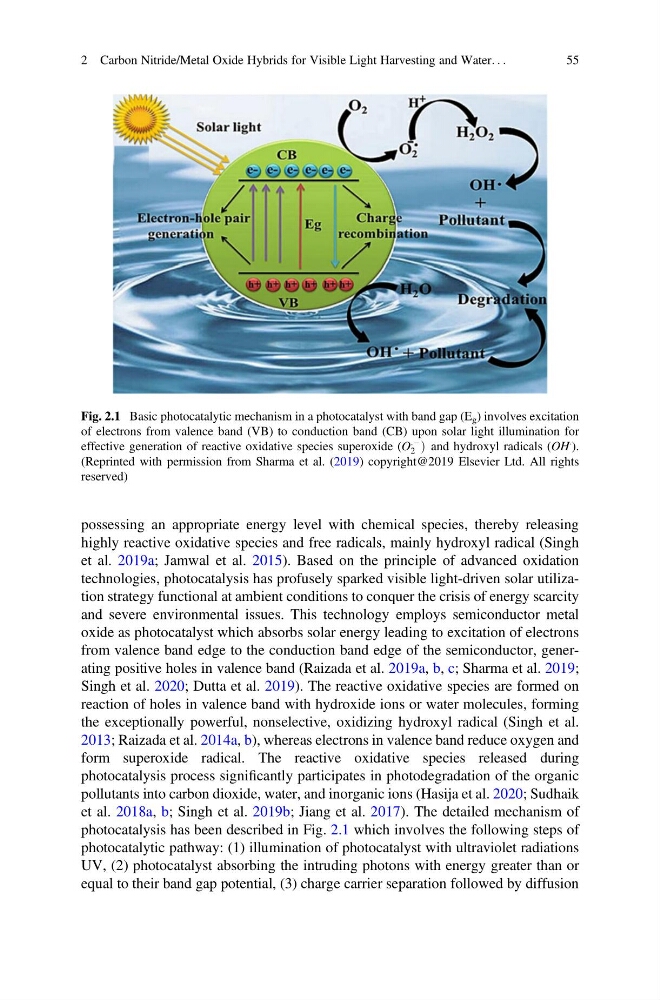
photocatalysis has been described in Fig. 2.1 which involves the following steps of
photocatalytic pathway: (1) illumination of photocatalyst with ultraviolet radiations
UV, (2) photocatalyst absorbing the intruding photons with energy greater than or
equal to their band gap potential, (3) charge carrier separation followed by diffusion
Fig. 2.1 Basic photocatalytic mechanism in a photocatalyst with band gap (E g ) involves excitation
of electrons from valence band (VB) to conduction band (CB) upon solar light illumination for
effective generation of reactive oxidative species superoxide (O
:À
2 Þ and hydroxyl radicals (OH
.
).
(Reprinted with permission from Sharma et al. (2019) copyright@2019 Elsevier Ltd. All rights
reserved)
2 Carbon Nitride/Metal Oxide Hybrids for Visible Light Harvesting and Water. . .
55
highly reactive oxidative species and free radicals, mainly hydroxyl radical (Singh
et al. 2019a; Jamwal et al. 2015). Based on the principle of advanced oxidation
technologies, photocatalysis has profusely sparked visible light-driven solar utilization strategy functional at ambient conditions to conquer the crisis of energy scarcity
and severe environmental issues. This technology employs semiconductor metal
oxide as photocatalyst which absorbs solar energy leading to excitation of electrons
from valence band edge to the conduction band edge of the semiconductor, generating positive holes in valence band (Raizada et al. 2019a, b, c; Sharma et al. 2019;
Singh et al. 2020; Dutta et al. 2019). The reactive oxidative species are formed on
reaction of holes in valence band with hydroxide ions or water molecules, forming
the exceptionally powerful, nonselective, oxidizing hydroxyl radical (Singh et al.
2013; Raizada et al. 2014a, b), whereas electrons in valence band reduce oxygen and
form superoxide radical. The reactive oxidative species released during
photocatalysis process significantly participates in photodegradation of the organic
pollutants into carbon dioxide, water, and inorganic ions (Hasija et al. 2020; Sudhaik
et al. 2018a, b; Singh et al. 2019b; Jiang et al. 2017). The detailed mechanism of
photocatalysis has been described in Fig. 2.1 which involves the following steps of
photocatalytic pathway: (1) illumination of photocatalyst with ultraviolet radiations
UV, (2) photocatalyst absorbing the intruding photons with energy greater than or
equal to their band gap potential, (3) charge carrier separation followed by diffusion
Fig. 2.1 Basic photocatalytic mechanism in a photocatalyst with band gap (E g ) involves excitation
of electrons from valence band (VB) to conduction band (CB) upon solar light illumination for
effective generation of reactive oxidative species superoxide (O
:À
2 Þ and hydroxyl radicals (OH
.
).
(Reprinted with permission from Sharma et al. (2019) copyright@2019 Elsevier Ltd. All rights
reserved)
2 Carbon Nitride/Metal Oxide Hybrids for Visible Light Harvesting and Water. . .
55