

two different chemical oxygen demand equivalent concentrations, namely, 300 mg
O 2 /L and 900 mg O 2 /L. The obtained results were comparatively presented in
Fig.13.6 and Fig. 13.7.
As can be seen in Fig. 13.6, there is no such difference between the degrees of
degradation of the studied antibiotics according to their initial concentration in the
solution, even if the second concentration is three times higher than the first one.
These results indicate a very good photocatalytic activity of the TiO 2 /sisal fiber
membrane and the possibility to use it even for high concentration of these types of
antibiotics in the solution. On the contrary, it seems that there is some difference in
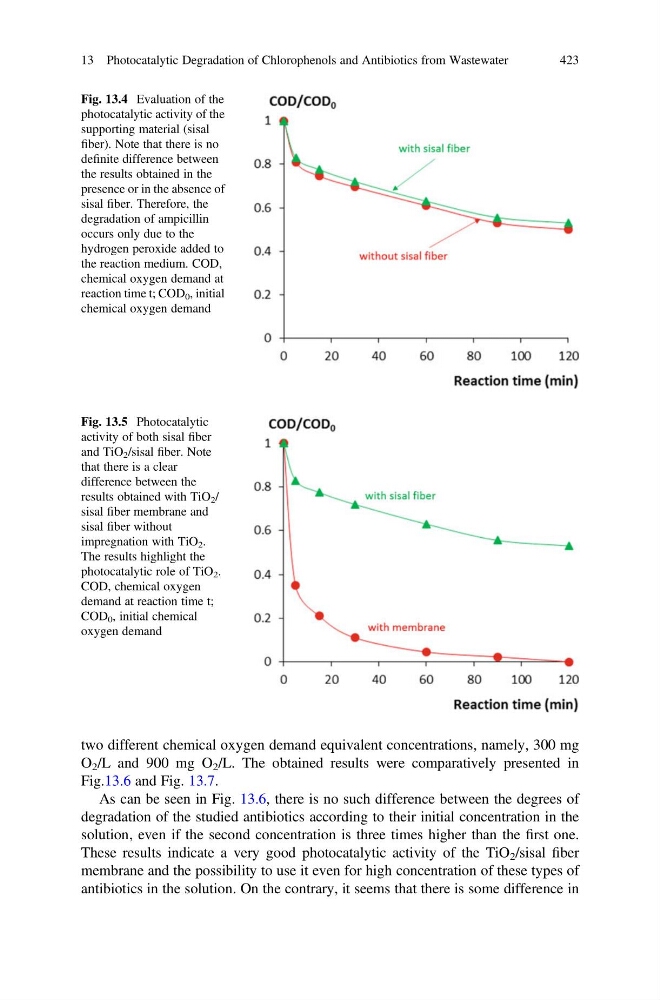
Fig. 13.4 Evaluation of the
photocatalytic activity of the
supporting material (sisal
fiber). Note that there is no
definite difference between
the results obtained in the
presence or in the absence of
sisal fiber. Therefore, the
degradation of ampicillin
occurs only due to the
hydrogen peroxide added to
the reaction medium. COD,
chemical oxygen demand at
reaction time t; COD 0 , initial
chemical oxygen demand
Fig. 13.5 Photocatalytic
activity of both sisal fiber
and TiO 2 /sisal fiber. Note
that there is a clear
difference between the
results obtained with TiO 2 /
sisal fiber membrane and
sisal fiber without
impregnation with TiO 2 .
The results highlight the
photocatalytic role of TiO 2 .
COD, chemical oxygen
demand at reaction time t;
COD 0 , initial chemical
oxygen demand
13 Photocatalytic Degradation of Chlorophenols and Antibiotics from Wastewater
423
O 2 /L and 900 mg O 2 /L. The obtained results were comparatively presented in
Fig.13.6 and Fig. 13.7.
As can be seen in Fig. 13.6, there is no such difference between the degrees of
degradation of the studied antibiotics according to their initial concentration in the
solution, even if the second concentration is three times higher than the first one.
These results indicate a very good photocatalytic activity of the TiO 2 /sisal fiber
membrane and the possibility to use it even for high concentration of these types of
antibiotics in the solution. On the contrary, it seems that there is some difference in
Fig. 13.4 Evaluation of the
photocatalytic activity of the
supporting material (sisal
fiber). Note that there is no
definite difference between
the results obtained in the
presence or in the absence of
sisal fiber. Therefore, the
degradation of ampicillin
occurs only due to the
hydrogen peroxide added to
the reaction medium. COD,
chemical oxygen demand at
reaction time t; COD 0 , initial
chemical oxygen demand
Fig. 13.5 Photocatalytic
activity of both sisal fiber
and TiO 2 /sisal fiber. Note
that there is a clear
difference between the
results obtained with TiO 2 /
sisal fiber membrane and
sisal fiber without
impregnation with TiO 2 .
The results highlight the
photocatalytic role of TiO 2 .
COD, chemical oxygen
demand at reaction time t;
COD 0 , initial chemical
oxygen demand
13 Photocatalytic Degradation of Chlorophenols and Antibiotics from Wastewater
423