

13.4 Photocatalytic Degradation of Chlorophenols
and Antibiotics from Wastewater
13.4.1 Materials and Methods
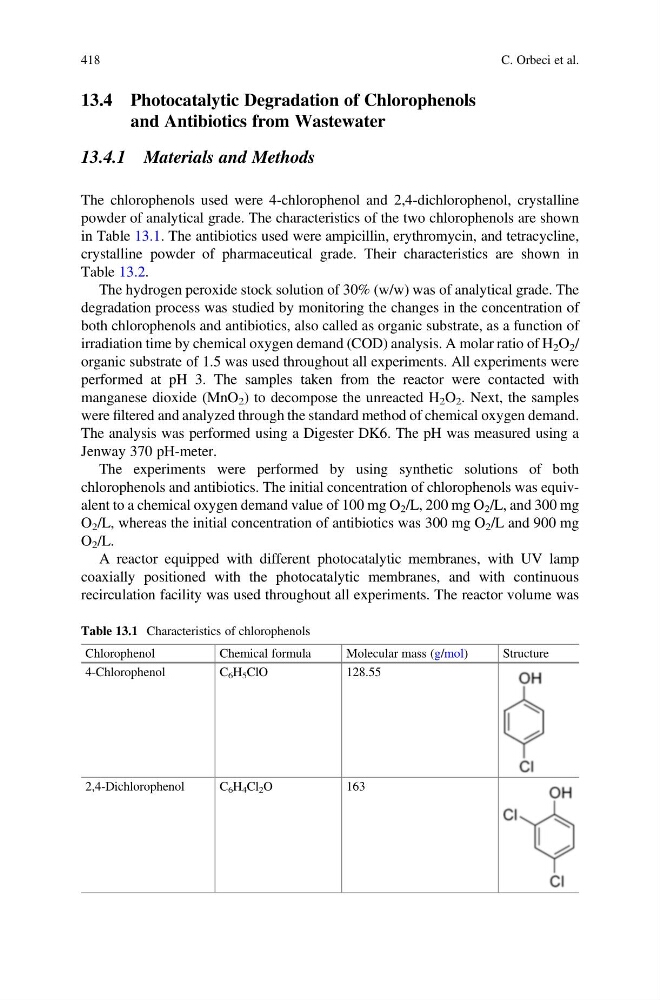
The chlorophenols used were 4-chlorophenol and 2,4-dichlorophenol, crystalline
powder of analytical grade. The characteristics of the two chlorophenols are shown
in Table 13.1. The antibiotics used were ampicillin, erythromycin, and tetracycline,
crystalline powder of pharmaceutical grade. Their characteristics are shown in
Table 13.2.
The hydrogen peroxide stock solution of 30% (w/w) was of analytical grade. The
degradation process was studied by monitoring the changes in the concentration of
both chlorophenols and antibiotics, also called as organic substrate, as a function of
irradiation time by chemical oxygen demand (COD) analysis. A molar ratio of H 2 O 2 /
organic substrate of 1.5 was used throughout all experiments. All experiments were
performed at pH 3. The samples taken from the reactor were contacted with
manganese dioxide (MnO 2 ) to decompose the unreacted H 2 O 2 . Next, the samples
were filtered and analyzed through the standard method of chemical oxygen demand.
The analysis was performed using a Digester DK6. The pH was measured using a
Jenway 370 pH-meter.
The experiments were performed by using synthetic solutions of both
chlorophenols and antibiotics. The initial concentration of chlorophenols was equivalent to a chemical oxygen demand value of 100 mg O 2 /L, 200 mg O 2 /L, and 300 mg
O 2 /L, whereas the initial concentration of antibiotics was 300 mg O 2 /L and 900 mg
O 2 /L.
A reactor equipped with different photocatalytic membranes, with UV lamp
coaxially positioned with the photocatalytic membranes, and with continuous
recirculation facility was used throughout all experiments. The reactor volume was
Table 13.1 Characteristics of chlorophenols
Chlorophenol
Chemical formula
Molecular mass (g/mol)
Structure
4-Chlorophenol
C 6 H 5 ClO
128.55
2,4-Dichlorophenol
C 6 H 4 Cl 2 O
163
418
C. Orbeci et al.
and Antibiotics from Wastewater
13.4.1 Materials and Methods
The chlorophenols used were 4-chlorophenol and 2,4-dichlorophenol, crystalline
powder of analytical grade. The characteristics of the two chlorophenols are shown
in Table 13.1. The antibiotics used were ampicillin, erythromycin, and tetracycline,
crystalline powder of pharmaceutical grade. Their characteristics are shown in
Table 13.2.
The hydrogen peroxide stock solution of 30% (w/w) was of analytical grade. The
degradation process was studied by monitoring the changes in the concentration of
both chlorophenols and antibiotics, also called as organic substrate, as a function of
irradiation time by chemical oxygen demand (COD) analysis. A molar ratio of H 2 O 2 /
organic substrate of 1.5 was used throughout all experiments. All experiments were
performed at pH 3. The samples taken from the reactor were contacted with
manganese dioxide (MnO 2 ) to decompose the unreacted H 2 O 2 . Next, the samples
were filtered and analyzed through the standard method of chemical oxygen demand.
The analysis was performed using a Digester DK6. The pH was measured using a
Jenway 370 pH-meter.
The experiments were performed by using synthetic solutions of both
chlorophenols and antibiotics. The initial concentration of chlorophenols was equivalent to a chemical oxygen demand value of 100 mg O 2 /L, 200 mg O 2 /L, and 300 mg
O 2 /L, whereas the initial concentration of antibiotics was 300 mg O 2 /L and 900 mg
O 2 /L.
A reactor equipped with different photocatalytic membranes, with UV lamp
coaxially positioned with the photocatalytic membranes, and with continuous
recirculation facility was used throughout all experiments. The reactor volume was
Table 13.1 Characteristics of chlorophenols
Chlorophenol
Chemical formula
Molecular mass (g/mol)
Structure
4-Chlorophenol
C 6 H 5 ClO
128.55
2,4-Dichlorophenol
C 6 H 4 Cl 2 O
163
418
C. Orbeci et al.