

12.4 Applications of IL in Wastewater Treatment
Ionic liquids have excellent features for extraction of metal ions/organic pollutants
from aqueous solutions because of its low volatility, chemical stability, and chelating
abilities. In this section, few recent studies are discussed particularly extraction of
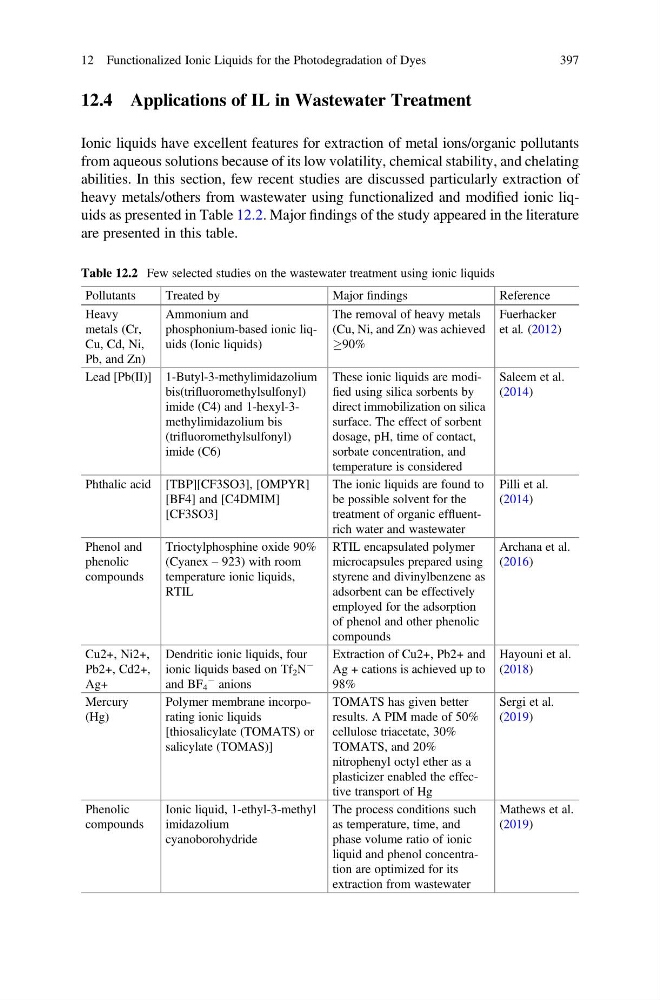
heavy metals/others from wastewater using functionalized and modified ionic liquids as presented in Table 12.2. Major findings of the study appeared in the literature
are presented in this table.
Table 12.2 Few selected studies on the wastewater treatment using ionic liquids
Pollutants
Treated by
Major findings
Reference
Heavy
metals (Cr,
Cu, Cd, Ni,
Pb, and Zn)
Ammonium and
phosphonium-based ionic liquids (Ionic liquids)
The removal of heavy metals
(Cu, Ni, and Zn) was achieved
!90%
Fuerhacker
et al. (2012)
Lead [Pb(II)] 1-Butyl-3-methylimidazolium
bis(trifluoromethylsulfonyl)
imide (C4) and 1-hexyl-3methylimidazolium bis
(trifluoromethylsulfonyl)
imide (C6)
These ionic liquids are modified using silica sorbents by
direct immobilization on silica
surface. The effect of sorbent
dosage, pH, time of contact,
sorbate concentration, and
temperature is considered
Saleem et al.
(2014)
Phthalic acid [TBP][CF3SO3], [OMPYR]
[BF4] and [C4DMIM]
[CF3SO3]
The ionic liquids are found to
be possible solvent for the
treatment of organic effluentrich water and wastewater
Pilli et al.
(2014)
Phenol and
phenolic
compounds
Trioctylphosphine oxide 90%
(Cyanex – 923) with room
temperature ionic liquids,
RTIL
RTIL encapsulated polymer
microcapsules prepared using
styrene and divinylbenzene as
adsorbent can be effectively
employed for the adsorption
of phenol and other phenolic
compounds
Archana et al.
(2016)
Cu2+, Ni2+,
Pb2+, Cd2+,
Ag+
Dendritic ionic liquids, four
ionic liquids based on Tf 2 N
À
and BF 4
À anions
Extraction of Cu2+, Pb2+ and
Ag + cations is achieved up to
98%
Hayouni et al.
(2018)
Mercury
(Hg)
Polymer membrane incorporating ionic liquids
[thiosalicylate (TOMATS) or
salicylate (TOMAS)]
TOMATS has given better
results. A PIM made of 50%
cellulose triacetate, 30%
TOMATS, and 20%
nitrophenyl octyl ether as a
plasticizer enabled the effective transport of Hg
Sergi et al.
(2019)
Phenolic
compounds
Ionic liquid, 1-ethyl-3-methyl
imidazolium
cyanoborohydride
The process conditions such
as temperature, time, and
phase volume ratio of ionic
liquid and phenol concentration are optimized for its
extraction from wastewater
Mathews et al.
(2019)
12 Functionalized Ionic Liquids for the Photodegradation of Dyes
397
Ionic liquids have excellent features for extraction of metal ions/organic pollutants
from aqueous solutions because of its low volatility, chemical stability, and chelating
abilities. In this section, few recent studies are discussed particularly extraction of
heavy metals/others from wastewater using functionalized and modified ionic liquids as presented in Table 12.2. Major findings of the study appeared in the literature
are presented in this table.
Table 12.2 Few selected studies on the wastewater treatment using ionic liquids
Pollutants
Treated by
Major findings
Reference
Heavy
metals (Cr,
Cu, Cd, Ni,
Pb, and Zn)
Ammonium and
phosphonium-based ionic liquids (Ionic liquids)
The removal of heavy metals
(Cu, Ni, and Zn) was achieved
!90%
Fuerhacker
et al. (2012)
Lead [Pb(II)] 1-Butyl-3-methylimidazolium
bis(trifluoromethylsulfonyl)
imide (C4) and 1-hexyl-3methylimidazolium bis
(trifluoromethylsulfonyl)
imide (C6)
These ionic liquids are modified using silica sorbents by
direct immobilization on silica
surface. The effect of sorbent
dosage, pH, time of contact,
sorbate concentration, and
temperature is considered
Saleem et al.
(2014)
Phthalic acid [TBP][CF3SO3], [OMPYR]
[BF4] and [C4DMIM]
[CF3SO3]
The ionic liquids are found to
be possible solvent for the
treatment of organic effluentrich water and wastewater
Pilli et al.
(2014)
Phenol and
phenolic
compounds
Trioctylphosphine oxide 90%
(Cyanex – 923) with room
temperature ionic liquids,
RTIL
RTIL encapsulated polymer
microcapsules prepared using
styrene and divinylbenzene as
adsorbent can be effectively
employed for the adsorption
of phenol and other phenolic
compounds
Archana et al.
(2016)
Cu2+, Ni2+,
Pb2+, Cd2+,
Ag+
Dendritic ionic liquids, four
ionic liquids based on Tf 2 N
À
and BF 4
À anions
Extraction of Cu2+, Pb2+ and
Ag + cations is achieved up to
98%
Hayouni et al.
(2018)
Mercury
(Hg)
Polymer membrane incorporating ionic liquids
[thiosalicylate (TOMATS) or
salicylate (TOMAS)]
TOMATS has given better
results. A PIM made of 50%
cellulose triacetate, 30%
TOMATS, and 20%
nitrophenyl octyl ether as a
plasticizer enabled the effective transport of Hg
Sergi et al.
(2019)
Phenolic
compounds
Ionic liquid, 1-ethyl-3-methyl
imidazolium
cyanoborohydride
The process conditions such
as temperature, time, and
phase volume ratio of ionic
liquid and phenol concentration are optimized for its
extraction from wastewater
Mathews et al.
(2019)
12 Functionalized Ionic Liquids for the Photodegradation of Dyes
397