

11.9 Photocatalytic Reactors
For the detoxification of pollutant, the sun provides UV flux 20–30 Wm
À2 in the
range of 300–400 nm with 0.2–0.3 mol photons m
2 h
À1 , which suggests the use of
sun as an economical source of sensible light, and a photocatalytic reactor is a device
which brings photons and pollutant in contact with the photocatalyst (Bahnemann
2004). These reactors are different from chemical reactors in terms of geometry and
operating parameters; the primary objective of these reactors is to transmit sufficient
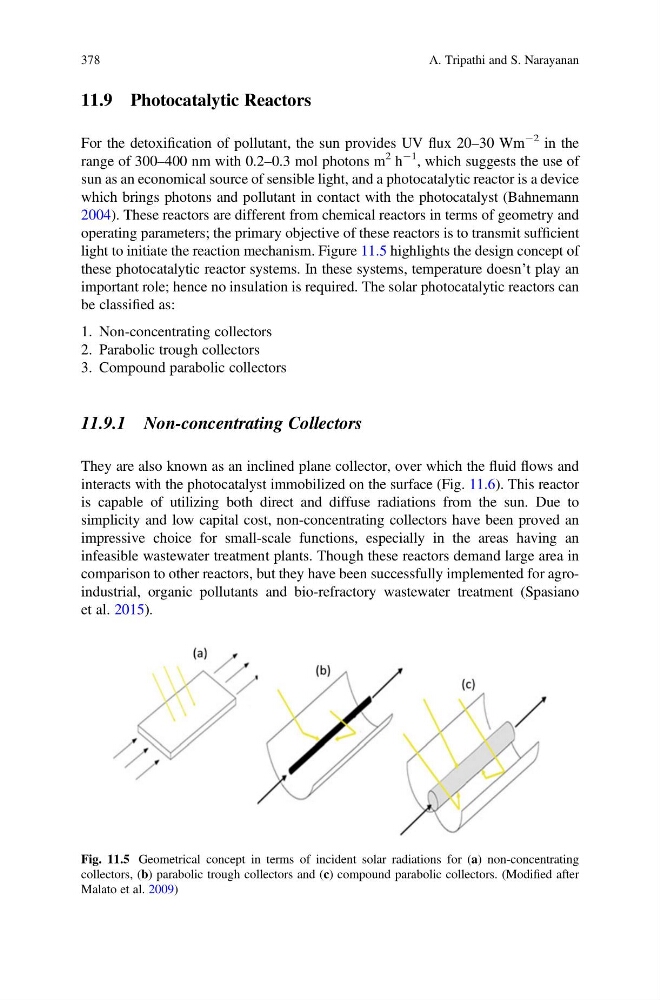
light to initiate the reaction mechanism. Figure 11.5 highlights the design concept of
these photocatalytic reactor systems. In these systems, temperature doesn’t play an
important role; hence no insulation is required. The solar photocatalytic reactors can
be classified as:
1. Non-concentrating collectors
2. Parabolic trough collectors
3. Compound parabolic collectors
11.9.1 Non-concentrating Collectors
They are also known as an inclined plane collector, over which the fluid flows and
interacts with the photocatalyst immobilized on the surface (Fig. 11.6). This reactor
is capable of utilizing both direct and diffuse radiations from the sun. Due to
simplicity and low capital cost, non-concentrating collectors have been proved an
impressive choice for small-scale functions, especially in the areas having an
infeasible wastewater treatment plants. Though these reactors demand large area in
comparison to other reactors, but they have been successfully implemented for agroindustrial, organic pollutants and bio-refractory wastewater treatment (Spasiano
et al. 2015).
Fig. 11.5 Geometrical concept in terms of incident solar radiations for (a) non-concentrating
collectors, (b) parabolic trough collectors and (c) compound parabolic collectors. (Modified after
Malato et al. 2009)
378
A. Tripathi and S. Narayanan
For the detoxification of pollutant, the sun provides UV flux 20–30 Wm
À2 in the
range of 300–400 nm with 0.2–0.3 mol photons m
2 h
À1 , which suggests the use of
sun as an economical source of sensible light, and a photocatalytic reactor is a device
which brings photons and pollutant in contact with the photocatalyst (Bahnemann
2004). These reactors are different from chemical reactors in terms of geometry and
operating parameters; the primary objective of these reactors is to transmit sufficient
light to initiate the reaction mechanism. Figure 11.5 highlights the design concept of
these photocatalytic reactor systems. In these systems, temperature doesn’t play an
important role; hence no insulation is required. The solar photocatalytic reactors can
be classified as:
1. Non-concentrating collectors
2. Parabolic trough collectors
3. Compound parabolic collectors
11.9.1 Non-concentrating Collectors
They are also known as an inclined plane collector, over which the fluid flows and
interacts with the photocatalyst immobilized on the surface (Fig. 11.6). This reactor
is capable of utilizing both direct and diffuse radiations from the sun. Due to
simplicity and low capital cost, non-concentrating collectors have been proved an
impressive choice for small-scale functions, especially in the areas having an
infeasible wastewater treatment plants. Though these reactors demand large area in
comparison to other reactors, but they have been successfully implemented for agroindustrial, organic pollutants and bio-refractory wastewater treatment (Spasiano
et al. 2015).
Fig. 11.5 Geometrical concept in terms of incident solar radiations for (a) non-concentrating
collectors, (b) parabolic trough collectors and (c) compound parabolic collectors. (Modified after
Malato et al. 2009)
378
A. Tripathi and S. Narayanan