

1.4 Photocatalytic Remediation of Organic Pollutants
in Water
In this section, photocatalytic organic pollutant treatments in water are categorized
into two groups based on types of photocatalysis, i.e., homogenous and
heterogeneous ones.
1.4.1 Homogeneous Photocatalysis
Homogeneous photocatalysis has attracted numerous attentions as a promising
technology for remediation of organic pollutants in water.
Treatments of Pharmaceuticals and Personal Care Products
The combination of UV and hydrogen peroxide (UV/H 2 O 2 ), ozonation (UV/O 3 ),
and photo-Fenton has demonstrated their effectiveness in the degradation of pharmaceuticals and personal care products with initial concentration ranging from μg/L
to ng/L as low as the commonly found levels in the environment. The completed
removal of pharmaceuticals and personal care products, such as sulfamethoxazole,
trimethoprim, bezafibrate, diclofenac, naproxen, ketoprofen, atenolol, metoprolol,
propranolol, diazepam, carbamazepine, primidone (Kim et al. 2009), ofloxacin,
ciprofloxacin, gemfibrozil, ibuprofen, sotalol, triclosan (De la Cruz et al. 2012),
tylosin (He and Hua 2013), and enoxacin (Santoke et al. 2015) from water by
UV/H 2 O 2 , has been reported by many researchers.
In the recent decade, the removal of some pharmaceuticals and personal care
products, such as ketoprofen (Illés et al. 2014), caffeine, diethyltoluamide, cyclophosphamide (Kim and Tanaka 2010), mefenamic acid (Chang et al. 2012), and
berberine (Qin et al. 2015), by UV/O 3 process, was performed. The degradation of
pharmaceuticals and personal care products by UV/O 3 process has not been widely
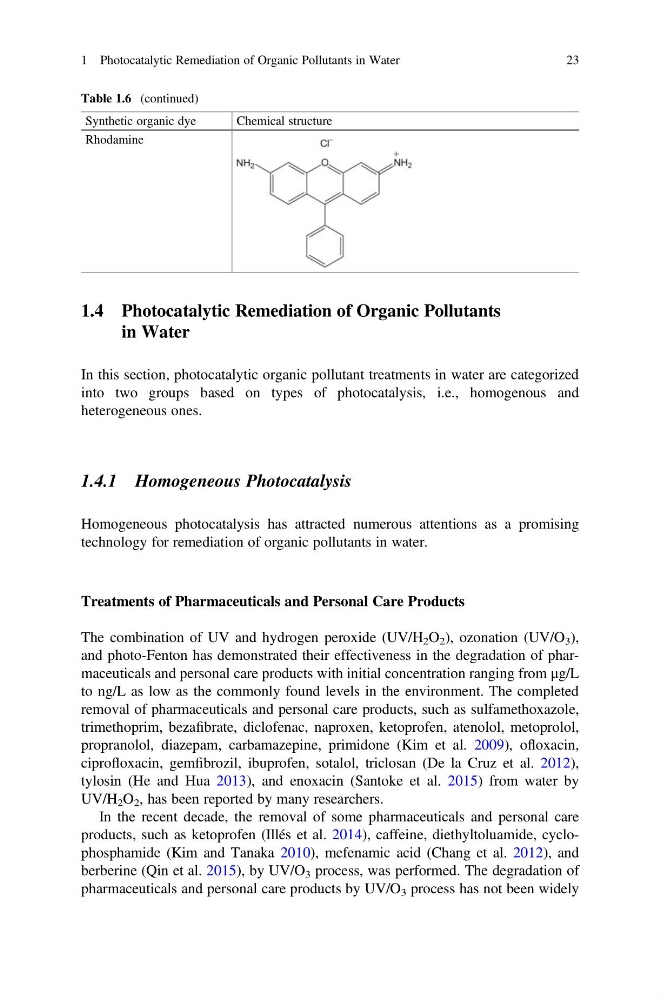
Table 1.6 (continued)
Synthetic organic dye
Chemical structure
Rhodamine
1 Photocatalytic Remediation of Organic Pollutants in Water
23
in Water
In this section, photocatalytic organic pollutant treatments in water are categorized
into two groups based on types of photocatalysis, i.e., homogenous and
heterogeneous ones.
1.4.1 Homogeneous Photocatalysis
Homogeneous photocatalysis has attracted numerous attentions as a promising
technology for remediation of organic pollutants in water.
Treatments of Pharmaceuticals and Personal Care Products
The combination of UV and hydrogen peroxide (UV/H 2 O 2 ), ozonation (UV/O 3 ),
and photo-Fenton has demonstrated their effectiveness in the degradation of pharmaceuticals and personal care products with initial concentration ranging from μg/L
to ng/L as low as the commonly found levels in the environment. The completed
removal of pharmaceuticals and personal care products, such as sulfamethoxazole,
trimethoprim, bezafibrate, diclofenac, naproxen, ketoprofen, atenolol, metoprolol,
propranolol, diazepam, carbamazepine, primidone (Kim et al. 2009), ofloxacin,
ciprofloxacin, gemfibrozil, ibuprofen, sotalol, triclosan (De la Cruz et al. 2012),
tylosin (He and Hua 2013), and enoxacin (Santoke et al. 2015) from water by
UV/H 2 O 2 , has been reported by many researchers.
In the recent decade, the removal of some pharmaceuticals and personal care
products, such as ketoprofen (Illés et al. 2014), caffeine, diethyltoluamide, cyclophosphamide (Kim and Tanaka 2010), mefenamic acid (Chang et al. 2012), and
berberine (Qin et al. 2015), by UV/O 3 process, was performed. The degradation of
pharmaceuticals and personal care products by UV/O 3 process has not been widely
Table 1.6 (continued)
Synthetic organic dye
Chemical structure
Rhodamine
1 Photocatalytic Remediation of Organic Pollutants in Water
23