

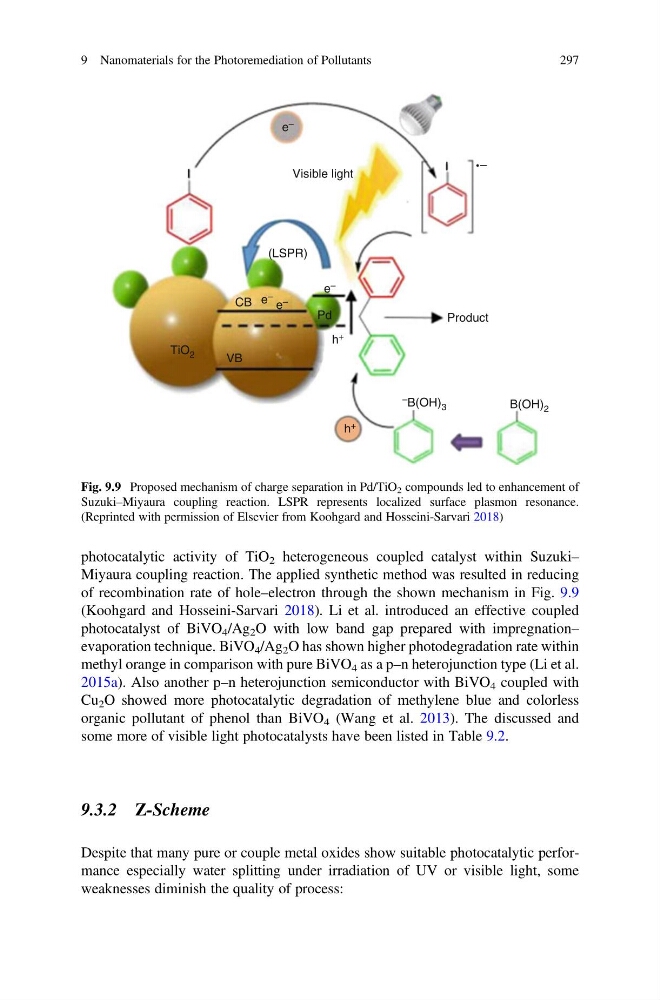
photocatalytic activity of TiO 2 heterogeneous coupled catalyst within Suzuki–
Miyaura coupling reaction. The applied synthetic method was resulted in reducing
of recombination rate of hole–electron through the shown mechanism in Fig. 9.9
(Koohgard and Hosseini-Sarvari 2018). Li et al. introduced an effective coupled
photocatalyst of BiVO 4 /Ag 2 O with low band gap prepared with impregnation–
evaporation technique. BiVO 4 /Ag 2 O has shown higher photodegradation rate within
methyl orange in comparison with pure BiVO 4 as a p–n heterojunction type (Li et al.
2015a). Also another p–n heterojunction semiconductor with BiVO 4 coupled with
Cu 2 O showed more photocatalytic degradation of methylene blue and colorless
organic pollutant of phenol than BiVO 4 (Wang et al. 2013). The discussed and
some more of visible light photocatalysts have been listed in Table 9.2.
9.3.2 Z-Scheme
Despite that many pure or couple metal oxides show suitable photocatalytic performance especially water splitting under irradiation of UV or visible light, some
weaknesses diminish the quality of process:
VB
TiO 2
e –
e –
Visible light
I
I
h +
h +
Pd
(LSPR)
CB e –
e –
Product
– B(OH) 3
B(OH) 2
–
Fig. 9.9 Proposed mechanism of charge separation in Pd/TiO 2 compounds led to enhancement of
Suzuki–Miyaura coupling reaction. LSPR represents localized surface plasmon resonance.
(Reprinted with permission of Elsevier from Koohgard and Hosseini-Sarvari 2018)
9 Nanomaterials for the Photoremediation of Pollutants
297
Miyaura coupling reaction. The applied synthetic method was resulted in reducing
of recombination rate of hole–electron through the shown mechanism in Fig. 9.9
(Koohgard and Hosseini-Sarvari 2018). Li et al. introduced an effective coupled
photocatalyst of BiVO 4 /Ag 2 O with low band gap prepared with impregnation–
evaporation technique. BiVO 4 /Ag 2 O has shown higher photodegradation rate within
methyl orange in comparison with pure BiVO 4 as a p–n heterojunction type (Li et al.
2015a). Also another p–n heterojunction semiconductor with BiVO 4 coupled with
Cu 2 O showed more photocatalytic degradation of methylene blue and colorless
organic pollutant of phenol than BiVO 4 (Wang et al. 2013). The discussed and
some more of visible light photocatalysts have been listed in Table 9.2.
9.3.2 Z-Scheme
Despite that many pure or couple metal oxides show suitable photocatalytic performance especially water splitting under irradiation of UV or visible light, some
weaknesses diminish the quality of process:
VB
TiO 2
e –
e –
Visible light
I
I
h +
h +
Pd
(LSPR)
CB e –
e –
Product
– B(OH) 3
B(OH) 2
–
Fig. 9.9 Proposed mechanism of charge separation in Pd/TiO 2 compounds led to enhancement of
Suzuki–Miyaura coupling reaction. LSPR represents localized surface plasmon resonance.
(Reprinted with permission of Elsevier from Koohgard and Hosseini-Sarvari 2018)
9 Nanomaterials for the Photoremediation of Pollutants
297