

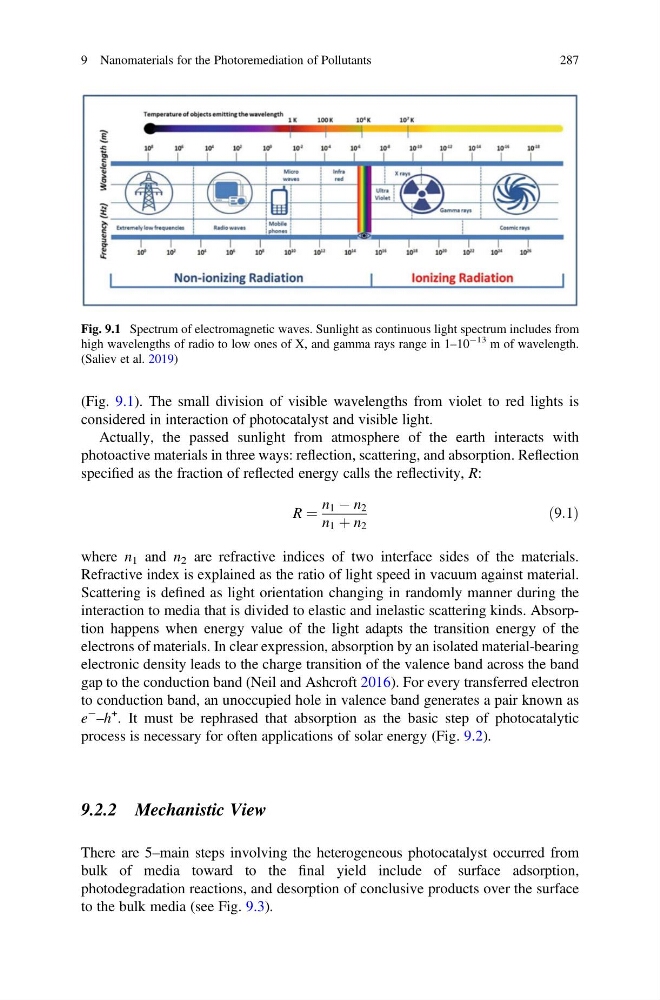
(Fig. 9.1). The small division of visible wavelengths from violet to red lights is
considered in interaction of photocatalyst and visible light.
Actually, the passed sunlight from atmosphere of the earth interacts with
photoactive materials in three ways: reflection, scattering, and absorption. Reflection
specified as the fraction of reflected energy calls the reflectivity, R:
R ¼
n 1 À n 2
n 1 þ n 2
ð9:1Þ
where n 1 and n 2 are refractive indices of two interface sides of the materials.
Refractive index is explained as the ratio of light speed in vacuum against material.
Scattering is defined as light orientation changing in randomly manner during the
interaction to media that is divided to elastic and inelastic scattering kinds. Absorption happens when energy value of the light adapts the transition energy of the
electrons of materials. In clear expression, absorption by an isolated material-bearing
electronic density leads to the charge transition of the valence band across the band
gap to the conduction band (Neil and Ashcroft 2016). For every transferred electron
to conduction band, an unoccupied hole in valence band generates a pair known as
e
À
–h
+
. It must be rephrased that absorption as the basic step of photocatalytic
process is necessary for often applications of solar energy (Fig. 9.2).
9.2.2 Mechanistic View
There are 5–main steps involving the heterogeneous photocatalyst occurred from
bulk of media toward to the final yield include of surface adsorption,
photodegradation reactions, and desorption of conclusive products over the surface
to the bulk media (see Fig. 9.3).
Fig. 9.1 Spectrum of electromagnetic waves. Sunlight as continuous light spectrum includes from
high wavelengths of radio to low ones of X, and gamma rays range in 1–10
À13 m of wavelength.
(Saliev et al. 2019)
9 Nanomaterials for the Photoremediation of Pollutants
287
considered in interaction of photocatalyst and visible light.
Actually, the passed sunlight from atmosphere of the earth interacts with
photoactive materials in three ways: reflection, scattering, and absorption. Reflection
specified as the fraction of reflected energy calls the reflectivity, R:
R ¼
n 1 À n 2
n 1 þ n 2
ð9:1Þ
where n 1 and n 2 are refractive indices of two interface sides of the materials.
Refractive index is explained as the ratio of light speed in vacuum against material.
Scattering is defined as light orientation changing in randomly manner during the
interaction to media that is divided to elastic and inelastic scattering kinds. Absorption happens when energy value of the light adapts the transition energy of the
electrons of materials. In clear expression, absorption by an isolated material-bearing
electronic density leads to the charge transition of the valence band across the band
gap to the conduction band (Neil and Ashcroft 2016). For every transferred electron
to conduction band, an unoccupied hole in valence band generates a pair known as
e
À
–h
+
. It must be rephrased that absorption as the basic step of photocatalytic
process is necessary for often applications of solar energy (Fig. 9.2).
9.2.2 Mechanistic View
There are 5–main steps involving the heterogeneous photocatalyst occurred from
bulk of media toward to the final yield include of surface adsorption,
photodegradation reactions, and desorption of conclusive products over the surface
to the bulk media (see Fig. 9.3).
Fig. 9.1 Spectrum of electromagnetic waves. Sunlight as continuous light spectrum includes from
high wavelengths of radio to low ones of X, and gamma rays range in 1–10
À13 m of wavelength.
(Saliev et al. 2019)
9 Nanomaterials for the Photoremediation of Pollutants
287