

the decades. Alternative route can be addressed by nanomaterials with photocatalytic
degradation ability of greenhouse gases and other emission pollutants (Taherzadeh
et al. 2013).
Environmental remediation can be performed by different methodologies, and
that one of the widely used is chemical degradation. It can be achieved by different
methods such as (1) photocatalytic, (2) Fenton method, (3) ozone/UV radiation/
H 2 O 2 oxidation, (4) sonochemical, (5) electrochemical, (6) supercritical water oxidation, (7) solvated electron reduction, (8) enzymatic treatment, and (9) the electron
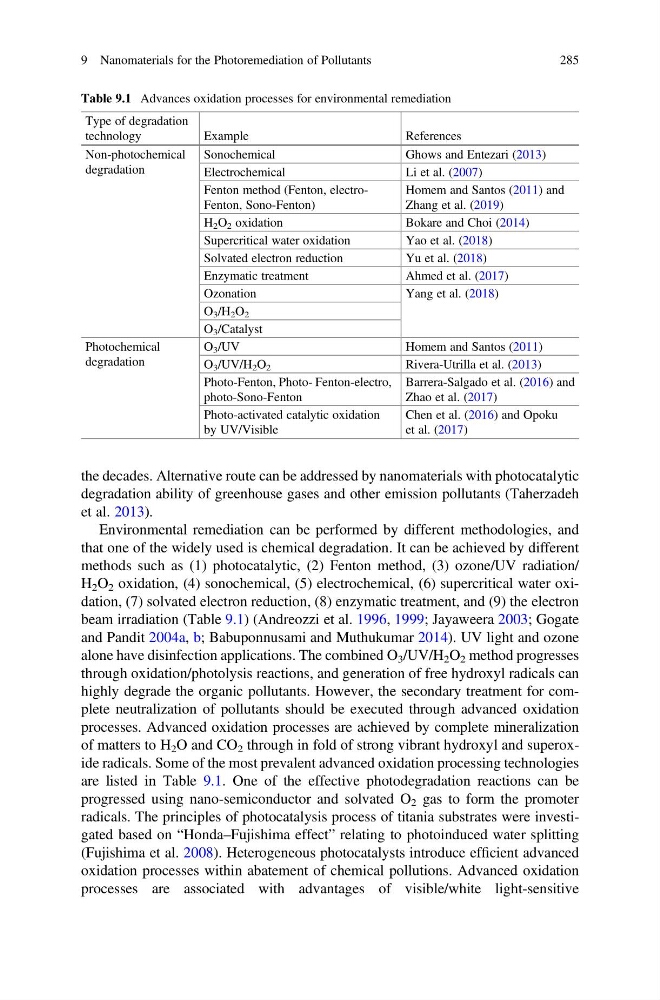
beam irradiation (Table 9.1) (Andreozzi et al. 1996, 1999; Jayaweera 2003; Gogate
and Pandit 2004a, b; Babuponnusami and Muthukumar 2014). UV light and ozone
alone have disinfection applications. The combined O 3 /UV/H 2 O 2 method progresses
through oxidation/photolysis reactions, and generation of free hydroxyl radicals can
highly degrade the organic pollutants. However, the secondary treatment for complete neutralization of pollutants should be executed through advanced oxidation
processes. Advanced oxidation processes are achieved by complete mineralization
of matters to H 2 O and CO 2 through in fold of strong vibrant hydroxyl and superoxide radicals. Some of the most prevalent advanced oxidation processing technologies
are listed in Table 9.1. One of the effective photodegradation reactions can be
progressed using nano-semiconductor and solvated O 2 gas to form the promoter
radicals. The principles of photocatalysis process of titania substrates were investigated based on “Honda–Fujishima effect” relating to photoinduced water splitting
(Fujishima et al. 2008). Heterogeneous photocatalysts introduce efficient advanced
oxidation processes within abatement of chemical pollutions. Advanced oxidation
processes are associated with advantages of visible/white light-sensitive
Table 9.1 Advances oxidation processes for environmental remediation
Type of degradation
technology
Example
References
Non-photochemical
degradation
Sonochemical
Ghows and Entezari (2013)
Electrochemical
Li et al. (2007)
Fenton method (Fenton, electroFenton, Sono-Fenton)
Homem and Santos (2011) and
Zhang et al. (2019)
H 2 O 2 oxidation
Bokare and Choi (2014)
Supercritical water oxidation
Yao et al. (2018)
Solvated electron reduction
Yu et al. (2018)
Enzymatic treatment
Ahmed et al. (2017)
Ozonation
Yang et al. (2018)
O 3 /H 2 O 2
O 3 /Catalyst
Photochemical
degradation
O 3 /UV
Homem and Santos (2011)
O 3 /UV/H 2 O 2
Rivera-Utrilla et al. (2013)
Photo-Fenton, Photo- Fenton-electro,
photo-Sono-Fenton
Barrera-Salgado et al. (2016) and
Zhao et al. (2017)
Photo-activated catalytic oxidation
by UV/Visible
Chen et al. (2016) and Opoku
et al. (2017)
9 Nanomaterials for the Photoremediation of Pollutants
285
degradation ability of greenhouse gases and other emission pollutants (Taherzadeh
et al. 2013).
Environmental remediation can be performed by different methodologies, and
that one of the widely used is chemical degradation. It can be achieved by different
methods such as (1) photocatalytic, (2) Fenton method, (3) ozone/UV radiation/
H 2 O 2 oxidation, (4) sonochemical, (5) electrochemical, (6) supercritical water oxidation, (7) solvated electron reduction, (8) enzymatic treatment, and (9) the electron
beam irradiation (Table 9.1) (Andreozzi et al. 1996, 1999; Jayaweera 2003; Gogate
and Pandit 2004a, b; Babuponnusami and Muthukumar 2014). UV light and ozone
alone have disinfection applications. The combined O 3 /UV/H 2 O 2 method progresses
through oxidation/photolysis reactions, and generation of free hydroxyl radicals can
highly degrade the organic pollutants. However, the secondary treatment for complete neutralization of pollutants should be executed through advanced oxidation
processes. Advanced oxidation processes are achieved by complete mineralization
of matters to H 2 O and CO 2 through in fold of strong vibrant hydroxyl and superoxide radicals. Some of the most prevalent advanced oxidation processing technologies
are listed in Table 9.1. One of the effective photodegradation reactions can be
progressed using nano-semiconductor and solvated O 2 gas to form the promoter
radicals. The principles of photocatalysis process of titania substrates were investigated based on “Honda–Fujishima effect” relating to photoinduced water splitting
(Fujishima et al. 2008). Heterogeneous photocatalysts introduce efficient advanced
oxidation processes within abatement of chemical pollutions. Advanced oxidation
processes are associated with advantages of visible/white light-sensitive
Table 9.1 Advances oxidation processes for environmental remediation
Type of degradation
technology
Example
References
Non-photochemical
degradation
Sonochemical
Ghows and Entezari (2013)
Electrochemical
Li et al. (2007)
Fenton method (Fenton, electroFenton, Sono-Fenton)
Homem and Santos (2011) and
Zhang et al. (2019)
H 2 O 2 oxidation
Bokare and Choi (2014)
Supercritical water oxidation
Yao et al. (2018)
Solvated electron reduction
Yu et al. (2018)
Enzymatic treatment
Ahmed et al. (2017)
Ozonation
Yang et al. (2018)
O 3 /H 2 O 2
O 3 /Catalyst
Photochemical
degradation
O 3 /UV
Homem and Santos (2011)
O 3 /UV/H 2 O 2
Rivera-Utrilla et al. (2013)
Photo-Fenton, Photo- Fenton-electro,
photo-Sono-Fenton
Barrera-Salgado et al. (2016) and
Zhao et al. (2017)
Photo-activated catalytic oxidation
by UV/Visible
Chen et al. (2016) and Opoku
et al. (2017)
9 Nanomaterials for the Photoremediation of Pollutants
285