

relatively less concentration of multivalent solutes and can serve as a feed to
electrolytic production of sodium hydroxide at higher efficiencies. Ramaswami
et al. (2018) have investigated the removal of water from landfill leachates using
nanofiltration–reverse osmosis as well as reverse osmosis–nanofiltration combinations and concluded that nanofiltration–reverse osmosis is advantageous and energyefficient over reverse osmosis–nanofiltration. Sarkar et al. (2011) have demonstrated
that a combination of nanofiltration and reverse osmosis can lead to the separation of
sulfates and chlorides, besides recovering water for recycle. The concentrated
reverse osmosis stream containing concentrated sodium chloride can be used for
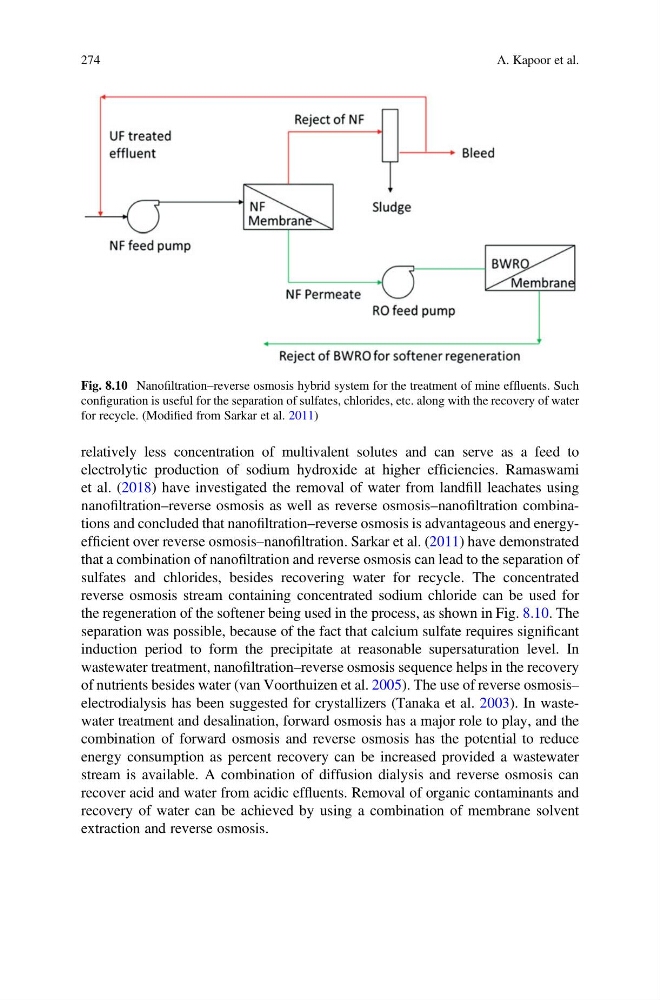
the regeneration of the softener being used in the process, as shown in Fig. 8.10. The
separation was possible, because of the fact that calcium sulfate requires significant
induction period to form the precipitate at reasonable supersaturation level. In
wastewater treatment, nanofiltration–reverse osmosis sequence helps in the recovery
of nutrients besides water (van Voorthuizen et al. 2005). The use of reverse osmosis–
electrodialysis has been suggested for crystallizers (Tanaka et al. 2003). In wastewater treatment and desalination, forward osmosis has a major role to play, and the
combination of forward osmosis and reverse osmosis has the potential to reduce
energy consumption as percent recovery can be increased provided a wastewater
stream is available. A combination of diffusion dialysis and reverse osmosis can
recover acid and water from acidic effluents. Removal of organic contaminants and
recovery of water can be achieved by using a combination of membrane solvent
extraction and reverse osmosis.
Fig. 8.10 Nanofiltration–reverse osmosis hybrid system for the treatment of mine effluents. Such
configuration is useful for the separation of sulfates, chlorides, etc. along with the recovery of water
for recycle. (Modified from Sarkar et al. 2011)
274
A. Kapoor et al.
electrolytic production of sodium hydroxide at higher efficiencies. Ramaswami
et al. (2018) have investigated the removal of water from landfill leachates using
nanofiltration–reverse osmosis as well as reverse osmosis–nanofiltration combinations and concluded that nanofiltration–reverse osmosis is advantageous and energyefficient over reverse osmosis–nanofiltration. Sarkar et al. (2011) have demonstrated
that a combination of nanofiltration and reverse osmosis can lead to the separation of
sulfates and chlorides, besides recovering water for recycle. The concentrated
reverse osmosis stream containing concentrated sodium chloride can be used for
the regeneration of the softener being used in the process, as shown in Fig. 8.10. The
separation was possible, because of the fact that calcium sulfate requires significant
induction period to form the precipitate at reasonable supersaturation level. In
wastewater treatment, nanofiltration–reverse osmosis sequence helps in the recovery
of nutrients besides water (van Voorthuizen et al. 2005). The use of reverse osmosis–
electrodialysis has been suggested for crystallizers (Tanaka et al. 2003). In wastewater treatment and desalination, forward osmosis has a major role to play, and the
combination of forward osmosis and reverse osmosis has the potential to reduce
energy consumption as percent recovery can be increased provided a wastewater
stream is available. A combination of diffusion dialysis and reverse osmosis can
recover acid and water from acidic effluents. Removal of organic contaminants and
recovery of water can be achieved by using a combination of membrane solvent
extraction and reverse osmosis.
Fig. 8.10 Nanofiltration–reverse osmosis hybrid system for the treatment of mine effluents. Such
configuration is useful for the separation of sulfates, chlorides, etc. along with the recovery of water
for recycle. (Modified from Sarkar et al. 2011)
274
A. Kapoor et al.