

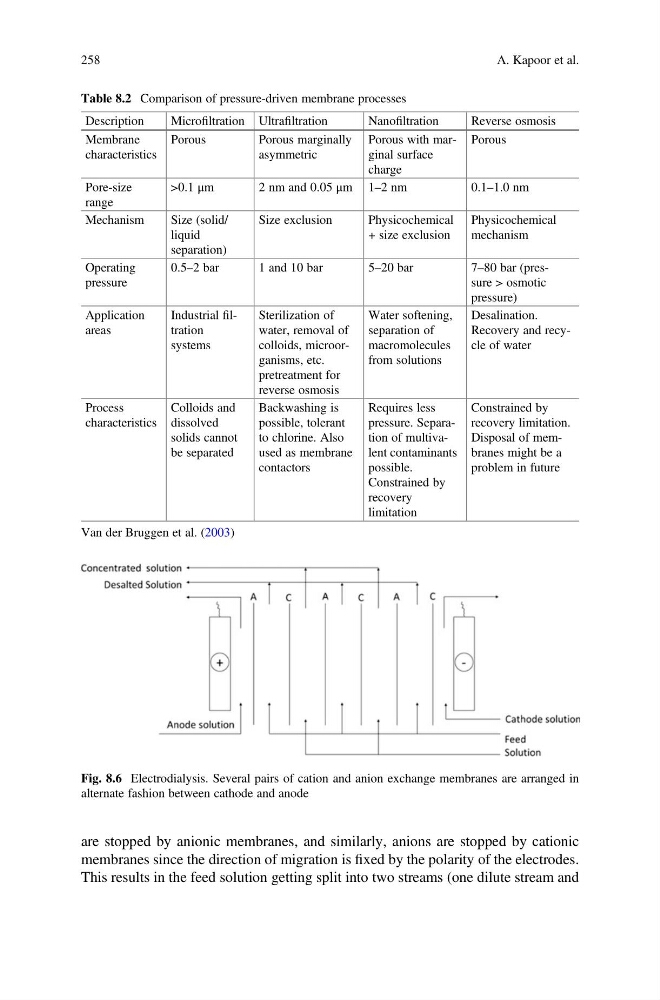
are stopped by anionic membranes, and similarly, anions are stopped by cationic
membranes since the direction of migration is fixed by the polarity of the electrodes.
This results in the feed solution getting split into two streams (one dilute stream and
Table 8.2 Comparison of pressure-driven membrane processes
Description
Microfiltration Ultrafiltration
Nanofiltration
Reverse osmosis
Membrane
characteristics
Porous
Porous marginally
asymmetric
Porous with marginal surface
charge
Porous
Pore-size
range
>0.1 μm
2 nm and 0.05 μm 1–2 nm
0.1–1.0 nm
Mechanism
Size (solid/
liquid
separation)
Size exclusion
Physicochemical
+ size exclusion
Physicochemical
mechanism
Operating
pressure
0.5–2 bar
1 and 10 bar
5–20 bar
7–80 bar (pressure > osmotic
pressure)
Application
areas
Industrial filtration
systems
Sterilization of
water, removal of
colloids, microorganisms, etc.
pretreatment for
reverse osmosis
Water softening,
separation of
macromolecules
from solutions
Desalination.
Recovery and recycle of water
Process
characteristics
Colloids and
dissolved
solids cannot
be separated
Backwashing is
possible, tolerant
to chlorine. Also
used as membrane
contactors
Requires less
pressure. Separation of multivalent contaminants
possible.
Constrained by
recovery
limitation
Constrained by
recovery limitation.
Disposal of membranes might be a
problem in future
Van der Bruggen et al. (2003)
Fig. 8.6 Electrodialysis. Several pairs of cation and anion exchange membranes are arranged in
alternate fashion between cathode and anode
258
A. Kapoor et al.
membranes since the direction of migration is fixed by the polarity of the electrodes.
This results in the feed solution getting split into two streams (one dilute stream and
Table 8.2 Comparison of pressure-driven membrane processes
Description
Microfiltration Ultrafiltration
Nanofiltration
Reverse osmosis
Membrane
characteristics
Porous
Porous marginally
asymmetric
Porous with marginal surface
charge
Porous
Pore-size
range
>0.1 μm
2 nm and 0.05 μm 1–2 nm
0.1–1.0 nm
Mechanism
Size (solid/
liquid
separation)
Size exclusion
Physicochemical
+ size exclusion
Physicochemical
mechanism
Operating
pressure
0.5–2 bar
1 and 10 bar
5–20 bar
7–80 bar (pressure > osmotic
pressure)
Application
areas
Industrial filtration
systems
Sterilization of
water, removal of
colloids, microorganisms, etc.
pretreatment for
reverse osmosis
Water softening,
separation of
macromolecules
from solutions
Desalination.
Recovery and recycle of water
Process
characteristics
Colloids and
dissolved
solids cannot
be separated
Backwashing is
possible, tolerant
to chlorine. Also
used as membrane
contactors
Requires less
pressure. Separation of multivalent contaminants
possible.
Constrained by
recovery
limitation
Constrained by
recovery limitation.
Disposal of membranes might be a
problem in future
Van der Bruggen et al. (2003)
Fig. 8.6 Electrodialysis. Several pairs of cation and anion exchange membranes are arranged in
alternate fashion between cathode and anode
258
A. Kapoor et al.