

highest occupied molecular orbital, HOMO) and the conduction band (the lowest
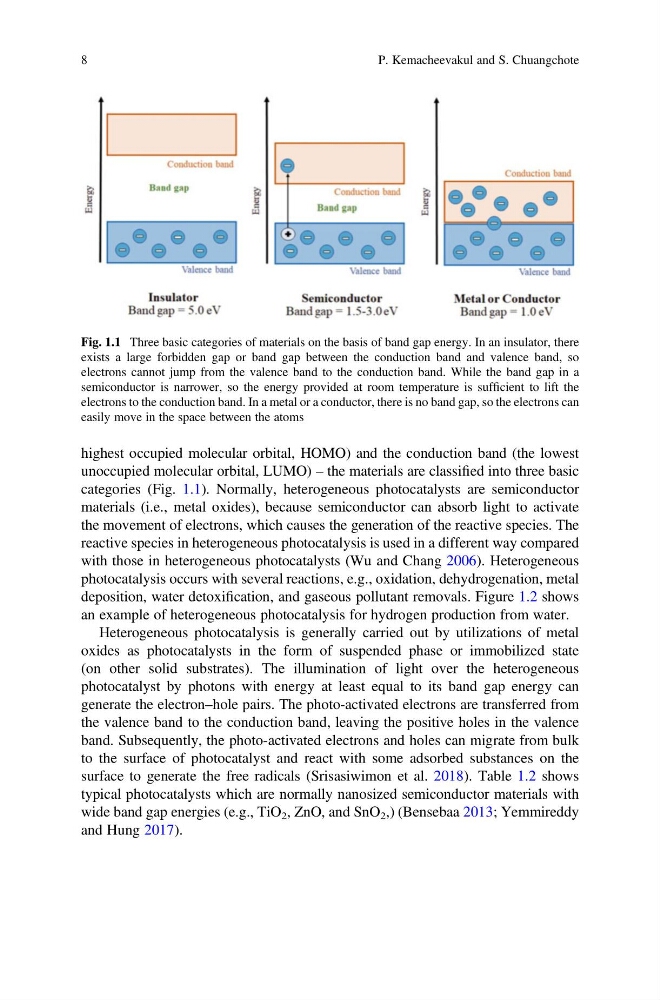
unoccupied molecular orbital, LUMO) – the materials are classified into three basic
categories (Fig. 1.1). Normally, heterogeneous photocatalysts are semiconductor
materials (i.e., metal oxides), because semiconductor can absorb light to activate
the movement of electrons, which causes the generation of the reactive species. The
reactive species in heterogeneous photocatalysis is used in a different way compared
with those in heterogeneous photocatalysts (Wu and Chang 2006). Heterogeneous
photocatalysis occurs with several reactions, e.g., oxidation, dehydrogenation, metal
deposition, water detoxification, and gaseous pollutant removals. Figure 1.2 shows
an example of heterogeneous photocatalysis for hydrogen production from water.
Heterogeneous photocatalysis is generally carried out by utilizations of metal
oxides as photocatalysts in the form of suspended phase or immobilized state
(on other solid substrates). The illumination of light over the heterogeneous
photocatalyst by photons with energy at least equal to its band gap energy can
generate the electron–hole pairs. The photo-activated electrons are transferred from
the valence band to the conduction band, leaving the positive holes in the valence
band. Subsequently, the photo-activated electrons and holes can migrate from bulk
to the surface of photocatalyst and react with some adsorbed substances on the
surface to generate the free radicals (Srisasiwimon et al. 2018). Table 1.2 shows
typical photocatalysts which are normally nanosized semiconductor materials with
wide band gap energies (e.g., TiO 2 , ZnO, and SnO 2 ,) (Bensebaa 2013; Yemmireddy
and Hung 2017).
Fig. 1.1 Three basic categories of materials on the basis of band gap energy. In an insulator, there
exists a large forbidden gap or band gap between the conduction band and valence band, so
electrons cannot jump from the valence band to the conduction band. While the band gap in a
semiconductor is narrower, so the energy provided at room temperature is sufficient to lift the
electrons to the conduction band. In a metal or a conductor, there is no band gap, so the electrons can
easily move in the space between the atoms
8
P. Kemacheevakul and S. Chuangchote
unoccupied molecular orbital, LUMO) – the materials are classified into three basic
categories (Fig. 1.1). Normally, heterogeneous photocatalysts are semiconductor
materials (i.e., metal oxides), because semiconductor can absorb light to activate
the movement of electrons, which causes the generation of the reactive species. The
reactive species in heterogeneous photocatalysis is used in a different way compared
with those in heterogeneous photocatalysts (Wu and Chang 2006). Heterogeneous
photocatalysis occurs with several reactions, e.g., oxidation, dehydrogenation, metal
deposition, water detoxification, and gaseous pollutant removals. Figure 1.2 shows
an example of heterogeneous photocatalysis for hydrogen production from water.
Heterogeneous photocatalysis is generally carried out by utilizations of metal
oxides as photocatalysts in the form of suspended phase or immobilized state
(on other solid substrates). The illumination of light over the heterogeneous
photocatalyst by photons with energy at least equal to its band gap energy can
generate the electron–hole pairs. The photo-activated electrons are transferred from
the valence band to the conduction band, leaving the positive holes in the valence
band. Subsequently, the photo-activated electrons and holes can migrate from bulk
to the surface of photocatalyst and react with some adsorbed substances on the
surface to generate the free radicals (Srisasiwimon et al. 2018). Table 1.2 shows
typical photocatalysts which are normally nanosized semiconductor materials with
wide band gap energies (e.g., TiO 2 , ZnO, and SnO 2 ,) (Bensebaa 2013; Yemmireddy
and Hung 2017).
Fig. 1.1 Three basic categories of materials on the basis of band gap energy. In an insulator, there
exists a large forbidden gap or band gap between the conduction band and valence band, so
electrons cannot jump from the valence band to the conduction band. While the band gap in a
semiconductor is narrower, so the energy provided at room temperature is sufficient to lift the
electrons to the conduction band. In a metal or a conductor, there is no band gap, so the electrons can
easily move in the space between the atoms
8
P. Kemacheevakul and S. Chuangchote