

5.3.2 Quantification of Acoustic Power in Sonochemical
Reactors
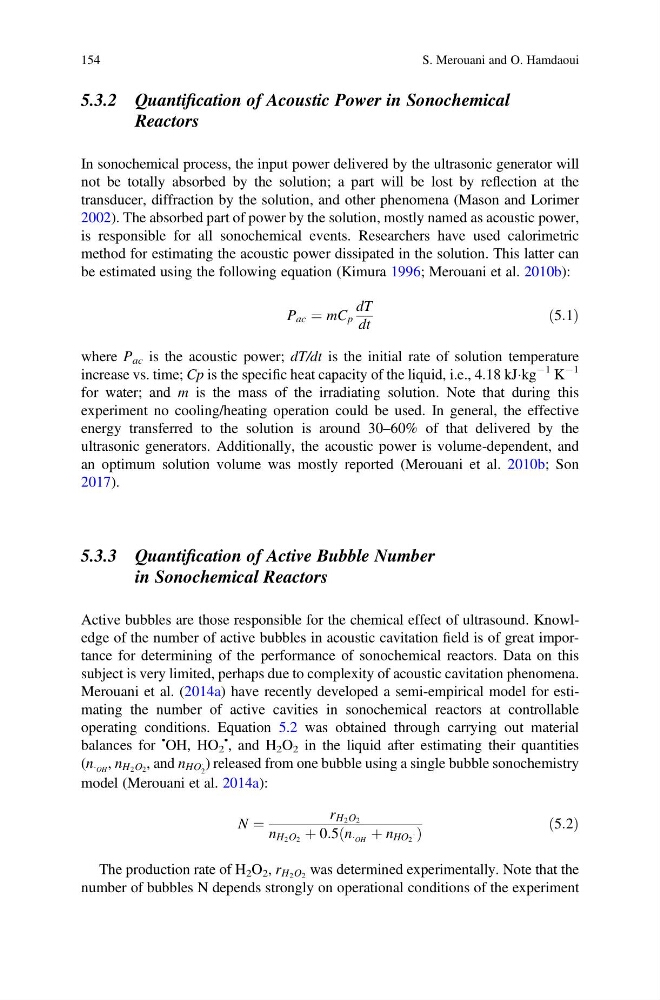
In sonochemical process, the input power delivered by the ultrasonic generator will
not be totally absorbed by the solution; a part will be lost by reflection at the
transducer, diffraction by the solution, and other phenomena (Mason and Lorimer
2002). The absorbed part of power by the solution, mostly named as acoustic power,
is responsible for all sonochemical events. Researchers have used calorimetric
method for estimating the acoustic power dissipated in the solution. This latter can
be estimated using the following equation (Kimura 1996; Merouani et al. 2010b):
P ac ¼ mC p
dT
dt
ð5:1Þ
where P ac is the acoustic power; dT/dt is the initial rate of solution temperature
increase vs. time; Cp is the specific heat capacity of the liquid, i.e., 4.18 kJÁkg
À1 K
À1
for water; and m is the mass of the irradiating solution. Note that during this
experiment no cooling/heating operation could be used. In general, the effective
energy transferred to the solution is around 30–60% of that delivered by the
ultrasonic generators. Additionally, the acoustic power is volume-dependent, and
an optimum solution volume was mostly reported (Merouani et al. 2010b; Son
2017).
5.3.3 Quantification of Active Bubble Number
in Sonochemical Reactors
Active bubbles are those responsible for the chemical effect of ultrasound. Knowledge of the number of active bubbles in acoustic cavitation field is of great importance for determining of the performance of sonochemical reactors. Data on this
subject is very limited, perhaps due to complexity of acoustic cavitation phenomena.
Merouani et al. (2014a) have recently developed a semi-empirical model for estimating the number of active cavities in sonochemical reactors at controllable
operating conditions. Equation 5.2 was obtained through carrying out material
balances for
• OH, HO 2
• , and H 2 O 2 in the liquid after estimating their quantities
(n Á OH , n H 2 O 2 , and n HO
Á
2
) released from one bubble using a single bubble sonochemistry
model (Merouani et al. 2014a):
N ¼
r H 2 O 2
n H 2 O 2 þ 0:5 n Á OH þ n HO 2
Á
ð
Þ
ð5:2Þ
The production rate of H 2 O 2 , r H 2 O 2 was determined experimentally. Note that the
number of bubbles N depends strongly on operational conditions of the experiment
154
S. Merouani and O. Hamdaoui
Reactors
In sonochemical process, the input power delivered by the ultrasonic generator will
not be totally absorbed by the solution; a part will be lost by reflection at the
transducer, diffraction by the solution, and other phenomena (Mason and Lorimer
2002). The absorbed part of power by the solution, mostly named as acoustic power,
is responsible for all sonochemical events. Researchers have used calorimetric
method for estimating the acoustic power dissipated in the solution. This latter can
be estimated using the following equation (Kimura 1996; Merouani et al. 2010b):
P ac ¼ mC p
dT
dt
ð5:1Þ
where P ac is the acoustic power; dT/dt is the initial rate of solution temperature
increase vs. time; Cp is the specific heat capacity of the liquid, i.e., 4.18 kJÁkg
À1 K
À1
for water; and m is the mass of the irradiating solution. Note that during this
experiment no cooling/heating operation could be used. In general, the effective
energy transferred to the solution is around 30–60% of that delivered by the
ultrasonic generators. Additionally, the acoustic power is volume-dependent, and
an optimum solution volume was mostly reported (Merouani et al. 2010b; Son
2017).
5.3.3 Quantification of Active Bubble Number
in Sonochemical Reactors
Active bubbles are those responsible for the chemical effect of ultrasound. Knowledge of the number of active bubbles in acoustic cavitation field is of great importance for determining of the performance of sonochemical reactors. Data on this
subject is very limited, perhaps due to complexity of acoustic cavitation phenomena.
Merouani et al. (2014a) have recently developed a semi-empirical model for estimating the number of active cavities in sonochemical reactors at controllable
operating conditions. Equation 5.2 was obtained through carrying out material
balances for
• OH, HO 2
• , and H 2 O 2 in the liquid after estimating their quantities
(n Á OH , n H 2 O 2 , and n HO
Á
2
) released from one bubble using a single bubble sonochemistry
model (Merouani et al. 2014a):
N ¼
r H 2 O 2
n H 2 O 2 þ 0:5 n Á OH þ n HO 2
Á
ð
Þ
ð5:2Þ
The production rate of H 2 O 2 , r H 2 O 2 was determined experimentally. Note that the
number of bubbles N depends strongly on operational conditions of the experiment
154
S. Merouani and O. Hamdaoui