

of C–S, C–N, C–C, N–N bond. Lachheb et al. in (2002) employed TiO 2
nanoparticles under ultraviolet light and explored the degradation of methyl red,
congo red, and crocein orange G azo dye. The photodegradation started with the
evolution of di-nitrogen gas from azo group, and the aromatic ring is subsequently
attacked by reactive oxidation species followed by ring cleavage followed by the
evolution of CO 2 gas.
Moreover, Konstantinou and Albanis in (2004) reviewed photodegradation of azo
dye using TiO 2 under visible and ultraviolet light separately and follows pseudofirst-order kinetics. The pH of solution, concentration of catalyst, and dye decide the
extent of degradation of azo dyes. The various intermediates are formed during the
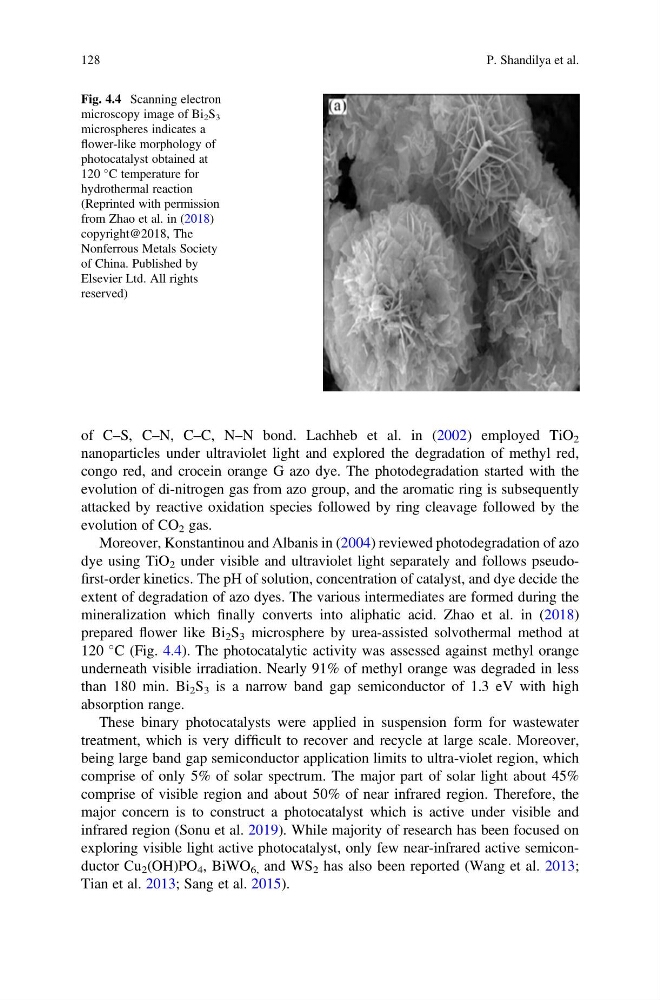
mineralization which finally converts into aliphatic acid. Zhao et al. in (2018)
prepared flower like Bi 2 S 3 microsphere by urea-assisted solvothermal method at
120
C (Fig. 4.4). The photocatalytic activity was assessed against methyl orange
underneath visible irradiation. Nearly 91% of methyl orange was degraded in less
than 180 min. Bi 2 S 3 is a narrow band gap semiconductor of 1.3 eV with high
absorption range.
These binary photocatalysts were applied in suspension form for wastewater
treatment, which is very difficult to recover and recycle at large scale. Moreover,
being large band gap semiconductor application limits to ultra-violet region, which
comprise of only 5% of solar spectrum. The major part of solar light about 45%
comprise of visible region and about 50% of near infrared region. Therefore, the
major concern is to construct a photocatalyst which is active under visible and
infrared region (Sonu et al. 2019). While majority of research has been focused on
exploring visible light active photocatalyst, only few near-infrared active semiconductor Cu 2 (OH)PO 4 , BiWO 6, and WS 2 has also been reported (Wang et al. 2013;
Tian et al. 2013; Sang et al. 2015).
Fig. 4.4 Scanning electron
microscopy image of Bi 2 S 3
microspheres indicates a
flower-like morphology of
photocatalyst obtained at
120
C temperature for
hydrothermal reaction
(Reprinted with permission
from Zhao et al. in (2018)
copyright@2018, The
Nonferrous Metals Society
of China. Published by
Elsevier Ltd. All rights
reserved)
128
P. Shandilya et al.
nanoparticles under ultraviolet light and explored the degradation of methyl red,
congo red, and crocein orange G azo dye. The photodegradation started with the
evolution of di-nitrogen gas from azo group, and the aromatic ring is subsequently
attacked by reactive oxidation species followed by ring cleavage followed by the
evolution of CO 2 gas.
Moreover, Konstantinou and Albanis in (2004) reviewed photodegradation of azo
dye using TiO 2 under visible and ultraviolet light separately and follows pseudofirst-order kinetics. The pH of solution, concentration of catalyst, and dye decide the
extent of degradation of azo dyes. The various intermediates are formed during the
mineralization which finally converts into aliphatic acid. Zhao et al. in (2018)
prepared flower like Bi 2 S 3 microsphere by urea-assisted solvothermal method at
120
C (Fig. 4.4). The photocatalytic activity was assessed against methyl orange
underneath visible irradiation. Nearly 91% of methyl orange was degraded in less
than 180 min. Bi 2 S 3 is a narrow band gap semiconductor of 1.3 eV with high
absorption range.
These binary photocatalysts were applied in suspension form for wastewater
treatment, which is very difficult to recover and recycle at large scale. Moreover,
being large band gap semiconductor application limits to ultra-violet region, which
comprise of only 5% of solar spectrum. The major part of solar light about 45%
comprise of visible region and about 50% of near infrared region. Therefore, the
major concern is to construct a photocatalyst which is active under visible and
infrared region (Sonu et al. 2019). While majority of research has been focused on
exploring visible light active photocatalyst, only few near-infrared active semiconductor Cu 2 (OH)PO 4 , BiWO 6, and WS 2 has also been reported (Wang et al. 2013;
Tian et al. 2013; Sang et al. 2015).
Fig. 4.4 Scanning electron
microscopy image of Bi 2 S 3
microspheres indicates a
flower-like morphology of
photocatalyst obtained at
120
C temperature for
hydrothermal reaction
(Reprinted with permission
from Zhao et al. in (2018)
copyright@2018, The
Nonferrous Metals Society
of China. Published by
Elsevier Ltd. All rights
reserved)
128
P. Shandilya et al.