

discharge into water bodies without treatment thereby causing major threat to the
environment (Jamwal et al. 2015; Pare et al. 2009a; Gautam et al. 2016; Raizada
et al. 2017).
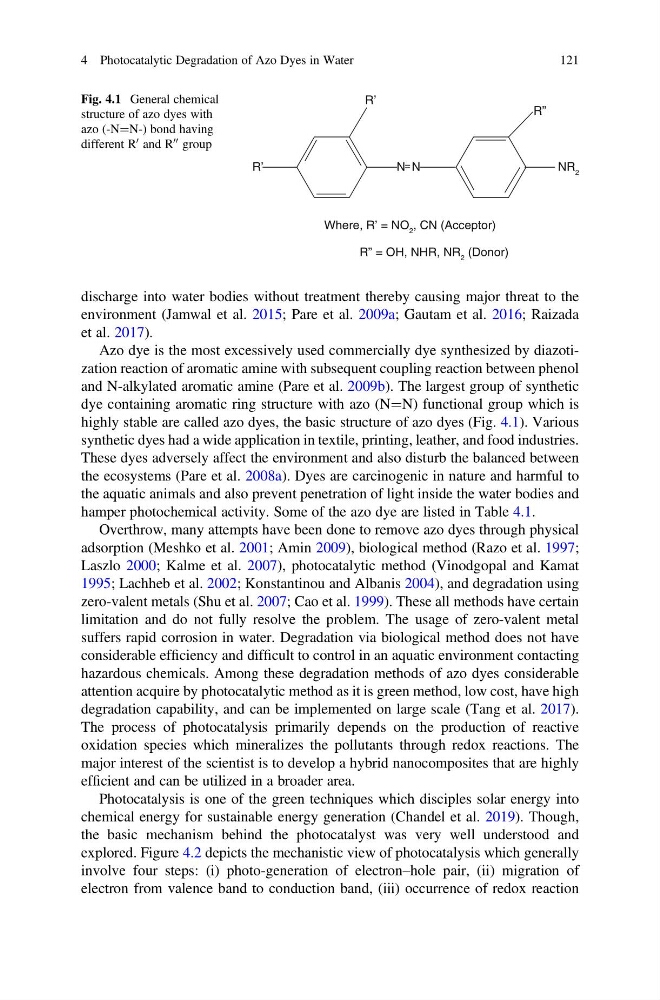
Azo dye is the most excessively used commercially dye synthesized by diazotization reaction of aromatic amine with subsequent coupling reaction between phenol
and N-alkylated aromatic amine (Pare et al. 2009b). The largest group of synthetic
dye containing aromatic ring structure with azo (N¼N) functional group which is
highly stable are called azo dyes, the basic structure of azo dyes (Fig. 4.1). Various
synthetic dyes had a wide application in textile, printing, leather, and food industries.
These dyes adversely affect the environment and also disturb the balanced between
the ecosystems (Pare et al. 2008a). Dyes are carcinogenic in nature and harmful to
the aquatic animals and also prevent penetration of light inside the water bodies and
hamper photochemical activity. Some of the azo dye are listed in Table 4.1.
Overthrow, many attempts have been done to remove azo dyes through physical
adsorption (Meshko et al. 2001; Amin 2009), biological method (Razo et al. 1997;
Laszlo 2000; Kalme et al. 2007), photocatalytic method (Vinodgopal and Kamat
1995; Lachheb et al. 2002; Konstantinou and Albanis 2004), and degradation using
zero-valent metals (Shu et al. 2007; Cao et al. 1999). These all methods have certain
limitation and do not fully resolve the problem. The usage of zero-valent metal
suffers rapid corrosion in water. Degradation via biological method does not have
considerable efficiency and difficult to control in an aquatic environment contacting
hazardous chemicals. Among these degradation methods of azo dyes considerable
attention acquire by photocatalytic method as it is green method, low cost, have high
degradation capability, and can be implemented on large scale (Tang et al. 2017).
The process of photocatalysis primarily depends on the production of reactive
oxidation species which mineralizes the pollutants through redox reactions. The
major interest of the scientist is to develop a hybrid nanocomposites that are highly
efficient and can be utilized in a broader area.
Photocatalysis is one of the green techniques which disciples solar energy into
chemical energy for sustainable energy generation (Chandel et al. 2019). Though,
the basic mechanism behind the photocatalyst was very well understood and
explored. Figure 4.2 depicts the mechanistic view of photocatalysis which generally
involve four steps: (i) photo-generation of electron–hole pair, (ii) migration of
electron from valence band to conduction band, (iii) occurrence of redox reaction
R’
R’
R”
NR 2
Where, R’ = NO 2 , CN (Acceptor)
R” = OH, NHR, NR 2 (Donor)
N N
Fig. 4.1 General chemical
structure of azo dyes with
azo (-N¼N-) bond having
different R
0 and R
00 group
4 Photocatalytic Degradation of Azo Dyes in Water
121
environment (Jamwal et al. 2015; Pare et al. 2009a; Gautam et al. 2016; Raizada
et al. 2017).
Azo dye is the most excessively used commercially dye synthesized by diazotization reaction of aromatic amine with subsequent coupling reaction between phenol
and N-alkylated aromatic amine (Pare et al. 2009b). The largest group of synthetic
dye containing aromatic ring structure with azo (N¼N) functional group which is
highly stable are called azo dyes, the basic structure of azo dyes (Fig. 4.1). Various
synthetic dyes had a wide application in textile, printing, leather, and food industries.
These dyes adversely affect the environment and also disturb the balanced between
the ecosystems (Pare et al. 2008a). Dyes are carcinogenic in nature and harmful to
the aquatic animals and also prevent penetration of light inside the water bodies and
hamper photochemical activity. Some of the azo dye are listed in Table 4.1.
Overthrow, many attempts have been done to remove azo dyes through physical
adsorption (Meshko et al. 2001; Amin 2009), biological method (Razo et al. 1997;
Laszlo 2000; Kalme et al. 2007), photocatalytic method (Vinodgopal and Kamat
1995; Lachheb et al. 2002; Konstantinou and Albanis 2004), and degradation using
zero-valent metals (Shu et al. 2007; Cao et al. 1999). These all methods have certain
limitation and do not fully resolve the problem. The usage of zero-valent metal
suffers rapid corrosion in water. Degradation via biological method does not have
considerable efficiency and difficult to control in an aquatic environment contacting
hazardous chemicals. Among these degradation methods of azo dyes considerable
attention acquire by photocatalytic method as it is green method, low cost, have high
degradation capability, and can be implemented on large scale (Tang et al. 2017).
The process of photocatalysis primarily depends on the production of reactive
oxidation species which mineralizes the pollutants through redox reactions. The
major interest of the scientist is to develop a hybrid nanocomposites that are highly
efficient and can be utilized in a broader area.
Photocatalysis is one of the green techniques which disciples solar energy into
chemical energy for sustainable energy generation (Chandel et al. 2019). Though,
the basic mechanism behind the photocatalyst was very well understood and
explored. Figure 4.2 depicts the mechanistic view of photocatalysis which generally
involve four steps: (i) photo-generation of electron–hole pair, (ii) migration of
electron from valence band to conduction band, (iii) occurrence of redox reaction
R’
R’
R”
NR 2
Where, R’ = NO 2 , CN (Acceptor)
R” = OH, NHR, NR 2 (Donor)
N N
Fig. 4.1 General chemical
structure of azo dyes with
azo (-N¼N-) bond having
different R
0 and R
00 group
4 Photocatalytic Degradation of Azo Dyes in Water
121