

Acid Oxidizing Exfoliation
In acid oxidizing exfoliation method, carbon quantum dots were synthesized by
controlled oxidation using strong oxidizing acids such as H 2 SO 4 and HNO 3 . Using
harsh and drastic condition is necessary for the formulation of carbon quantum dots
and one of the major disadvantages of acid oxidizing exfoliation method. Graphene
quantum dots have promising application in nanotechnology and can be synthesized
by chemical breakdown of graphene oxide (Zhu et al. 2010; Terrones et al. 2010).
Peng et al. (2012) prepared graphene quantum dots in large scale by acid exfoliation
followed by etching of carbon fibers having resin-rich surface. Different sized
graphene quantum dots which can be accessed by easily varying the reaction
temperature were observed.
Various strategies are focused on regulating the size of the carbonaceous material
not more than 10 nm which is called carbon quantum dots that attributes to the
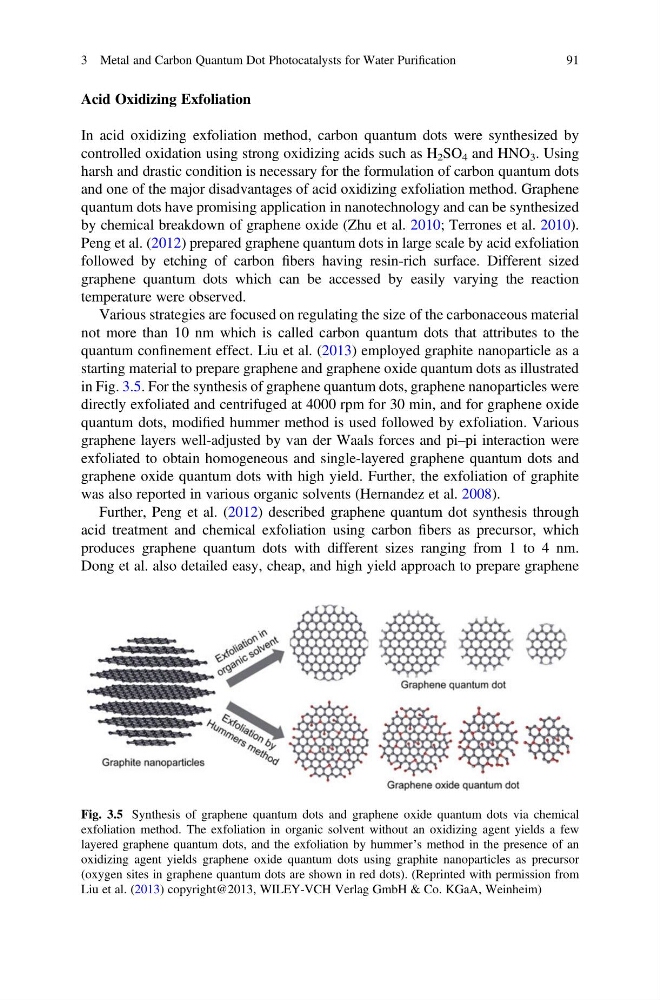
quantum confinement effect. Liu et al. (2013) employed graphite nanoparticle as a
starting material to prepare graphene and graphene oxide quantum dots as illustrated
in Fig. 3.5. For the synthesis of graphene quantum dots, graphene nanoparticles were
directly exfoliated and centrifuged at 4000 rpm for 30 min, and for graphene oxide
quantum dots, modified hummer method is used followed by exfoliation. Various
graphene layers well-adjusted by van der Waals forces and pi–pi interaction were
exfoliated to obtain homogeneous and single-layered graphene quantum dots and
graphene oxide quantum dots with high yield. Further, the exfoliation of graphite
was also reported in various organic solvents (Hernandez et al. 2008).
Further, Peng et al. (2012) described graphene quantum dot synthesis through
acid treatment and chemical exfoliation using carbon fibers as precursor, which
produces graphene quantum dots with different sizes ranging from 1 to 4 nm.
Dong et al. also detailed easy, cheap, and high yield approach to prepare graphene
Fig. 3.5 Synthesis of graphene quantum dots and graphene oxide quantum dots via chemical
exfoliation method. The exfoliation in organic solvent without an oxidizing agent yields a few
layered graphene quantum dots, and the exfoliation by hummer’s method in the presence of an
oxidizing agent yields graphene oxide quantum dots using graphite nanoparticles as precursor
(oxygen sites in graphene quantum dots are shown in red dots). (Reprinted with permission from
Liu et al. (2013) copyright@2013, WILEY-VCH Verlag GmbH & Co. KGaA, Weinheim)
3 Metal and Carbon Quantum Dot Photocatalysts for Water Purification
91
In acid oxidizing exfoliation method, carbon quantum dots were synthesized by
controlled oxidation using strong oxidizing acids such as H 2 SO 4 and HNO 3 . Using
harsh and drastic condition is necessary for the formulation of carbon quantum dots
and one of the major disadvantages of acid oxidizing exfoliation method. Graphene
quantum dots have promising application in nanotechnology and can be synthesized
by chemical breakdown of graphene oxide (Zhu et al. 2010; Terrones et al. 2010).
Peng et al. (2012) prepared graphene quantum dots in large scale by acid exfoliation
followed by etching of carbon fibers having resin-rich surface. Different sized
graphene quantum dots which can be accessed by easily varying the reaction
temperature were observed.
Various strategies are focused on regulating the size of the carbonaceous material
not more than 10 nm which is called carbon quantum dots that attributes to the
quantum confinement effect. Liu et al. (2013) employed graphite nanoparticle as a
starting material to prepare graphene and graphene oxide quantum dots as illustrated
in Fig. 3.5. For the synthesis of graphene quantum dots, graphene nanoparticles were
directly exfoliated and centrifuged at 4000 rpm for 30 min, and for graphene oxide
quantum dots, modified hummer method is used followed by exfoliation. Various
graphene layers well-adjusted by van der Waals forces and pi–pi interaction were
exfoliated to obtain homogeneous and single-layered graphene quantum dots and
graphene oxide quantum dots with high yield. Further, the exfoliation of graphite
was also reported in various organic solvents (Hernandez et al. 2008).
Further, Peng et al. (2012) described graphene quantum dot synthesis through
acid treatment and chemical exfoliation using carbon fibers as precursor, which
produces graphene quantum dots with different sizes ranging from 1 to 4 nm.
Dong et al. also detailed easy, cheap, and high yield approach to prepare graphene
Fig. 3.5 Synthesis of graphene quantum dots and graphene oxide quantum dots via chemical
exfoliation method. The exfoliation in organic solvent without an oxidizing agent yields a few
layered graphene quantum dots, and the exfoliation by hummer’s method in the presence of an
oxidizing agent yields graphene oxide quantum dots using graphite nanoparticles as precursor
(oxygen sites in graphene quantum dots are shown in red dots). (Reprinted with permission from
Liu et al. (2013) copyright@2013, WILEY-VCH Verlag GmbH & Co. KGaA, Weinheim)
3 Metal and Carbon Quantum Dot Photocatalysts for Water Purification
91