

4 Climate Change and Water Resources in West Africa …
71
3.2.2 Impacts of Rainfall Variation on Groundwater Levels
In West Africa, data collected between 1992 and 2005 by the AMMA project (Multidisciplinary Analysis of the African Monsoon) show that there is no direct correlation between annual rainfall and groundwater recharge. This is due to the intensity of
precipitation, which is more decisive. Moderate rains lead to more infiltration than
intense and light rains (Hammond Murray-Rust and Fakhruddin 2014). Estimating
the impacts of precipitation on groundwater is difficult to achieve in West Africa
because locally collected data are scarce and the rates of change in rainfall, runoff,
and infiltration can be highly variable, even in small areas. However, we note that
anthropogenic factors, particularly irrigation, have a greater influence on the decrease
in groundwater levels than climate change, according to a simulation in Mali. The
increase in the groundwater level of the Continental Terminal in Niger averaging
0.2 m/year since the 1960s shows that the climate-groundwater relationship is not
simple (Barrat, 2012).
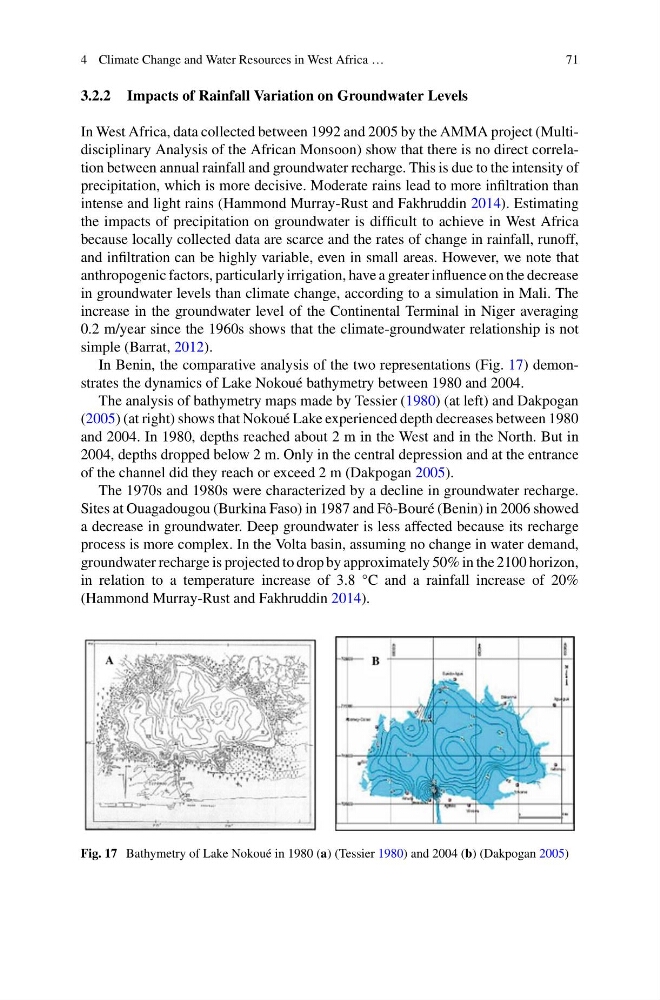
In Benin, the comparative analysis of the two representations (Fig. 17) demonstrates the dynamics of Lake Nokoué bathymetry between 1980 and 2004.
The analysis of bathymetry maps made by Tessier (1980) (at left) and Dakpogan
(2005) (at right) shows that Nokoué Lake experienced depth decreases between 1980
and 2004. In 1980, depths reached about 2 m in the West and in the North. But in
2004, depths dropped below 2 m. Only in the central depression and at the entrance
of the channel did they reach or exceed 2 m (Dakpogan 2005).
The 1970s and 1980s were characterized by a decline in groundwater recharge.
Sites at Ouagadougou (Burkina Faso) in 1987 and Fô-Bouré (Benin) in 2006 showed
a decrease in groundwater. Deep groundwater is less affected because its recharge
process is more complex. In the Volta basin, assuming no change in water demand,
groundwater recharge is projected to drop by approximately 50% in the 2100 horizon,
in relation to a temperature increase of 3.8 °C and a rainfall increase of 20%
(Hammond Murray-Rust and Fakhruddin 2014).
Fig. 17 Bathymetry of Lake Nokoué in 1980 (a) (Tessier 1980) and 2004 (b) (Dakpogan 2005)
71
3.2.2 Impacts of Rainfall Variation on Groundwater Levels
In West Africa, data collected between 1992 and 2005 by the AMMA project (Multidisciplinary Analysis of the African Monsoon) show that there is no direct correlation between annual rainfall and groundwater recharge. This is due to the intensity of
precipitation, which is more decisive. Moderate rains lead to more infiltration than
intense and light rains (Hammond Murray-Rust and Fakhruddin 2014). Estimating
the impacts of precipitation on groundwater is difficult to achieve in West Africa
because locally collected data are scarce and the rates of change in rainfall, runoff,
and infiltration can be highly variable, even in small areas. However, we note that
anthropogenic factors, particularly irrigation, have a greater influence on the decrease
in groundwater levels than climate change, according to a simulation in Mali. The
increase in the groundwater level of the Continental Terminal in Niger averaging
0.2 m/year since the 1960s shows that the climate-groundwater relationship is not
simple (Barrat, 2012).
In Benin, the comparative analysis of the two representations (Fig. 17) demonstrates the dynamics of Lake Nokoué bathymetry between 1980 and 2004.
The analysis of bathymetry maps made by Tessier (1980) (at left) and Dakpogan
(2005) (at right) shows that Nokoué Lake experienced depth decreases between 1980
and 2004. In 1980, depths reached about 2 m in the West and in the North. But in
2004, depths dropped below 2 m. Only in the central depression and at the entrance
of the channel did they reach or exceed 2 m (Dakpogan 2005).
The 1970s and 1980s were characterized by a decline in groundwater recharge.
Sites at Ouagadougou (Burkina Faso) in 1987 and Fô-Bouré (Benin) in 2006 showed
a decrease in groundwater. Deep groundwater is less affected because its recharge
process is more complex. In the Volta basin, assuming no change in water demand,
groundwater recharge is projected to drop by approximately 50% in the 2100 horizon,
in relation to a temperature increase of 3.8 °C and a rainfall increase of 20%
(Hammond Murray-Rust and Fakhruddin 2014).
Fig. 17 Bathymetry of Lake Nokoué in 1980 (a) (Tessier 1980) and 2004 (b) (Dakpogan 2005)