

66
P. Sagna et al.
Fig. 10 Evolution of Lee
and Heghinian’s test results
in Burkina Faso from 1921
to 2016
Bayesian’s method results
A posteriori probability density function mode of
the break point position: 0,3954 in 1969
1952, and 1039.3 mm in 1964. The driest years in the second period are closer to
each other, with 691.5 mm in 1980, 598.5 mm in 1983, 662.6 mm in 1984, 704.4 mm
in 1990, and 681.6 mm in 2002. The difference between the rainiest year (1933) and
the driest year (1983) is 466.1 mm. This series of rainfall measurements in Burkina
Faso is on average 48 years greater than the average of the period 1921–2016, with
37 years in the wet period and 11 years in the dry period and 48 years lower, including
12 in the first period and 36 in the second. Despite this relative balance, recent years
have marked an increase in rainfall.
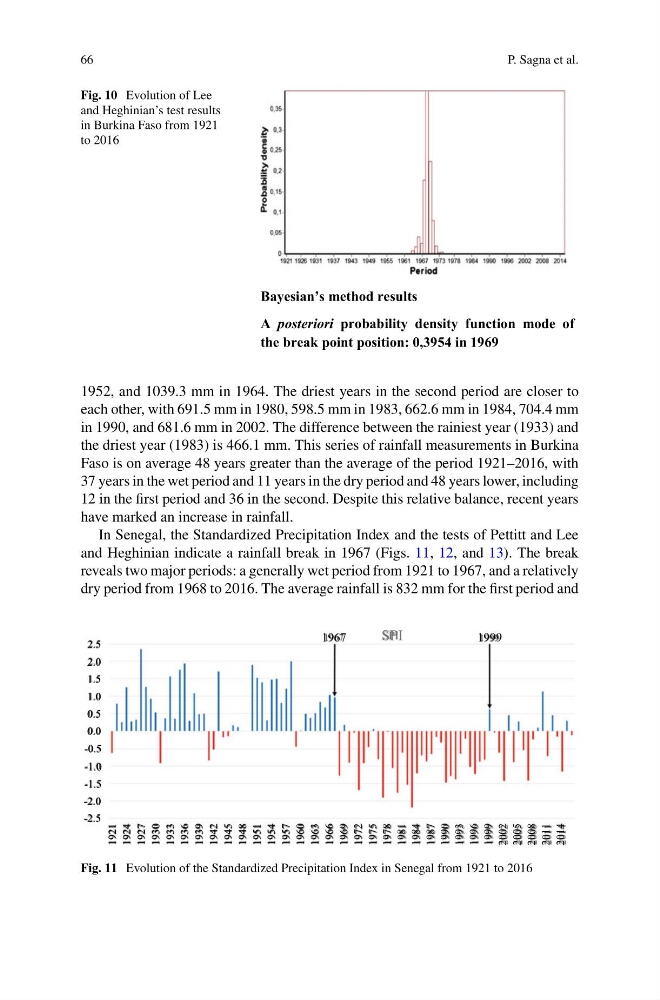
In Senegal, the Standardized Precipitation Index and the tests of Pettitt and Lee
and Heghinian indicate a rainfall break in 1967 (Figs. 11, 12, and 13). The break
reveals two major periods: a generally wet period from 1921 to 1967, and a relatively
dry period from 1968 to 2016. The average rainfall is 832 mm for the first period and
-2.5
-2.0
-1.5
-1.0
-0.5
0.0
0.5
1.0
1.5
2.0
2.5
1921
1924
1927
1930
1933
1936
1939
1942
1945
1948
1951
1954
1957
1960
1963
1966
1969
1972
1975
1978
1981
1984
1987
1990
1993
1996
1999
2002
2005
2008
2011
2014
SPI
1999
1967
Fig. 11 Evolution of the Standardized Precipitation Index in Senegal from 1921 to 2016
P. Sagna et al.
Fig. 10 Evolution of Lee
and Heghinian’s test results
in Burkina Faso from 1921
to 2016
Bayesian’s method results
A posteriori probability density function mode of
the break point position: 0,3954 in 1969
1952, and 1039.3 mm in 1964. The driest years in the second period are closer to
each other, with 691.5 mm in 1980, 598.5 mm in 1983, 662.6 mm in 1984, 704.4 mm
in 1990, and 681.6 mm in 2002. The difference between the rainiest year (1933) and
the driest year (1983) is 466.1 mm. This series of rainfall measurements in Burkina
Faso is on average 48 years greater than the average of the period 1921–2016, with
37 years in the wet period and 11 years in the dry period and 48 years lower, including
12 in the first period and 36 in the second. Despite this relative balance, recent years
have marked an increase in rainfall.
In Senegal, the Standardized Precipitation Index and the tests of Pettitt and Lee
and Heghinian indicate a rainfall break in 1967 (Figs. 11, 12, and 13). The break
reveals two major periods: a generally wet period from 1921 to 1967, and a relatively
dry period from 1968 to 2016. The average rainfall is 832 mm for the first period and
-2.5
-2.0
-1.5
-1.0
-0.5
0.0
0.5
1.0
1.5
2.0
2.5
1921
1924
1927
1930
1933
1936
1939
1942
1945
1948
1951
1954
1957
1960
1963
1966
1969
1972
1975
1978
1981
1984
1987
1990
1993
1996
1999
2002
2005
2008
2011
2014
SPI
1999
1967
Fig. 11 Evolution of the Standardized Precipitation Index in Senegal from 1921 to 2016