

38
O. Mahjoub et al.
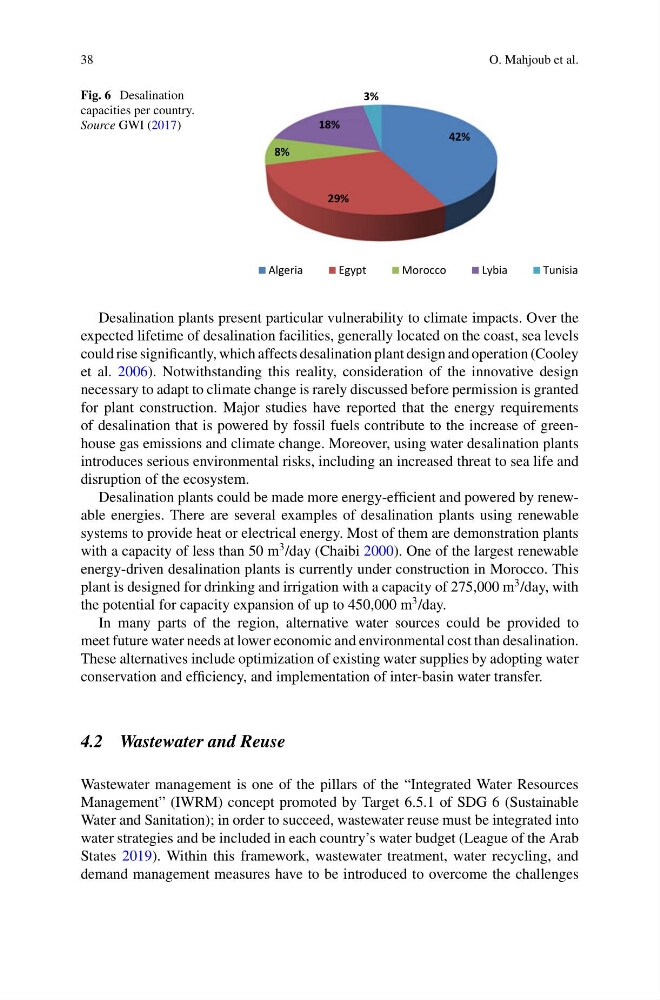
Fig. 6 Desalination
capacities per country.
Source GWI (2017)
42%
29%
8%
18%
3%
Algeria
Egypt
Morocco
Lybia
Tunisia
Desalination plants present particular vulnerability to climate impacts. Over the
expected lifetime of desalination facilities, generally located on the coast, sea levels
could rise significantly, which affects desalination plant design and operation (Cooley
et al. 2006). Notwithstanding this reality, consideration of the innovative design
necessary to adapt to climate change is rarely discussed before permission is granted
for plant construction. Major studies have reported that the energy requirements
of desalination that is powered by fossil fuels contribute to the increase of greenhouse gas emissions and climate change. Moreover, using water desalination plants
introduces serious environmental risks, including an increased threat to sea life and
disruption of the ecosystem.
Desalination plants could be made more energy-efficient and powered by renewable energies. There are several examples of desalination plants using renewable
systems to provide heat or electrical energy. Most of them are demonstration plants
with a capacity of less than 50 m
3 /day (Chaibi 2000). One of the largest renewable
energy-driven desalination plants is currently under construction in Morocco. This
plant is designed for drinking and irrigation with a capacity of 275,000 m
3 /day, with
the potential for capacity expansion of up to 450,000 m
3 /day.
In many parts of the region, alternative water sources could be provided to
meet future water needs at lower economic and environmental cost than desalination.
These alternatives include optimization of existing water supplies by adopting water
conservation and efficiency, and implementation of inter-basin water transfer.
4.2 Wastewater and Reuse
Wastewater management is one of the pillars of the “Integrated Water Resources
Management” (IWRM) concept promoted by Target 6.5.1 of SDG 6 (Sustainable
Water and Sanitation); in order to succeed, wastewater reuse must be integrated into
water strategies and be included in each country’s water budget (League of the Arab
States 2019). Within this framework, wastewater treatment, water recycling, and
demand management measures have to be introduced to overcome the challenges
O. Mahjoub et al.
Fig. 6 Desalination
capacities per country.
Source GWI (2017)
42%
29%
8%
18%
3%
Algeria
Egypt
Morocco
Lybia
Tunisia
Desalination plants present particular vulnerability to climate impacts. Over the
expected lifetime of desalination facilities, generally located on the coast, sea levels
could rise significantly, which affects desalination plant design and operation (Cooley
et al. 2006). Notwithstanding this reality, consideration of the innovative design
necessary to adapt to climate change is rarely discussed before permission is granted
for plant construction. Major studies have reported that the energy requirements
of desalination that is powered by fossil fuels contribute to the increase of greenhouse gas emissions and climate change. Moreover, using water desalination plants
introduces serious environmental risks, including an increased threat to sea life and
disruption of the ecosystem.
Desalination plants could be made more energy-efficient and powered by renewable energies. There are several examples of desalination plants using renewable
systems to provide heat or electrical energy. Most of them are demonstration plants
with a capacity of less than 50 m
3 /day (Chaibi 2000). One of the largest renewable
energy-driven desalination plants is currently under construction in Morocco. This
plant is designed for drinking and irrigation with a capacity of 275,000 m
3 /day, with
the potential for capacity expansion of up to 450,000 m
3 /day.
In many parts of the region, alternative water sources could be provided to
meet future water needs at lower economic and environmental cost than desalination.
These alternatives include optimization of existing water supplies by adopting water
conservation and efficiency, and implementation of inter-basin water transfer.
4.2 Wastewater and Reuse
Wastewater management is one of the pillars of the “Integrated Water Resources
Management” (IWRM) concept promoted by Target 6.5.1 of SDG 6 (Sustainable
Water and Sanitation); in order to succeed, wastewater reuse must be integrated into
water strategies and be included in each country’s water budget (League of the Arab
States 2019). Within this framework, wastewater treatment, water recycling, and
demand management measures have to be introduced to overcome the challenges