

19 Mainstreaming Climate Change into Transboundary …
441
3.3 Assessing Climate Change Impacts on Key Hydrological
Drivers and Responses in the Orange-Senqu River Basin
The Orange-Senqu is a water-scarce high-risk hydro-climatic basin as a consequence
of low rainfall-to-runoff conversion, high aridity, and high climatic variability. It is
thus at higher risk to climate change impacts than many other regions in the world
(Knoesen 2012). Each of the 1,443 hydrologically interlinked quinary catchments
that make up the Orange River Catchment was simulated using data from the Quinary
Catchment Database.
Streamflows for the intermediate (2046–2065) and distant (2081–2100) future
climate were also simulated. However, that was only for catchments that exist in
South Africa and Lesotho, while Botswana and Namibia were not included due to
the lack of readily available historical data and downscaled values for these areas of
the basin.
3.4 Projected Changes Due to Climate Change
in the Orange-Senqu River Basin
3.4.1 Rainfall
Rainfall is categorized as short or long duration. Short duration rainfall occurs over
24 h or less, and depending on the intensity, it may contribute to local flooding. Long
duration rainfall in contrast occurs over 1 to 7 days and, if extreme, may result in
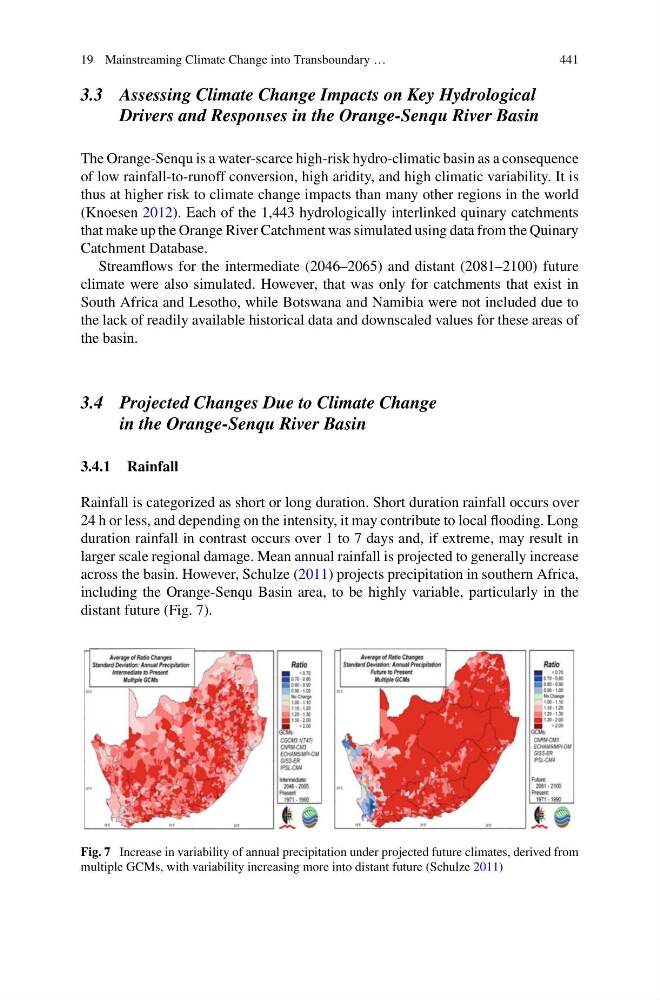
larger scale regional damage. Mean annual rainfall is projected to generally increase
across the basin. However, Schulze (2011) projects precipitation in southern Africa,
including the Orange-Senqu Basin area, to be highly variable, particularly in the
distant future (Fig. 7).
Fig. 7 Increase in variability of annual precipitation under projected future climates, derived from
multiple GCMs, with variability increasing more into distant future (Schulze 2011)
441
3.3 Assessing Climate Change Impacts on Key Hydrological
Drivers and Responses in the Orange-Senqu River Basin
The Orange-Senqu is a water-scarce high-risk hydro-climatic basin as a consequence
of low rainfall-to-runoff conversion, high aridity, and high climatic variability. It is
thus at higher risk to climate change impacts than many other regions in the world
(Knoesen 2012). Each of the 1,443 hydrologically interlinked quinary catchments
that make up the Orange River Catchment was simulated using data from the Quinary
Catchment Database.
Streamflows for the intermediate (2046–2065) and distant (2081–2100) future
climate were also simulated. However, that was only for catchments that exist in
South Africa and Lesotho, while Botswana and Namibia were not included due to
the lack of readily available historical data and downscaled values for these areas of
the basin.
3.4 Projected Changes Due to Climate Change
in the Orange-Senqu River Basin
3.4.1 Rainfall
Rainfall is categorized as short or long duration. Short duration rainfall occurs over
24 h or less, and depending on the intensity, it may contribute to local flooding. Long
duration rainfall in contrast occurs over 1 to 7 days and, if extreme, may result in
larger scale regional damage. Mean annual rainfall is projected to generally increase
across the basin. However, Schulze (2011) projects precipitation in southern Africa,
including the Orange-Senqu Basin area, to be highly variable, particularly in the
distant future (Fig. 7).
Fig. 7 Increase in variability of annual precipitation under projected future climates, derived from
multiple GCMs, with variability increasing more into distant future (Schulze 2011)